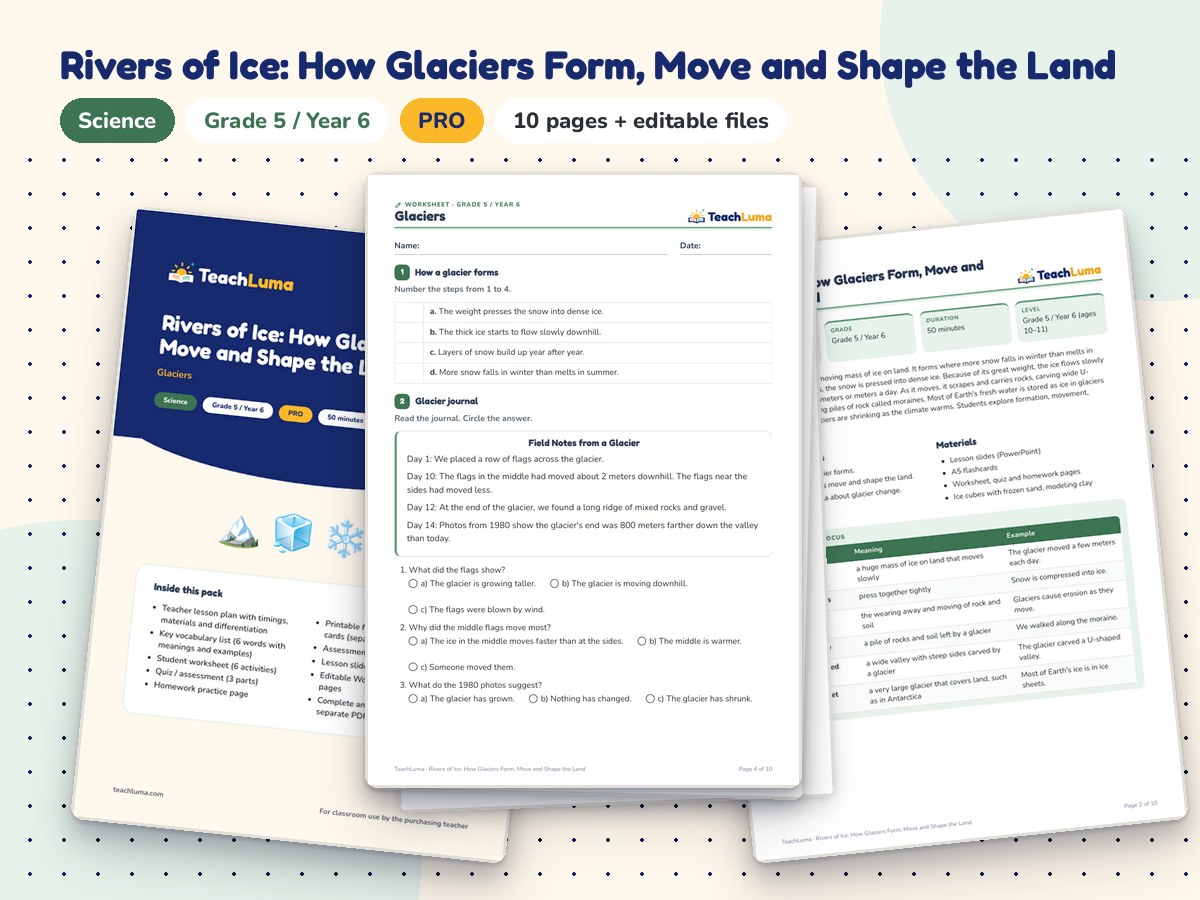
Rivers of Ice: How Glaciers Form, Move and Shape the Land
About This Resource
A complete Grade 5 science pack on glaciers. Students learn how layers of snow are pressed into glacier ice over many years, how glaciers slowly flow downhill, how they carve U-shaped valleys and carry rocks, and why glaciers matter as stores of fresh water. They read a glacier journal, sequence formation and interpret data about a shrinking glacier. Includes slides, a lesson plan, worksheet, quiz, homework, A5 flashcards, a rubric, Word files and answer keys.
Overview
A glacier is a huge, slow-moving mass of ice on land. It forms where more snow falls in winter than melts in summer. Over many years, the snow is pressed into dense ice. Because of its great weight, the ice flows slowly downhill, often only centimeters or meters a day. As it moves, it scrapes and carries rocks, carving wide U-shaped valleys and leaving piles of rock called moraines. Most of Earth's fresh water is stored as ice in glaciers and ice sheets. Many glaciers are shrinking as the climate warms. Students explore formation, movement, landforms and change.
Resource Details
- Subject
- Science
- Topic
- Glaciers
- Category
- Earth & Space
- File Type
- File Size
- 377.7 KB
- Published
- 26 Nov 2026
- Downloads
- 0
Members Only
Create a free account to download this resource with one of your 3 Free Pro Previews, or upgrade to Teacher Pro (from ฿199/month) for the whole library.
Looking for something different? Request a Resource.
Learning Objectives
- Describe how a glacier forms.
- Explain how glaciers move and shape the land.
- Interpret simple data about glacier change.
How to Use This Resource
- Show a photo of a glacier. Ask: "Is this ice moving? How could we find out?"
- Teach formation and movement with the slides, then do activities 1 and 2 together.
- Students complete activities 3 to 6. Use the quiz and send the homework page home.
Classroom Activity Ideas
- Squish model: press snow or crushed ice into a cup and compare density.
- Ice block erosion: drag an ice cube with sand frozen in it across modeling clay.
- Before and after: compare photos of a glacier over 50 years.
Differentiation
Support: give a labeled glacier valley diagram. Challenge: explain why glacier valleys are U-shaped but river valleys are V-shaped.
Assessment
Use the worksheet and quiz to check understanding. Use the rubric for the homework explanation.
Teacher Tips
The ice-and-clay model shows erosion clearly. Freeze sand and small stones into ice cubes the day before.
What's Included
- 10-page printable PDF lesson pack: teacher lesson plan with timings, materials and differentiation
- Key vocabulary list (6 words with meanings and examples)
- Student worksheet (6 activities)
- Quiz / assessment (3 parts)
- Homework practice page
- Printable flashcards: 6 A5 picture cards (separate PDF)
- Assessment rubric (4 levels)
- Lesson slides (editable PowerPoint)
- Editable Word version of all student pages
- Complete answer key (also as a separate PDF)
Additional Files
- Lesson Slides (PPTX)
- Editable Student Pages and Lesson Plan (DOCX)
- A5 Flashcards (PDF)
- Answer Key (PDF)
Warning: require(/home/teachlum/public_html/includes/pro-comparison-card.php): Failed to open stream: No such file or directory in /home/teachlum/public_html/resource.php on line 559
Warning: require(/home/teachlum/public_html/includes/pro-comparison-card.php): Failed to open stream: No such file or directory in /home/teachlum/public_html/resource.php on line 559
Fatal error: Uncaught Error: Failed opening required '/home/teachlum/public_html/includes/pro-comparison-card.php' (include_path='.:/opt/alt/php82/usr/share/pear:/opt/alt/php82/usr/share/php:/usr/share/pear:/usr/share/php') in /home/teachlum/public_html/resource.php:559 Stack trace: #0 {main} thrown in /home/teachlum/public_html/resource.php on line 559