Skip to content
Preview
Free Math Quiz Grade 2
No ratings yet

Grade 2 Math Quick Quiz: 2D and 3D Shapes (12 Marks)

About This Resource

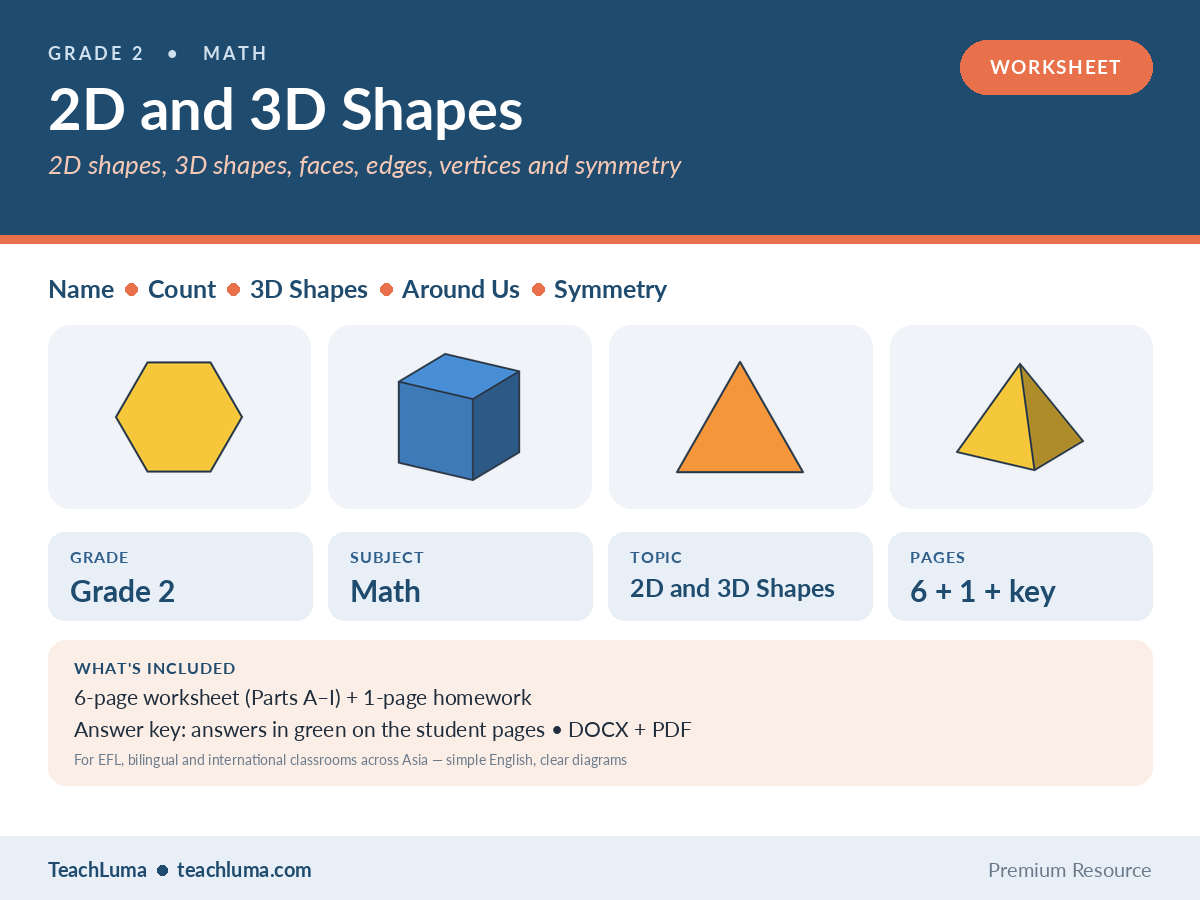
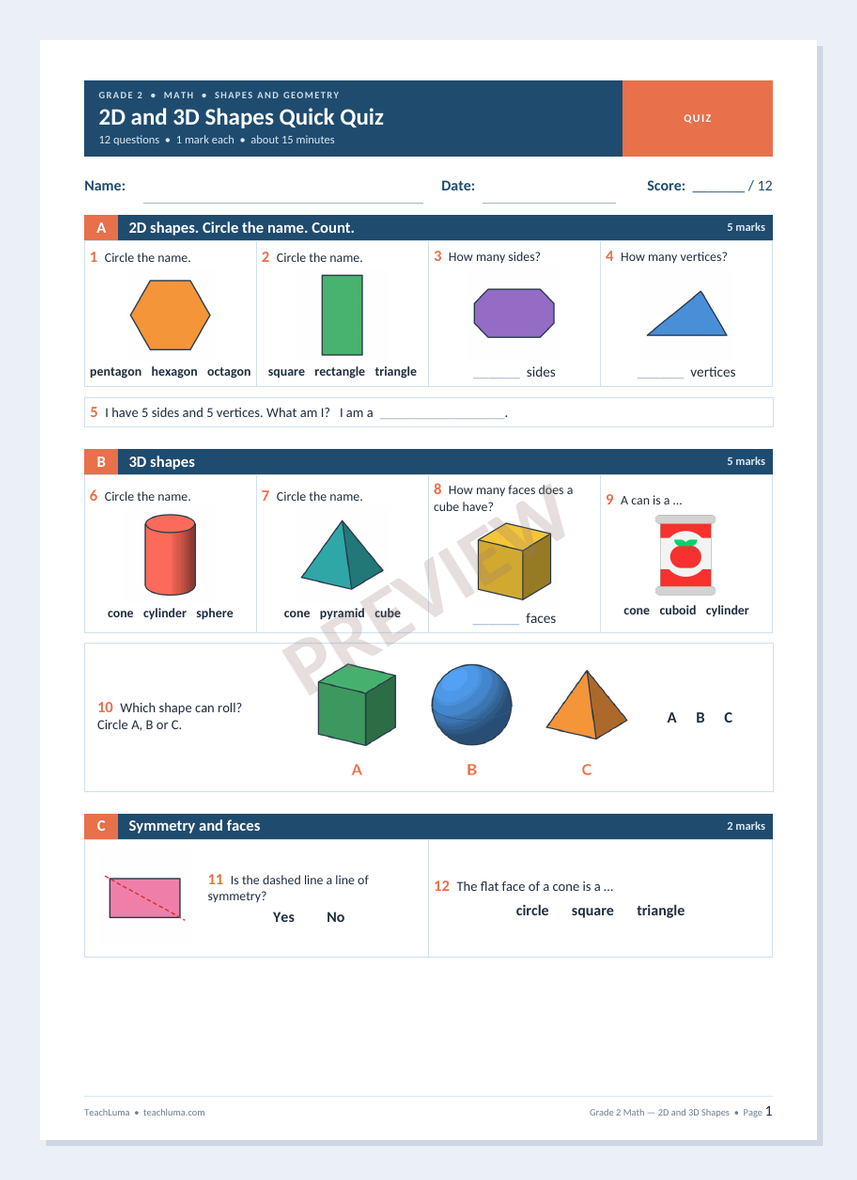
A 1-page, 12-mark quick quiz: name 2D shapes, count sides and vertices, What am I?, name 3D shapes, faces of a cube, which shape rolls, a 3D shape around us, a line of symmetry and the face of a cone — with a full answer key.

Overview

This pack teaches Grade 2 children to name, describe and sort 2D and 3D shapes and to find lines of symmetry. Children learn that 2D shapes are flat, count sides and vertices, and name circle, triangle, square, rectangle, pentagon, hexagon and octagon — including shapes that are turned, long or irregular. They then learn that 3D shapes are solid, count faces, edges and vertices, name cube, cuboid, sphere, cylinder, cone, pyramid and triangular prism, find out which shapes roll or stack, see that the faces of 3D shapes are 2D shapes, and find shapes in everyday objects. Finally they check, draw and complete lines of symmetry. Every shape is drawn with exact geometry, 3D shapes show their hidden edges as dashed lines, and every symmetry answer was checked by computer. The English is short and repeated, for ESL / EFL learners. This listing covers the Quiz only.

Resource Details

Subject
Math
Topic
2D and 3D Shapes
Category
Shapes & Geometry
File Type
PDF
File Size
74.9 KB
Published
08 Oct 2026
Downloads
0
Download

Free download — no account required.

Teaching this in class? Try our free Random Name Picker & Timer.

Share:

Looking for something different? Request a Resource.

Grade 2 45-55 Minutes Quiz 2D and 3D Shapes

Learning Objectives

  • Name circle, triangle, square, rectangle, pentagon, hexagon and octagon in any size or position.
  • Count the sides and vertices of 2D shapes.
  • Name cube, cuboid, sphere, cylinder, cone, pyramid and triangular prism.
  • Count the faces, edges and vertices of 3D shapes and say which shapes can roll.
  • Recognise that the faces of 3D shapes are 2D shapes.
  • Find 2D and 3D shapes in everyday objects.
  • Say if a line is a line of symmetry, draw a line of symmetry and complete a symmetric picture.

How to Use This Resource

  • Use the quiz after Lesson 2 or Lesson 3 as a quick check. Read each part aloud with the class, then children answer alone. Mark with the answer key (1 mark per question).

Classroom Activity Ideas

  • Use it as a pre-test before the unit and again after it to show progress.
  • Let children who need support hold real 3D shapes during Part B.

Differentiation

Support: Give real 3D shapes to hold and paper 2D shapes to fold. Let children put a dot on each vertex and tick each side as they count. Keep the Shape Facts poster on the desk. Give sentence frames ("It is a ___. It has ___ sides and ___ vertices." "It can / cannot roll."). Pair a child who is new to English with a partner who models the sentences.
Extension: Draw shapes with 5, 6 and 8 sides on dot paper that look different from the poster, find how many lines of symmetry a square has, build 3D shapes with straws and modelling clay and count the edges and vertices, or sort shapes in a Venn diagram. Fast finishers can play Shape Detective (Count It or Symmetry mode).

Assessment

12 marks, 1 per question, with a complete, numbering-matched answer key.

Teacher Tips

The two most common Grade 2 shape mistakes are calling a turned square a "diamond" (or not a square) and thinking a hexagon must look like a honeycomb. Always ask "How many sides?" before "What is it called?" — the number of sides decides the name, not the look or the position. For 3D shapes, use real objects (a dice, a tissue box, a ball, a can, an ice cream cone) so children can touch faces and run a finger along edges; the dashed lines in the pictures show the edges at the back. For symmetry, fold paper shapes: a rectangle folded on its diagonal does not match, which convinces children better than any explanation.

What's Included

  • Quick quiz, 1 page, 12 questions in 3 parts (DOCX + PDF)
  • Answer key, 1 page (DOCX + PDF)

Additional Files


Teacher Reviews

No ratings yet

Be the first teacher to review this resource.

Sign in to review this resource.

Related Resources

Advertisement