Skip to content
Preview
Free Math Quiz Grade 2
No ratings yet

Grade 2 Math Quick Quiz: Area (12 Marks)

About This Resource

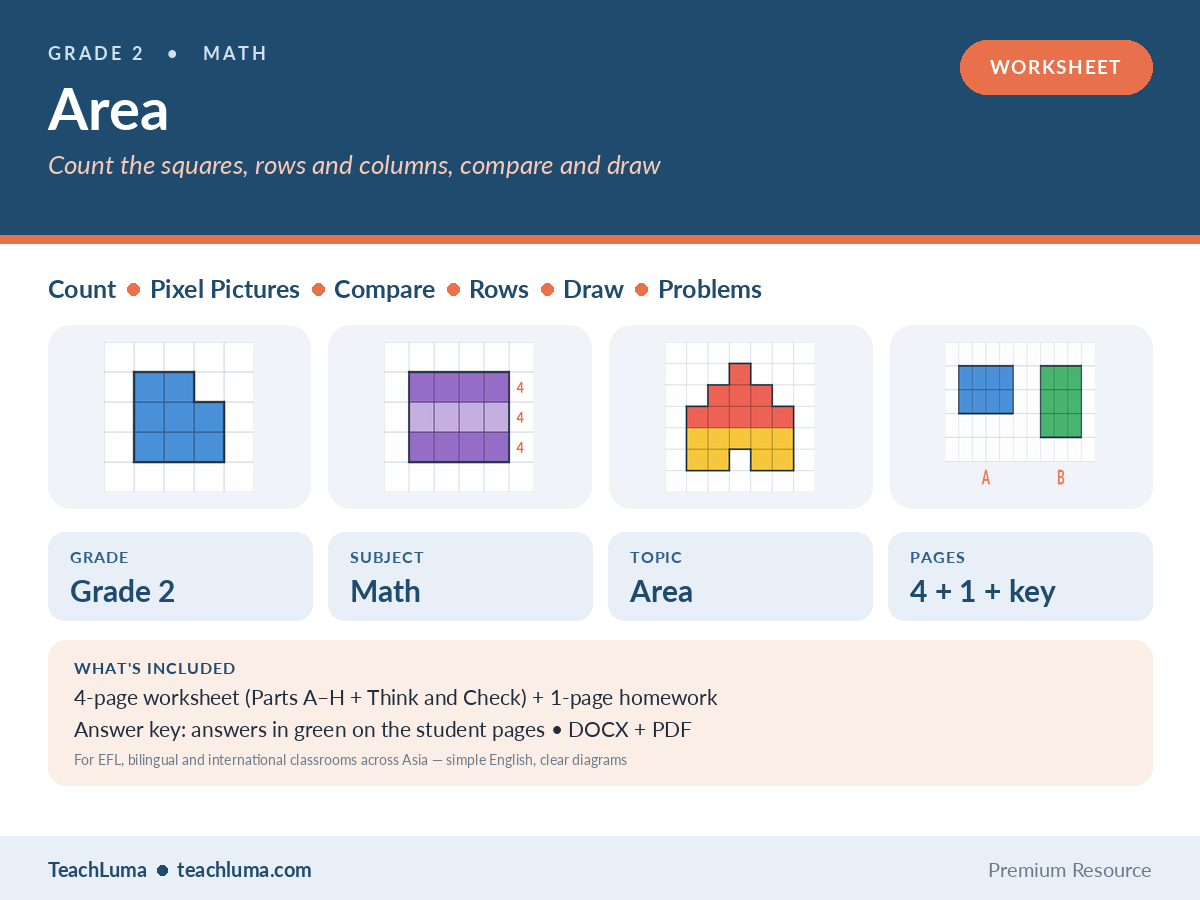
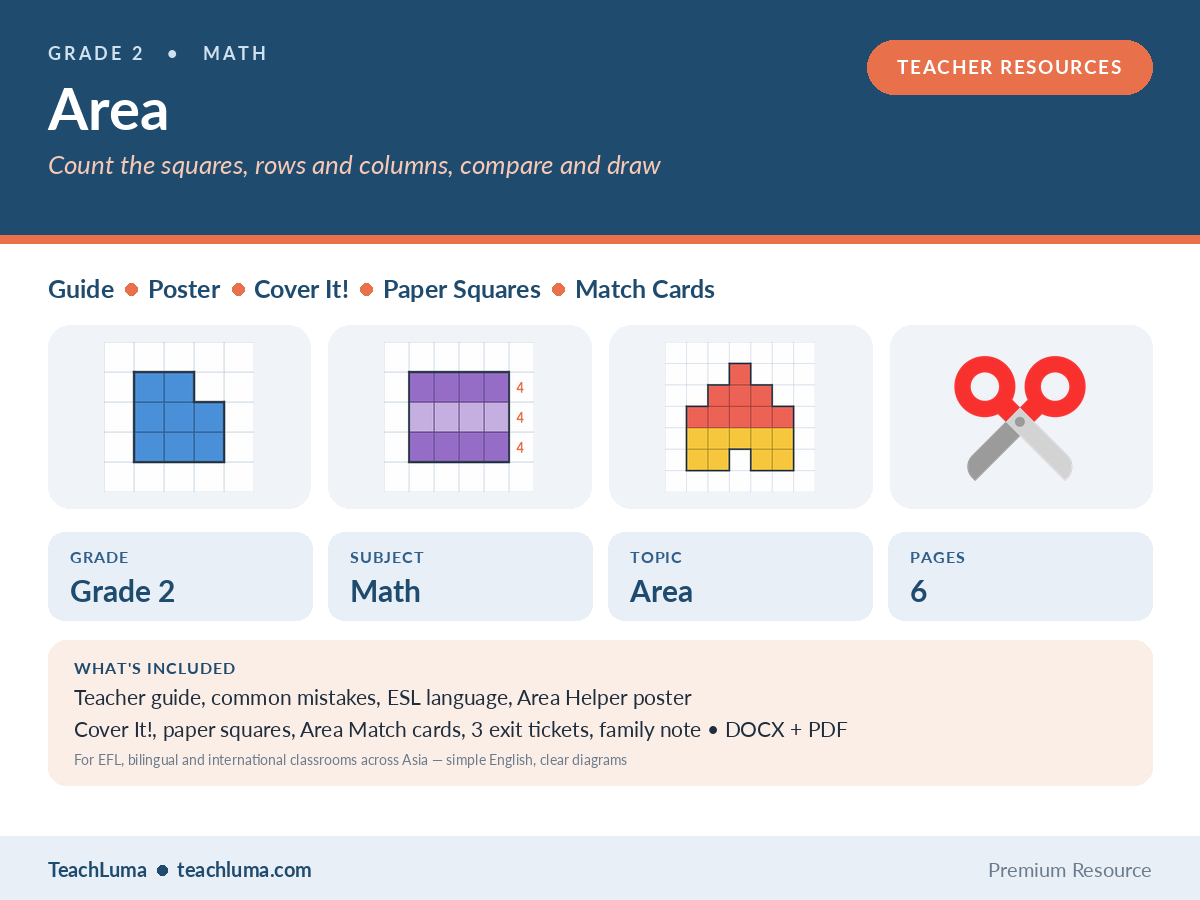
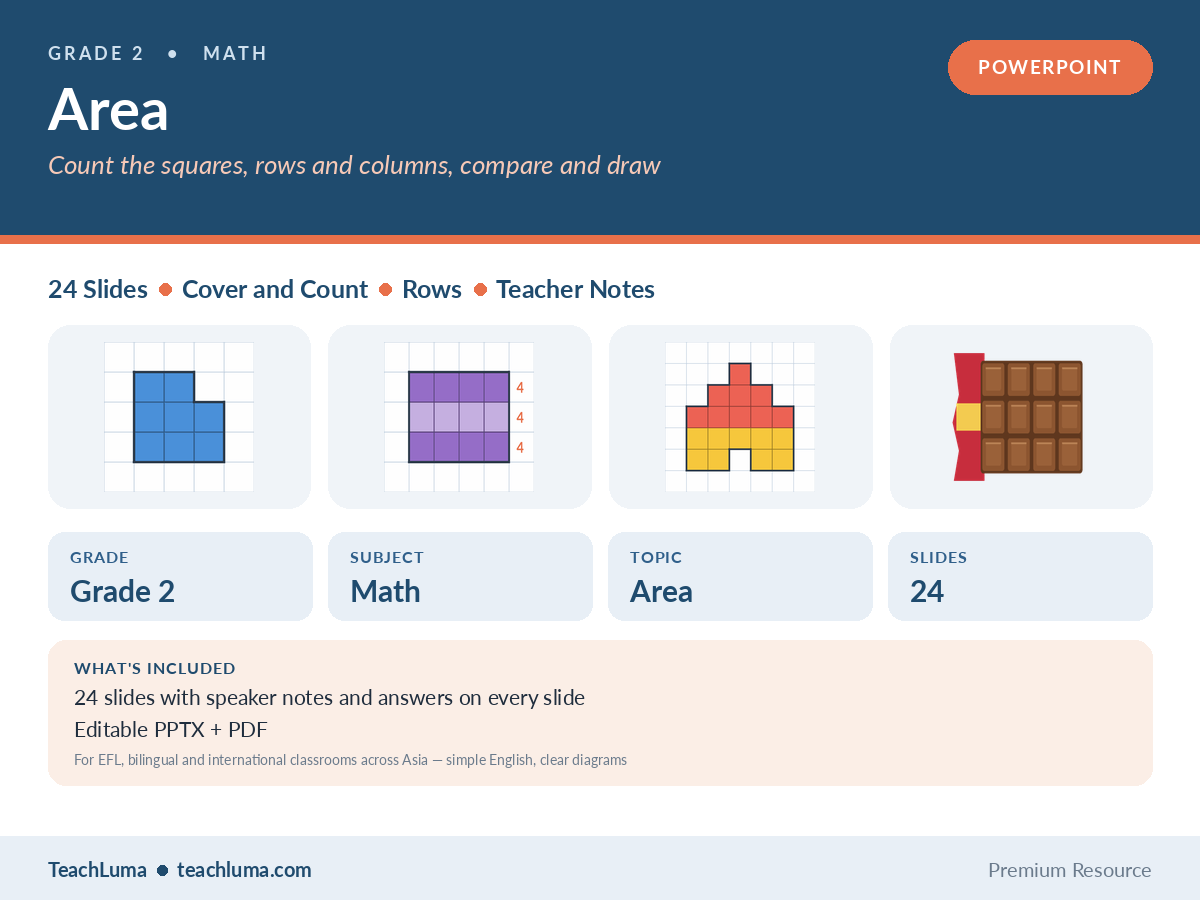
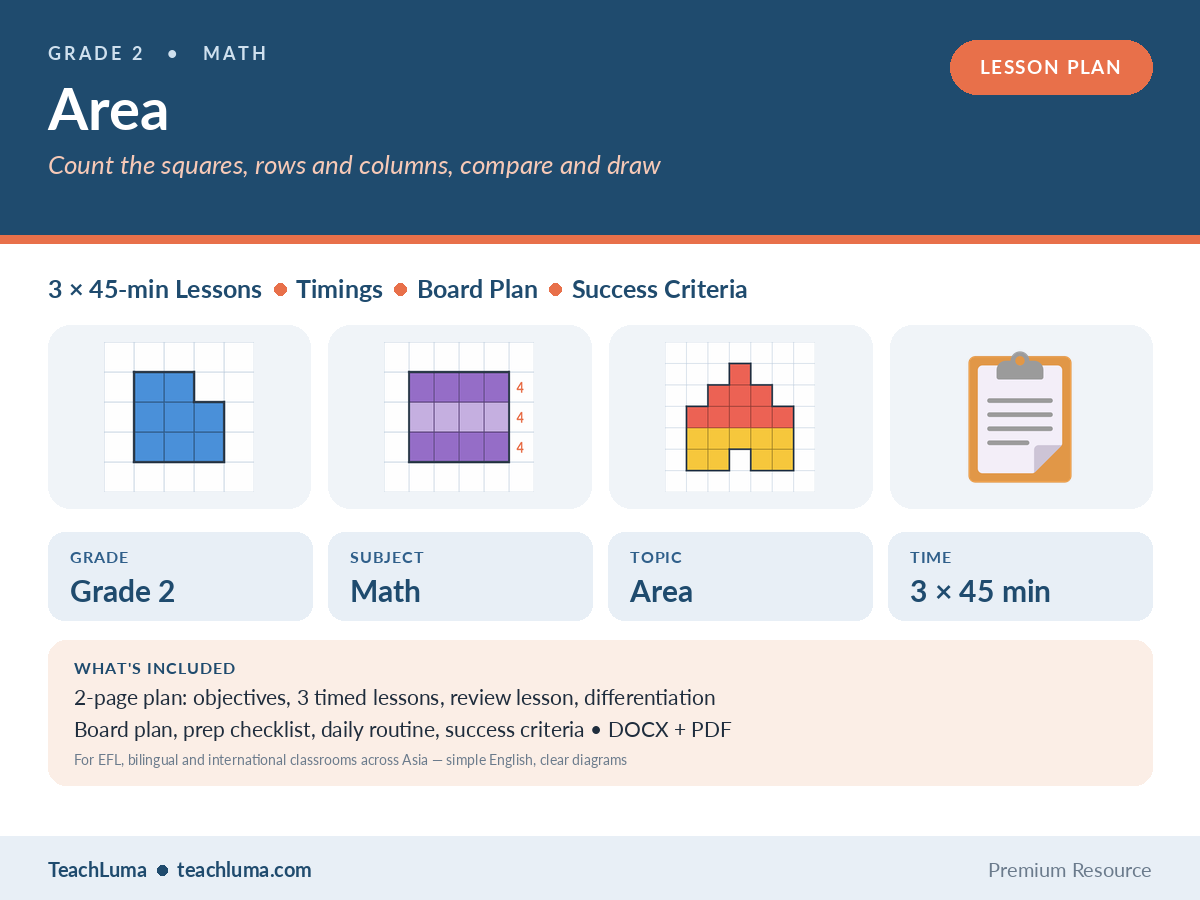
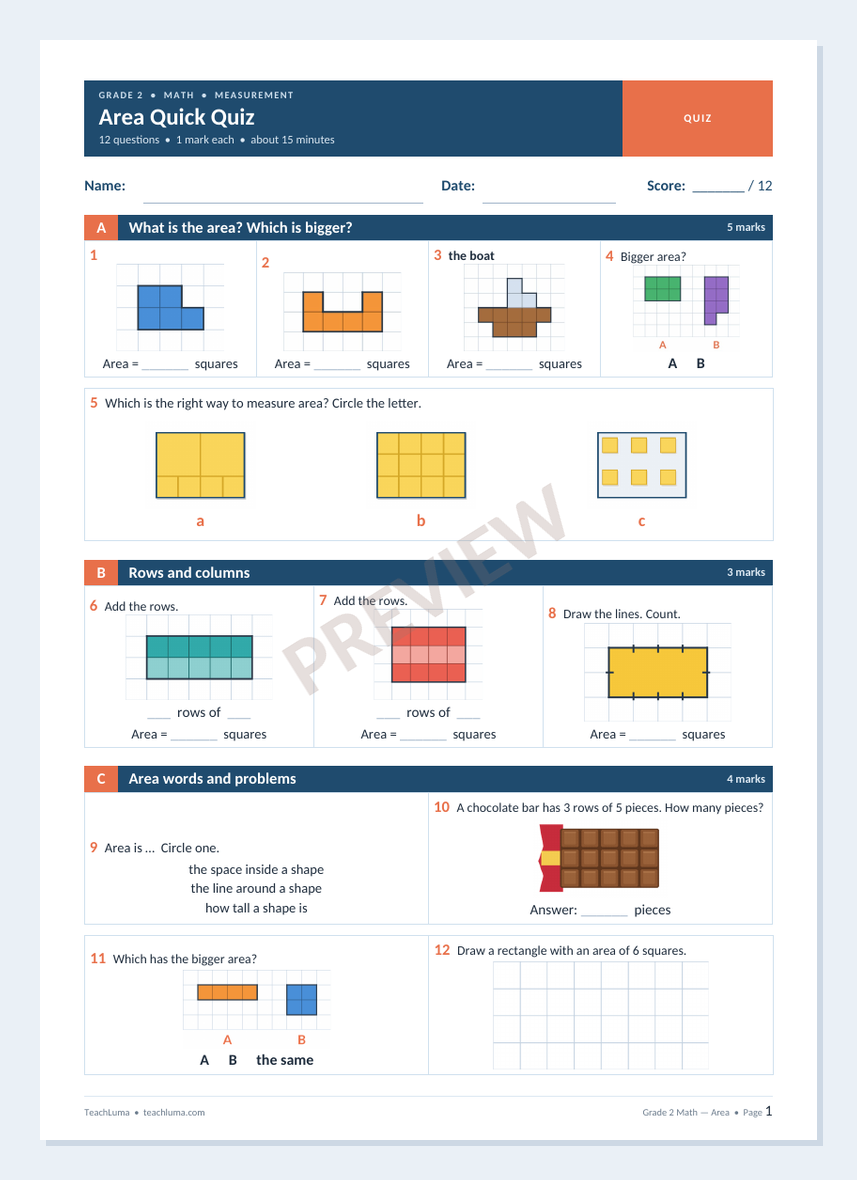
A 1-page, 12-mark quick quiz: count the squares, a pixel picture, which is bigger?, the right way to measure, rows and columns, draw the lines, what is area?, a chocolate problem, the same area and draw a rectangle — with a full answer key.

Overview

This pack teaches Grade 2 children what area is and how to measure it by counting squares. Children learn that area is the space inside a flat shape, cover things with same-size squares (no gaps, no overlaps) and count the squares in shapes and pixel pictures. They then see rectangles as rows and columns, find the area by adding the rows (3 rows of 4 = 4 + 4 + 4 = 12), draw the lines to split a rectangle into squares and find that different shapes can have the same area. Finally they compare and order areas, learn that a longer shape does not always have a bigger area, draw shapes with a given area and solve simple area problems with chocolate bars, floor tiles, gardens and sticky notes. Every picture is drawn from exact square grids and every area was counted by computer. The English is short and repeated, for ESL / EFL learners. This listing covers the Quiz only.

Resource Details

Subject
Math
Topic
Area
Category
Measurement
File Type
PDF
File Size
87.8 KB
Published
08 Oct 2026
Downloads
0
Download

Free download — no account required.

Teaching this in class? Try our free Random Name Picker & Timer.

Share:

Looking for something different? Request a Resource.

Grade 2 35-45 Minutes Math Area

Learning Objectives

  • Say that area is the space inside a flat shape.
  • Measure area fairly with same-size squares: no gaps and no overlaps.
  • Find the area of a shape by counting squares.
  • Find the area of a rectangle by adding the rows (3 rows of 4 = 4 + 4 + 4 = 12).
  • Split a rectangle into rows and columns of same-size squares and count them.
  • Compare and order shapes by area, and know that different shapes can have the same area.
  • Draw shapes with a given area and solve simple area problems.

How to Use This Resource

  • Use the quiz after Lesson 2 or Lesson 3 as a quick check. Read each part aloud with the class, then children answer alone. Mark with the answer key (1 mark per question).

Classroom Activity Ideas

  • Use it as a pre-test before the unit and again after it to show progress.
  • Let children who need support use paper squares on question 12.

Differentiation

Support: Give paper squares or sticky notes to cover and count. Let children put a dot on each square as they count, and start with shapes of fewer than 10 squares. Keep the Area Helper poster on the desk. Give sentence frames ("The area is ___ squares." "It has ___ rows of ." " has the bigger area."). Pair a child who is new to English with a partner who models the sentences.
Extension: Find all the rectangles with an area of 12 squares (1 row of 12, 2 rows of 6, 3 rows of 4), draw 3 different shapes with an area of 7, estimate and then measure the area of a desk in sticky notes, or make a pixel picture with an area of exactly 20 squares. Fast finishers can play Area Explorer (Rows and Columns or Area Problems mode).

Assessment

12 marks, 1 per question, with a complete, numbering-matched answer key.

Teacher Tips

The most common Grade 2 area mistake is counting the little lines around the edge instead of the squares inside (this gives the perimeter, not the area). Ask children to put a dot in every square they count, and to trace the edge with a finger only to show what area is NOT. Start with real covering — sticky notes or paper squares on a book — before squared paper, so children see why the squares must be the same size with no gaps and no overlaps. When rectangles get bigger, move children from counting one by one to adding the rows: "4, 8, 12" is faster and is the first step towards multiplication.

What's Included

  • Quick quiz, 1 page, 12 questions in 3 parts (DOCX + PDF)
  • Answer key, 1 page (DOCX + PDF)

Additional Files


Teacher Reviews

No ratings yet

Be the first teacher to review this resource.

Sign in to review this resource.

Related Resources

Advertisement