Learning Objectives
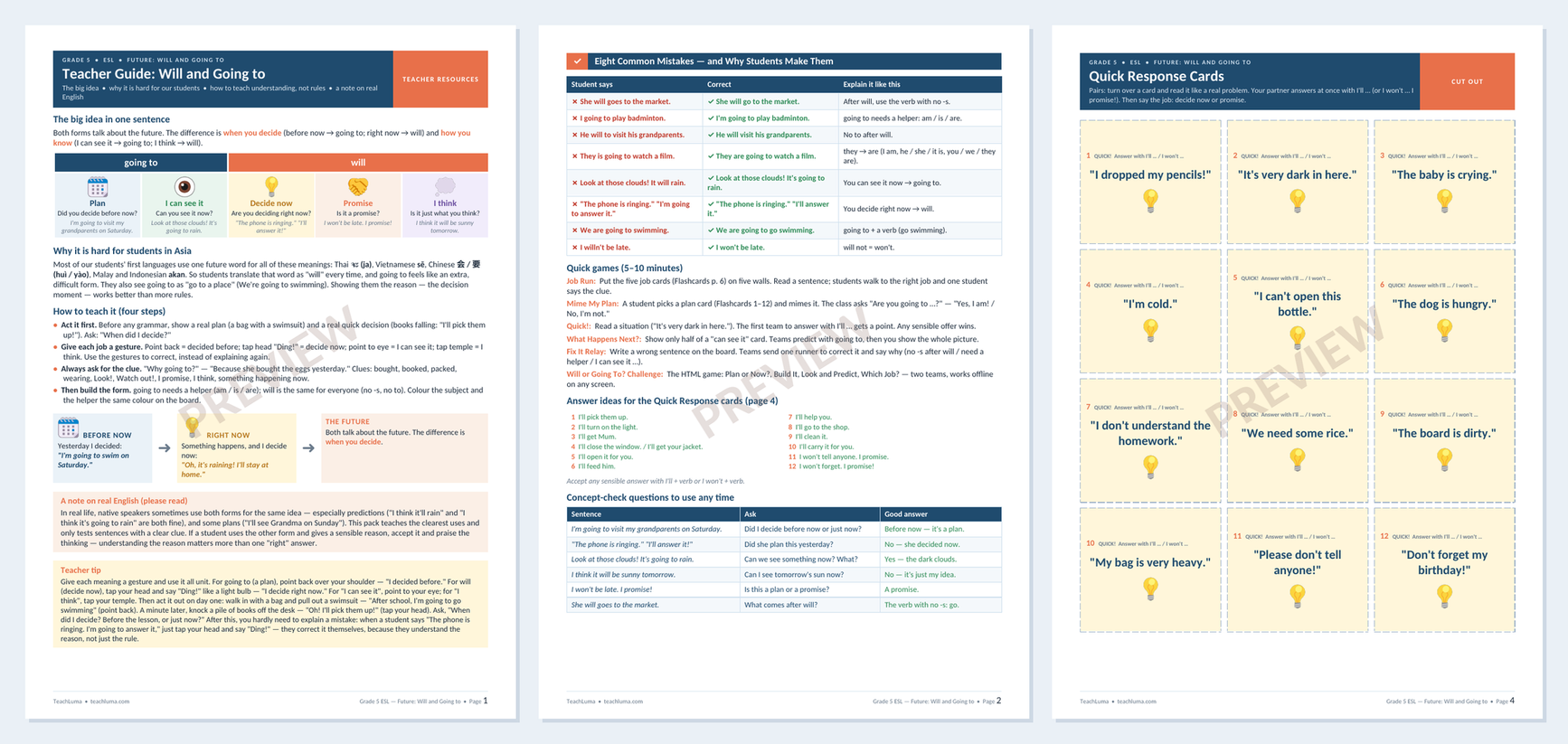
- Make sentences with going to (am / is / are + going to + verb) in the positive, negative and question form, and give short answers (Yes, I am. / No, she isn't.).
- Make sentences with will and won't (will + verb, no -s, no to) and ask Will you …? questions.
- Explain when to use each form with the "Decision Test": going to for a plan you decided before now; will for a decision you make right now, an offer or a promise.
- Make predictions and explain the choice: going to when you can see it now (Look! It's going to rain.), will for what you think (I think it will be sunny.).
- Find and correct common mistakes (She will goes, I going to, He will to visit) and say why each one is wrong.
- Read a short text and a picture story, find examples of each job, and write 60–80 words about their weekend plans, predictions and a promise.
How to Use This Resource
- Read page 1 before you teach. Use page 3 in Lesson 1, page 4 in Lesson 2, page 5 in Lesson 3 and the exit tickets (page 6) at the end of every lesson. Send the family note home with the homework.
Classroom Activity Ideas
- Quick Response race: teams answer situation cards with I'll … — the fastest sensible answer wins.
- Crystal Ball 2050 report: groups make a class bar chart of their predictions.
Differentiation
Support: Give students the Grammar Guide (page 1 flowchart) and the five "job" cards from the Flashcards (page 6) to keep on the desk all unit. In Parts A and B, let them colour-code the subject and the helper first (She → is, We → are). In Parts D and G, ask them to underline the clue words before they choose (bought, booked, Look!, I think, I promise). Let them say each answer to a partner before they write. For the writing (Part I), they can use the sentence starters in the plan and write 40–50 words.
Extension: Students explain their choices in full sentences ("It's going to, because she can see the clouds."). They add more time words (next month, in five years) and use questions with both forms (What are you going to do …? / Do you think … will …?). In the writing, they write 90–110 words and include one sentence where both forms appear ("I'm going to visit Hue, and I think I'll take lots of photos."). Fast finishers write a new panel 9 for the Picture Story, using all five jobs, or make a "Will or going to?" quiz for a partner with a clue in every sentence.
Assessment
Exit tickets 1–4 check one idea per lesson; ticket 2 asks students to explain why it is will, not going to.
Teacher Tips
Give each meaning a gesture and use it all unit. For going to (a plan), point back over your shoulder — "I decided before." For will (decide now), tap your head and say "Ding!" like a light bulb — "I decide right now." For "I can see it", point to your eye; for "I think", tap your temple. Then act it out on day one: walk in with a bag and pull out a swimsuit — "After school, I'm going to go swimming" (point back). A minute later, knock a pile of books off the desk — "Oh! I'll pick them up!" (tap your head). Ask, "When did I decide? Before the lesson, or just now?" After this, you hardly need to explain a mistake: when a student says "The phone is ringing. I'm going to answer it," just tap your head and say "Ding!" — they correct it themselves, because they understand the reason, not just the rule.
What's Included
- Teacher resources, 6 pages: guide, mistakes and why, CCQs, games, Find Someone Who, Quick Response cards, Crystal Ball 2050 survey, exit tickets, family note (DOCX + PDF)
Additional Files
-
Grade 5 ESL — Future: Will and Going to — Teacher Resource (DOCX)