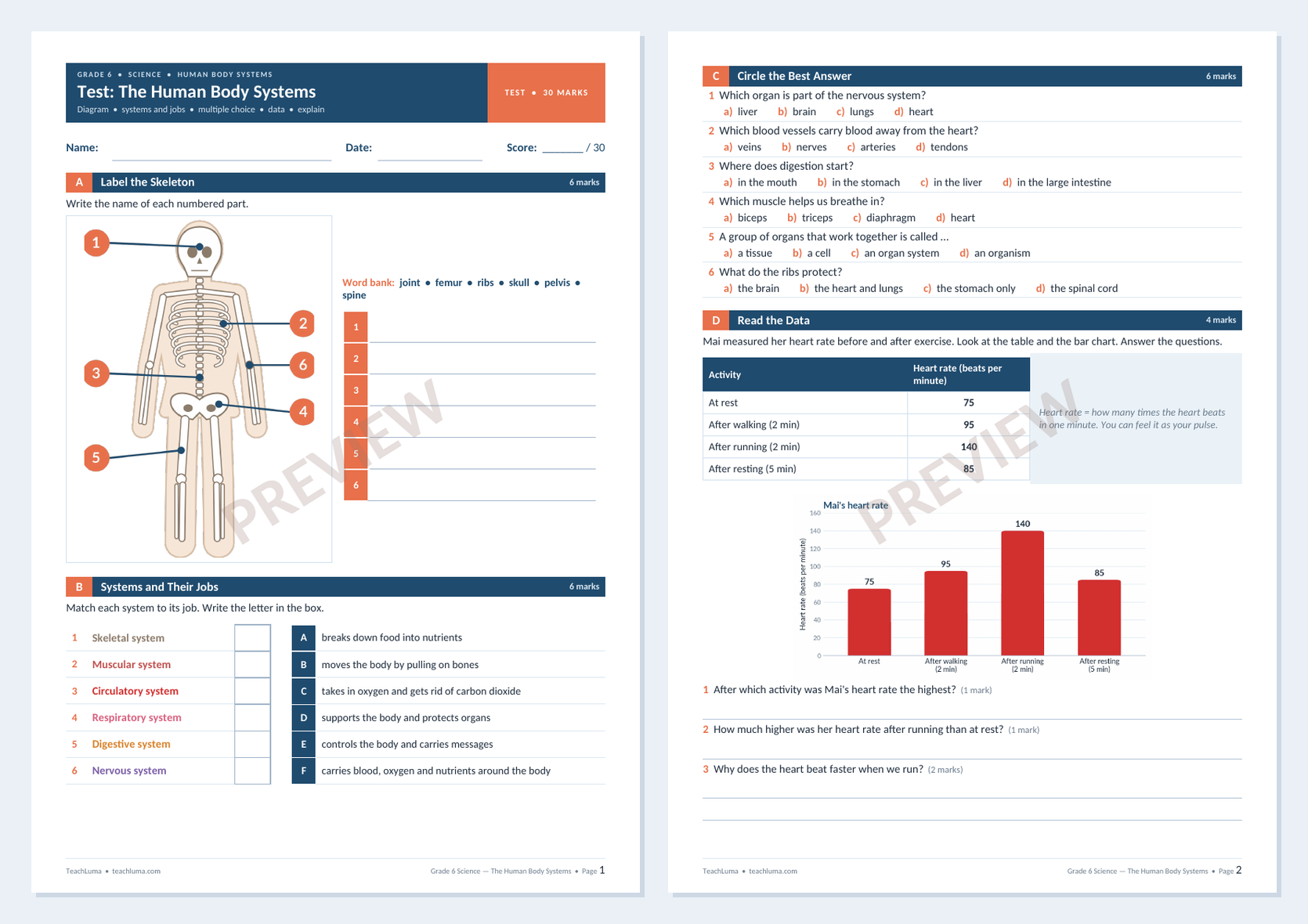
Grade 6 Science Test: The Human Body Systems (30 Marks)
About This Resource
A 3-page, 30-mark unit test: label the skeleton, match systems to jobs, multiple choice, a heart-rate data question with a bar chart, and three short explanations — with a mark scheme and model answers.
Resource Details
- Subject
- Science
- Topic
- The Human Body Systems
- Category
- Human Body
- File Type
- File Size
- 283.7 KB
- Published
- 24 Sep 2026
- Downloads
- 0
Members Only
Upgrade to Teacher Pro (from ฿199/month) to download this resource.
Looking for something different? Request a Resource.
Question Types & Suggested Use
A 6 + B 6 + C 6 + D 4 + E 8 = 30 marks. Bands: 27–30 Excellent, 21–26 Good, 15–20 Developing, 0–14 Needs Practice.
Skills Assessed
- Put the levels of organization in order — cell, tissue, organ, organ system, organism — and give an example of each.
- Name the 6 main body systems (skeletal, muscular, circulatory, respiratory, digestive, nervous) and match 16 organs and parts to the correct system.
- Describe the job of each body system in one sentence.
- Label diagrams of the digestive, respiratory and skeletal systems.
- Explain how muscles work in pairs, and how several systems work together when we exercise.
- Measure heart rate, record results in a table and bar chart, and explain why exercise changes it.
How to Administer
- Give the test in the optional review lesson. Read the instructions together. Students work alone; allow 35–40 minutes. Mark with the answer key and mark scheme; record scores in the box on page 3.
Differentiation
Support: Give a word bank for every labeling task and the sentence frames "The ___ is part of the ___ system. Its job is to ___." Let students answer the Which System? tasks with the organ cards in their hands. In the investigation, pair a stronger reader with a weaker one; any student can be the timekeeper or record data instead of exercising.
Extension: Add the excretory system (kidneys, bladder) and the idea of alveoli (tiny air sacs). Students design a fair test — "Does the type of exercise change the heart rate?" — and explain one way the model lung is different from real lungs.
Follow-Up Activities
- Use Part D (data) as a model before students write their own investigation conclusion.
- Return Part E with one "next step" from the Grading Rubric.
Teacher Tips
Science words are long and new for EFL learners, so teach them as word families and link them to the body: "digest → digestion → digestive" while students rub their stomach, "breathe → respiratory" while they breathe in, "circle → circulate → circulatory" while they trace a circle over the heart. Keep the same gesture for each system in every lesson. Also watch for two common mix-ups: the spine (skeletal system) and the spinal cord (nervous system), and "blue veins" — blood is always red; blue is only a diagram color.
What's Included
- 3-page test (DOCX + PDF)
- Answer key and mark scheme with model answers (DOCX + PDF)
Additional Files
- Grade 6 Science Test: The Human Body Systems (30 Marks) (DOCX)
- Answer Key (PDF)
Teacher Reviews
No ratings yet
Be the first teacher to review this resource.
Related Resources
Grade 6 Science PowerPoint: The Human Body Systems — Levels, 6 Systems and Diagrams (24 Slides)
PowerPoint · The Human Body Systems
A 24-slide teaching PowerPoint with speaker notes: levels of organization, the six body sy...
View Resource
Grade 6 Science Lesson Plan: The Human Body Systems — 3 Lessons with Investigation
Lesson Plan · The Human Body Systems
A 3-page, minute-by-minute plan for three 50-minute Grade 6 lessons on the levels of organ...
View Resource
Grade 6 Science Grading Rubric: The Human Body Systems
Grading Rubric · The Human Body Systems
A 1-page rubric that scores 6 skills (organs and systems, jobs, levels of organization, di...
View Resource
Grade 6 Science Flashcards: The Human Body Systems — 16 Organ Cards + 6 System Cards
Flashcards · The Human Body Systems
16 large, color-coded organ cards (4 per A4 page) showing each organ, its system and its j...
View Resource
Grade 6 Science Assessment: Cells — The Building Blocks of Life
Assessment · Cells
A 25-point, 4-section formal assessment covering cell theory, cell part functions, diagram...
View Resource
My Five Senses — Exploration Pack
Complete Lesson Pack · My Five Senses
A complete, classroom-ready complete lesson pack for Grade 1 Science: My Five Senses. Incl...
View ResourceAdvertisement