Skip to content
Preview
Free Math Worksheet Grade 3 (Year 4)
No ratings yet

Train Times: 12-Hour and 24-Hour Time

About This Resource

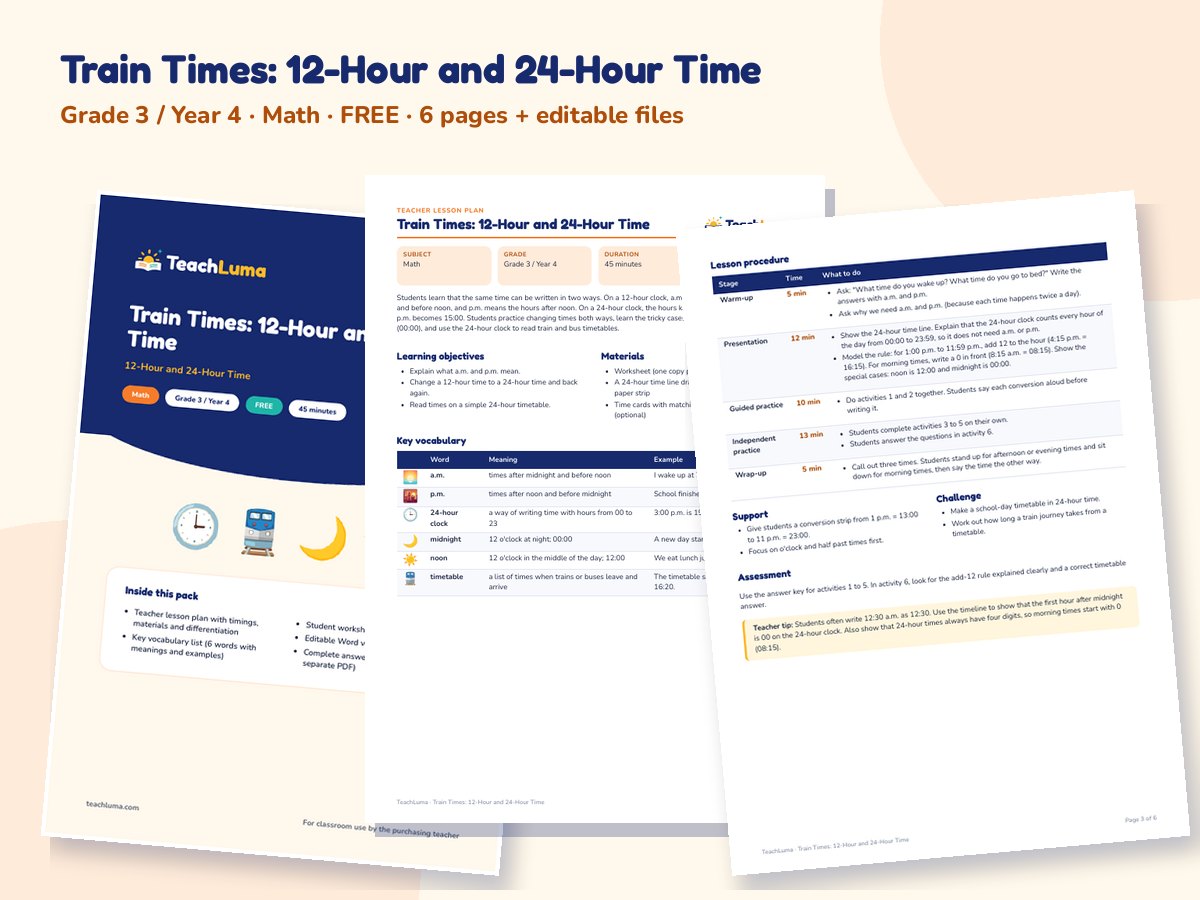
A free Grade 3 math worksheet on 12-hour and 24-hour time: what a.m. and p.m. mean, why the 24-hour clock counts from 00:00 at midnight to 23:59, adding or subtracting 12 to change afternoon and evening times, the special cases of noon and midnight, and reading real timetables for trains and buses. Students match, convert both ways, answer timetable questions and explain the rule. Includes a timed lesson plan, a six-activity worksheet, an editable Word version and answer key.

Overview

Students learn that the same time can be written in two ways. On a 12-hour clock, a.m. means the hours after midnight and before noon, and p.m. means the hours after noon. On a 24-hour clock, the hours keep counting after 12, so 3:00 p.m. becomes 15:00. Students practice changing times both ways, learn the tricky cases of noon (12:00) and midnight (00:00), and use the 24-hour clock to read train and bus timetables.

Resource Details

Subject
Math
Topic
12-Hour and 24-Hour Time
Category
Time & Money
File Type
PDF
File Size
260.4 KB
Published
08 Nov 2026
Downloads
0
Download

Free download — no account required.

Teaching this in class? Try our free Random Name Picker & Timer.

Share:

Looking for something different? Request a Resource.

Grade 3 math (ages 8–9) 45 minutes Telling time converting between 12-hour and 24-hour time reading timetables math vocabulary

Student Task

  • Draw a long line from midnight to midnight on the board, marking 12-hour and 24-hour times underneath each other. Show that after 12:00 the 24-hour clock carries on to 13:00, 14:00 and so on.
  • Do activities 1 and 2 together, saying the rule aloud: for p.m. times after 1:00, add 12 hours; for 24-hour times after 13:00, take away 12.
  • Students complete activities 3 to 6 on their own. Answers are in the answer key.

Classroom Use

  • Human time line: give each student a card with a 12-hour or 24-hour time. They find their partner with the same time.
  • Timetable detectives: show a real bus or train timetable and ask students to find departures in the morning, afternoon and evening.
  • Digital clock race: call a 12-hour time; teams write the 24-hour time on mini whiteboards.

Differentiation

Support: give students a two-row conversion strip (1 p.m. = 13:00 up to 11 p.m. = 23:00) to use. Challenge: students make their own timetable for a school day using the 24-hour clock and write five questions about it.

Answer Key & Assessment

Activities 1 to 5 check converting and reading 24-hour times (answer key included). Activity 6 shows whether students can explain the rule and solve a timetable problem.

Learning Objectives

  • Explain what a.m. and p.m. mean.
  • Change a 12-hour time to a 24-hour time and back again.
  • Read times on a simple 24-hour timetable.

Teacher Tips

Students often write 12:30 a.m. as 12:30. Use the timeline to show that the first hour after midnight is 00 on the 24-hour clock. Also show that 24-hour times always have four digits, so morning times start with 0 (08:15).

What's Included

  • 6-page printable PDF lesson pack: teacher lesson plan with timings, materials and differentiation
  • Key vocabulary list (6 words with meanings and examples)
  • Student worksheet (6 activities)
  • Editable Word version of the worksheet
  • Complete answer key (also as a separate PDF)

Additional Files


Teacher Reviews

No ratings yet

Be the first teacher to review this resource.

Sign in to review this resource.

Related Resources

Advertisement