Skip to content
Preview
Members Only ESL Complete Lesson Pack Grade 6 (Year 7)
No ratings yet

Up or Down? Intonation in Questions

About This Resource

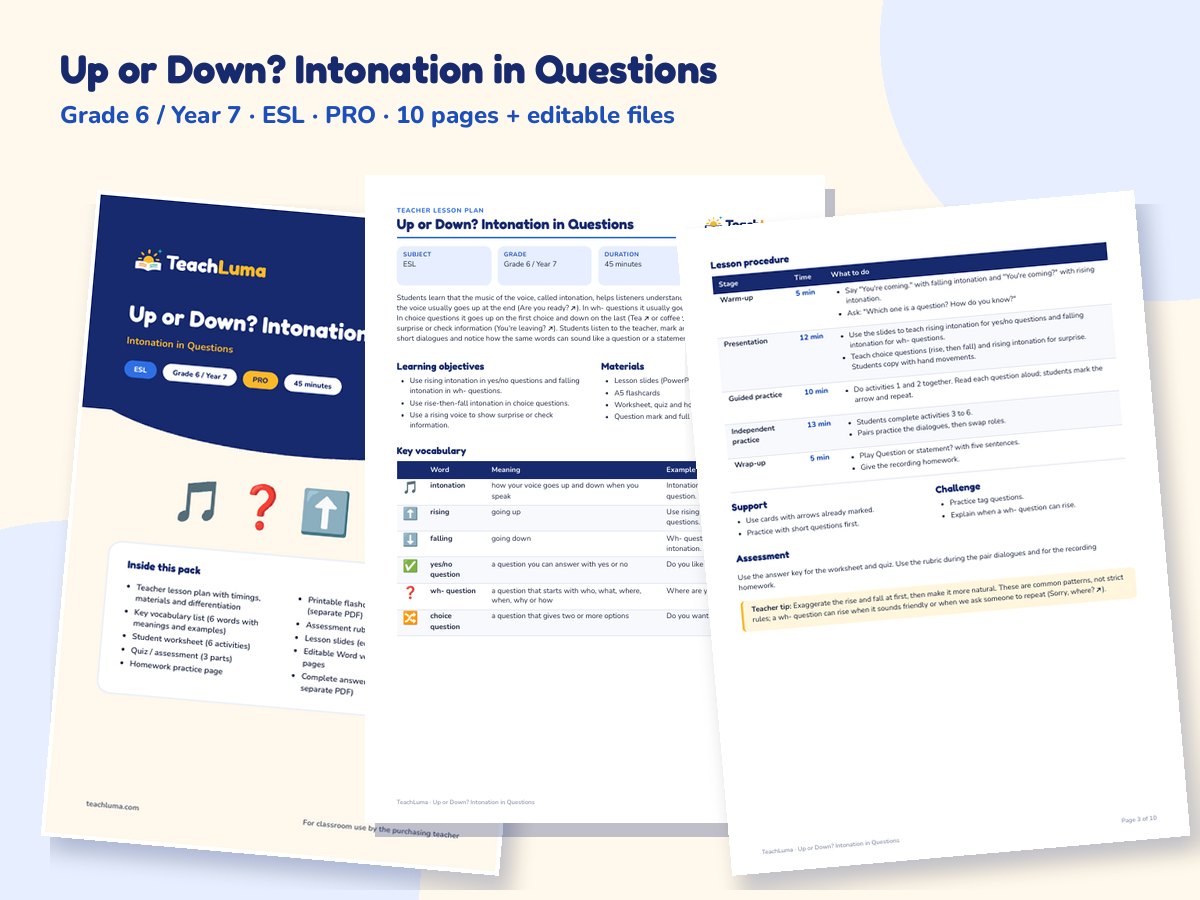
A complete Grade 6 ESL pronunciation pack on question intonation: rising intonation for yes/no questions, falling intonation for wh- questions, rise-then-fall for choice questions, and rising voice to show surprise or check information. Students mark arrows, sort questions, practice dialogues in pairs, notice how intonation changes meaning and record their own questions. Includes slides with speaking notes, a lesson plan, worksheet, quiz, homework, flashcards, a rubric and answer keys.

Overview

Students learn that the music of the voice, called intonation, helps listeners understand a question. In yes/no questions the voice usually goes up at the end (Are you ready? ↗). In wh- questions it usually goes down (Where do you live? ↘). In choice questions it goes up on the first choice and down on the last (Tea ↗ or coffee ↘?). A rising voice can also show surprise or check information (You're leaving? ↗). Students listen to the teacher, mark arrows, sort questions, practice short dialogues and notice how the same words can sound like a question or a statement.

Resource Details

Subject
ESL
Topic
Intonation in Questions
Category
Pronunciation
File Type
PDF
File Size
328.6 KB
Published
09 Nov 2026
Downloads
0

Members Only

Upgrade to Teacher Pro (from ฿199/month) to download this resource.

Share:

Looking for something different? Request a Resource.

Grade 6 ESL (ages 11–12), A2–B1 45 minutes Pronunciation listening speaking question forms

Learning Objectives

  • Use rising intonation in yes/no questions and falling intonation in wh- questions.
  • Use rise-then-fall intonation in choice questions.
  • Use a rising voice to show surprise or check information.

How to Use This Resource

  • Start with the slides: say "You're coming" twice, once falling and once rising, and ask which one is a question.
  • Teach the patterns with the slides, using hand movements to show the voice going up or down, then do worksheet activities 1 and 2 together.
  • Students complete activities 3 to 6 and practice in pairs, then use the quiz and send the recording homework home.

Classroom Activity Ideas

  • Hand conductor: students move a hand up or down as they say each question.
  • Question or statement? The teacher says sentences with rising or falling intonation; students hold up a question mark or a full stop card.
  • Café role-play: pairs order food using choice questions (Rice or noodles?) and yes/no questions.

Differentiation

Support: give question cards with the arrows already marked. Challenge: students practice tag questions (It's cold, isn't it? ↘ to agree, ↗ to really ask) and explain the difference.

Assessment

Use the worksheet and quiz to check that students can identify the patterns. Use the rubric during the pair dialogues and for the recording homework.

Teacher Tips

Exaggerate the rise and fall at first, then make it more natural. These are common patterns, not strict rules; a wh- question can rise when it sounds friendly or when we ask someone to repeat (Sorry, where? ↗).

What's Included

  • 10-page printable PDF lesson pack: teacher lesson plan with timings, materials and differentiation
  • Key vocabulary list (6 words with meanings and examples)
  • Student worksheet (6 activities)
  • Quiz / assessment (3 parts)
  • Homework practice page
  • Printable flashcards: 6 A5 picture cards (separate PDF)
  • Assessment rubric (4 levels)
  • Lesson slides (editable PowerPoint)
  • Editable Word version of all student pages
  • Complete answer key (also as a separate PDF)

Additional Files

  • Lesson Slides (PPTX)
  • Editable Student Pages and Lesson Plan (DOCX)
  • A5 Flashcards (PDF)
  • Answer Key (PDF)

Teacher Reviews

No ratings yet

Be the first teacher to review this resource.

Sign in to review this resource.

Related Resources

Advertisement