Skip to content
Preview
Free Math Worksheet Grade 5 (Year 6)
No ratings yet

Break It Down: Prime Factorization with Factor Trees

About This Resource

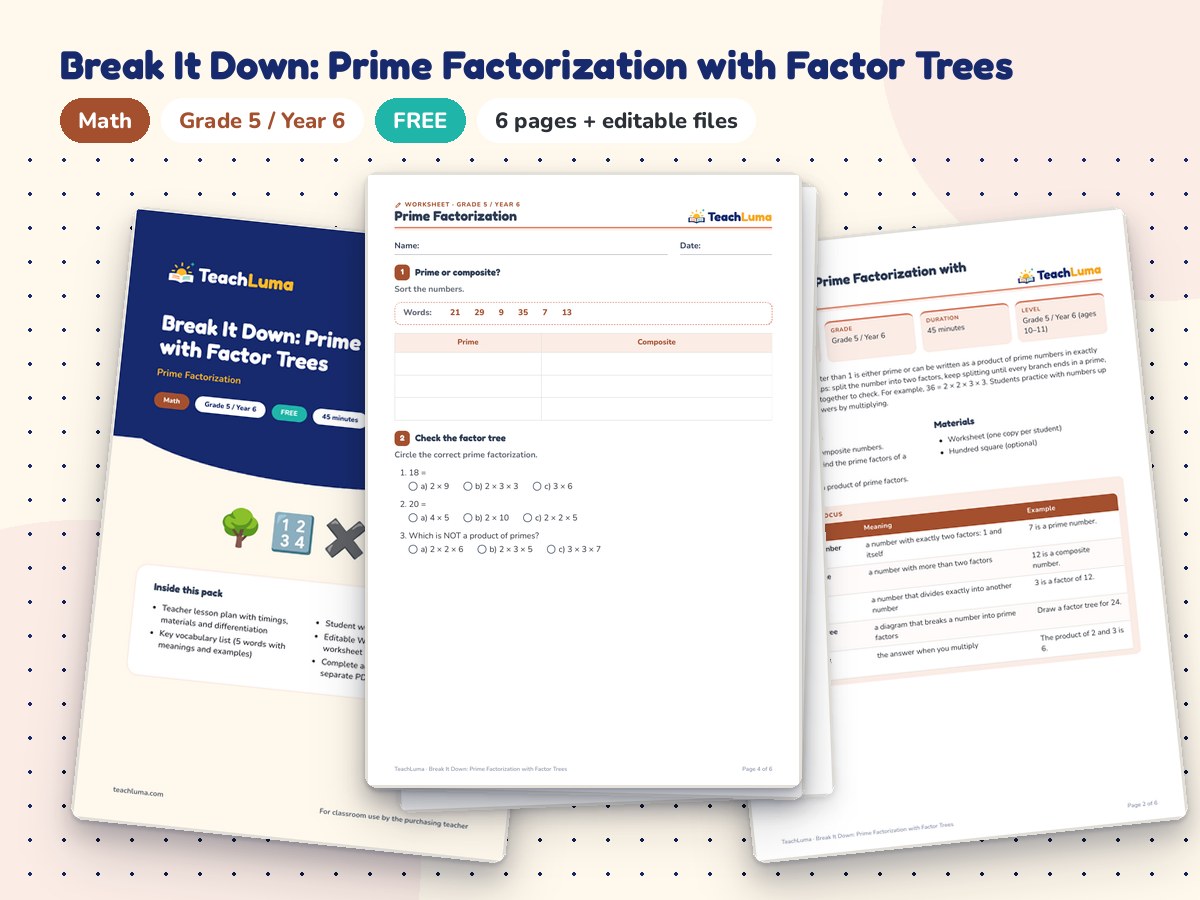
A free Grade 5 math worksheet on prime factorization. Students review prime and composite numbers, use factor trees to break numbers into prime factors, and write each number as a product of primes. Includes a timed lesson plan, an editable Word version and an answer key.

Overview

Every whole number greater than 1 is either prime or can be written as a product of prime numbers in exactly one way. A factor tree helps: split the number into two factors, keep splitting until every branch ends in a prime, then multiply the primes together to check. For example, 36 = 2 × 2 × 3 × 3. Students practice with numbers up to 60 and check their answers by multiplying.

Resource Details

Subject
Math
Topic
Prime Factorization
Category
Number Sense
File Type
PDF
File Size
217.2 KB
Published
14 Nov 2026
Downloads
0
Download Free

Free with a TeachLuma account — it takes a minute.

Share:

Looking for something different? Request a Resource.


Grade 5 (ages 10–11) 45 minutes Number sense multiplication division reasoning

Student Task

  • Ask: "Which numbers can only be divided by 1 and themselves?" List primes up to 20.
  • Model a factor tree for 24, then do activities 1 and 2 together.
  • Students complete activities 3 to 5. Answers are in the answer key.

Classroom Use

  • Different trees, same answer: pairs make different factor trees for 48 and compare the results.
  • Prime hunt: color the primes on a hundred square.
  • Factor detective: a partner gives the prime factors and you find the number.

Differentiation

Support: provide a list of primes to 30 and start with numbers under 30. Challenge: write answers using index notation (for example, 2³ × 3) and find numbers with exactly three prime factors.

Answer Key & Assessment

Activities 1 to 4 check prime factorization (answer key included). Activity 5 shows whether students can explain their method.

Learning Objectives

  • Identify prime and composite numbers.
  • Use a factor tree to find the prime factors of a number.
  • Write a number as a product of prime factors.

Teacher Tips

Students often stop when they reach a composite number such as 4 or 9. Remind them to keep splitting until every branch ends in a prime. Listing factors in order from smallest to largest makes checking easier.

What's Included

  • 6-page printable PDF lesson pack: teacher lesson plan with timings, materials and differentiation
  • Key vocabulary list (5 words with meanings and examples)
  • Student worksheet (5 activities)
  • Editable Word version of the worksheet
  • Complete answer key (also as a separate PDF)

Additional Files


Teacher Reviews

No ratings yet

Be the first teacher to review this resource.

Sign in to review this resource.

Related Resources

Advertisement