Skip to content
Preview
Members Only ESL Complete Lesson Pack Grade 7 (Year 8)
No ratings yet

Breaking News! Media and News Vocabulary

About This Resource

A complete Grade 7 ESL vocabulary pack on the media and the news: headline, journalist, reporter, article, source, interview, broadcast, podcast, social media and fact-check. Students match words and meanings, sort types of media, read short news items, practice checking sources and talk about where they get their news. Includes slides, a lesson plan, worksheet, quiz, homework, flashcards, a rubric and answer keys.

Overview

Students meet the key words they need to talk about news and media. They learn who makes the news (journalists, reporters, editors), the forms it comes in (articles, broadcasts, podcasts, posts on social media) and the steps we take to check it (look at the source, compare reports, fact-check). Students match words and meanings, sort media into print, broadcast and online, read three short news items and decide which source is the most reliable, and finish with a class survey about how people get their news.

Resource Details

Subject
ESL
Topic
Media and News Vocabulary
Category
Vocabulary
File Type
PDF
File Size
302.6 KB
Published
12 Nov 2026
Downloads
0

Members Only

Upgrade to Teacher Pro (from ฿199/month) to download this resource.

Share:

Looking for something different? Request a Resource.

Grade 7 ESL (ages 12–13), A2–B1 50 minutes Vocabulary reading media literacy speaking

Learning Objectives

  • Understand and use ten key words about media and news.
  • Classify media as print, broadcast or online.
  • Use simple questions to check whether a news source is reliable.

How to Use This Resource

  • Show the slides with three headlines. Ask: "Where can you find news? Which source do you trust most?"
  • Do worksheet activities 1 and 2 together.
  • Students complete activities 3 to 6, then use the quiz and send the homework page home.

Classroom Activity Ideas

  • News survey: students ask classmates where they get their news and present the results in a bar chart.
  • Headline match: students match short news stories to their headlines.
  • Fact-check challenge: groups check a surprising claim using two trusted sources.

Differentiation

Support: give a picture glossary and focus on six words. Challenge: students write a short guide for younger students on how to check news online.

Assessment

Use the worksheet and quiz to check vocabulary and classification. Use the rubric to assess the survey and fact-check discussion.

Teacher Tips

Keep news examples neutral and age-appropriate, and use invented or school-based stories when real news may upset students. The goal is media vocabulary and simple checking habits, not discussing specific news events.

What's Included

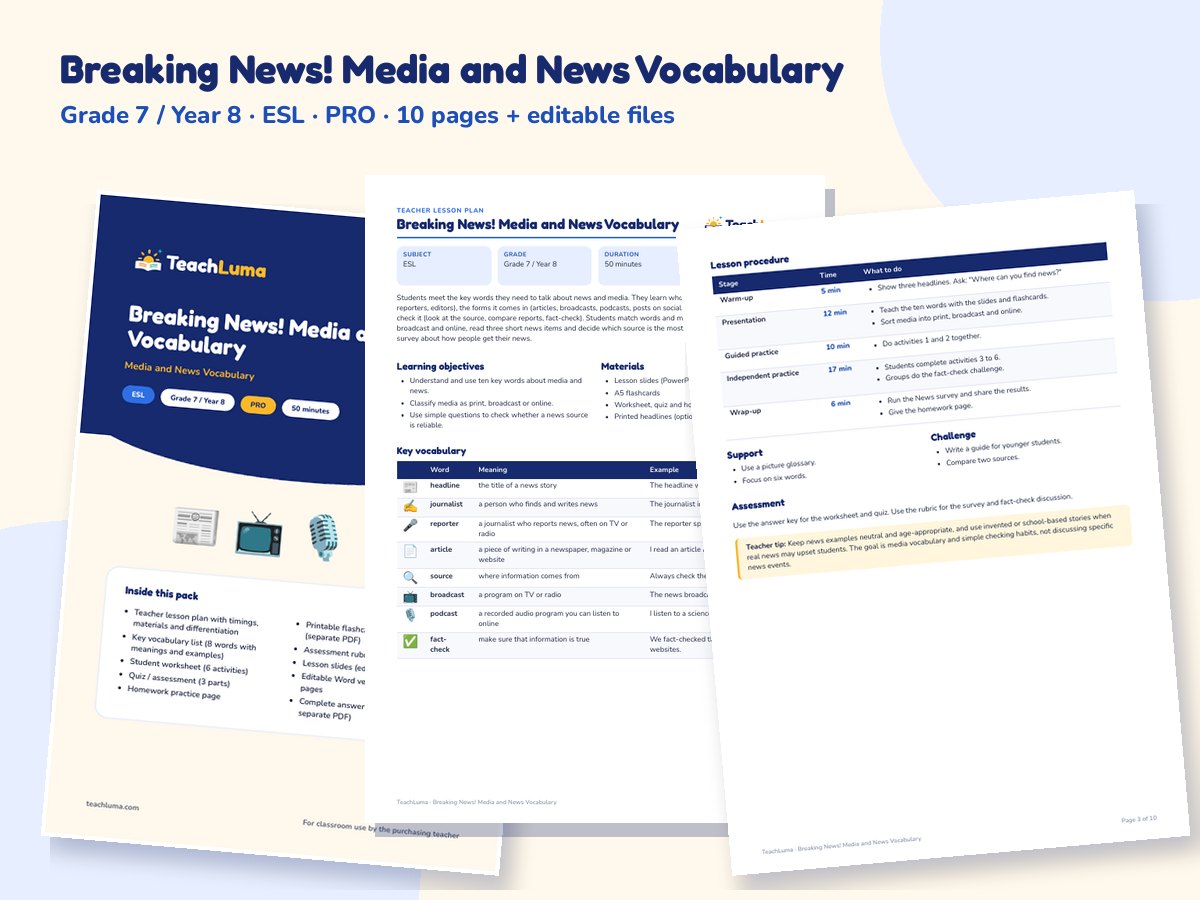
  • 10-page printable PDF lesson pack: teacher lesson plan with timings, materials and differentiation
  • Key vocabulary list (8 words with meanings and examples)
  • Student worksheet (6 activities)
  • Quiz / assessment (3 parts)
  • Homework practice page
  • Printable flashcards: 8 A5 picture cards (separate PDF)
  • Assessment rubric (4 levels)
  • Lesson slides (editable PowerPoint)
  • Editable Word version of all student pages
  • Complete answer key (also as a separate PDF)

Additional Files

  • Lesson Slides (PPTX)
  • Editable Student Pages and Lesson Plan (DOCX)
  • A5 Flashcards (PDF)
  • Answer Key (PDF)

Teacher Reviews

No ratings yet

Be the first teacher to review this resource.

Sign in to review this resource.

Related Resources

Advertisement