Skip to content
Preview
Members Only Science Complete Lesson Pack Grade 3 (Year 4)
No ratings yet

Busy Bees: How Pollination Works

About This Resource

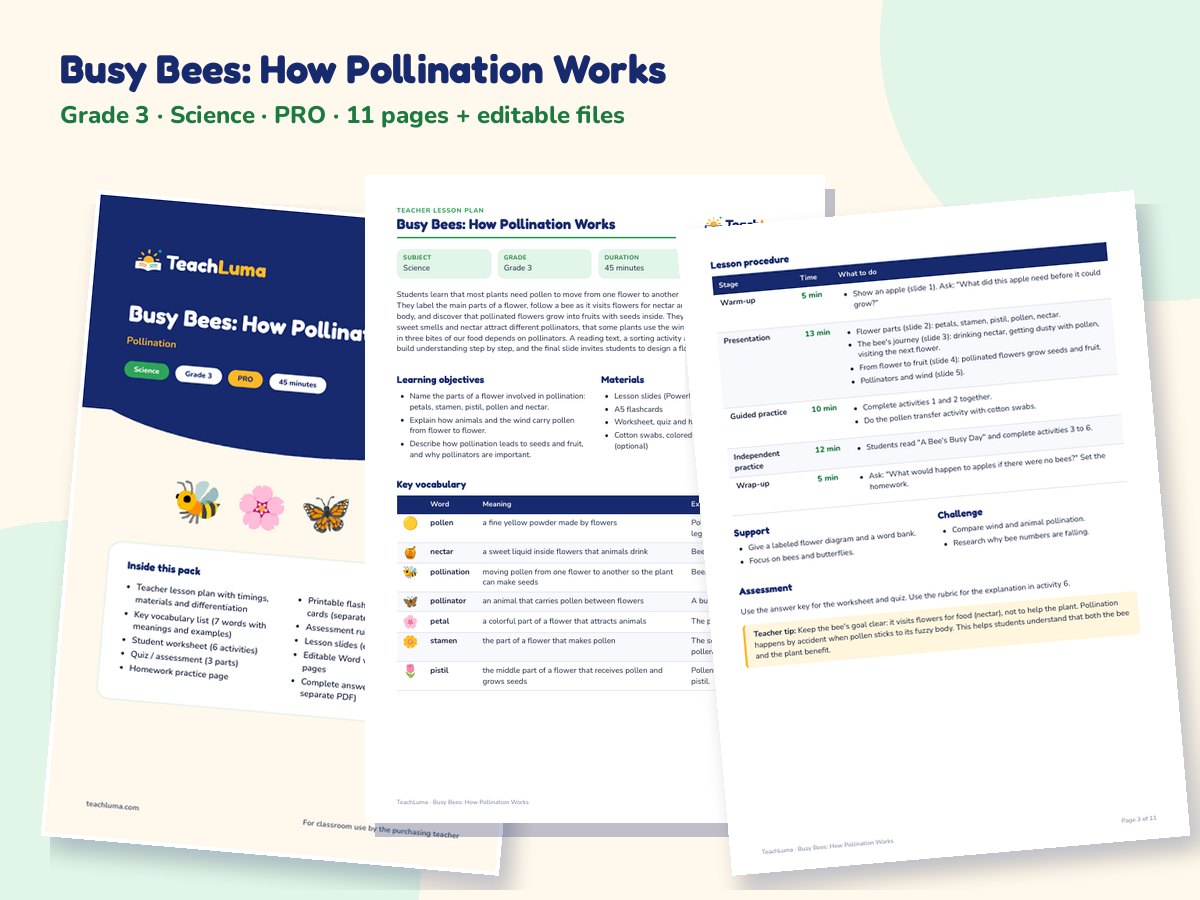
A complete Grade 3 science lesson pack on pollination: the parts of a flower (petals, stamen, pistil, pollen, nectar), how bees, butterflies, birds, bats and the wind carry pollen from flower to flower, how pollination leads to seeds and fruit, how flowers attract pollinators, and why pollinators matter for our food. Includes slides, a timed lesson plan, flashcards, worksheet, quiz, homework, rubric and answer key.

Overview

Students learn that most plants need pollen to move from one flower to another before they can make seeds. They label the main parts of a flower, follow a bee as it visits flowers for nectar and carries sticky pollen on its body, and discover that pollinated flowers grow into fruits with seeds inside. They learn how bright petals, sweet smells and nectar attract different pollinators, that some plants use the wind instead, and that about one in three bites of our food depends on pollinators. A reading text, a sorting activity and explanation questions build understanding step by step, and the final slide invites students to design a flower for a butterfly.

Resource Details

Subject
Science
Topic
Pollination
Category
Plants
File Type
PDF
File Size
378.8 KB
Published
04 Nov 2026
Downloads
0

Members Only

Upgrade to Teacher Pro (from ฿199/month) to download this resource.

Share:

Looking for something different? Request a Resource.

Grade 3 (ages 8–9) 45 minutes Life science labeling reading sequencing explaining

Learning Objectives

  • Name the parts of a flower involved in pollination: petals, stamen, pistil, pollen and nectar.
  • Explain how animals and the wind carry pollen from flower to flower.
  • Describe how pollination leads to seeds and fruit, and why pollinators are important.

How to Use This Resource

  • Start with slide 1: show an apple and ask, "What did this apple need before it could grow?"
  • Teach flower parts, the bee's journey and the path from flower to fruit with the slides, then do activities 1 and 2 together.
  • Students complete activities 3 to 6, then use the quiz to check and the homework flower hunt. Answers are in the answer key.

Classroom Activity Ideas

  • Pollen transfer: students use a cotton swab as a bee to move colored chalk dust (pollen) between paper flowers.
  • Flower dissection: groups gently open a large flower (such as a lily) and find the petals, stamens and pistil.
  • Design a flower: students design a flower that would attract a particular pollinator and explain their choices.

Differentiation

Support: give a labeled flower diagram and a word bank, and focus on bees and butterflies. Challenge: compare wind-pollinated and animal-pollinated flowers and research why bee numbers are falling in some places.

Assessment

Worksheet activities and the quiz check flower parts, pollinators and the steps from flower to fruit (answer key included). Activity 6 and the rubric check explaining why pollinators matter.

Teacher Tips

Keep the bee's goal clear: it visits flowers for food (nectar), not to help the plant. Pollination happens by accident when pollen sticks to its fuzzy body. This helps students understand that both the bee and the plant benefit.

What's Included

  • 11-page printable PDF lesson pack: teacher lesson plan with timings, materials and differentiation
  • Key vocabulary list (7 words with meanings and examples)
  • Student worksheet (6 activities)
  • Quiz / assessment (3 parts)
  • Homework practice page
  • Printable flashcards: 7 A5 picture cards (separate PDF)
  • Assessment rubric (4 levels)
  • Lesson slides (editable PowerPoint)
  • Editable Word version of all student pages
  • Complete answer key (also as a separate PDF)

Additional Files

  • Lesson Slides (PPTX)
  • Editable Student Pages and Lesson Plan (DOCX)
  • A5 Flashcards (PDF)
  • Answer Key (PDF)

Teacher Reviews

No ratings yet

Be the first teacher to review this resource.

Sign in to review this resource.

Related Resources

Advertisement