Skip to content
Preview
Members Only Science Quiz Grade 3
No ratings yet

Grade 3 Science Quiz: Plants (15 Marks)

About This Resource

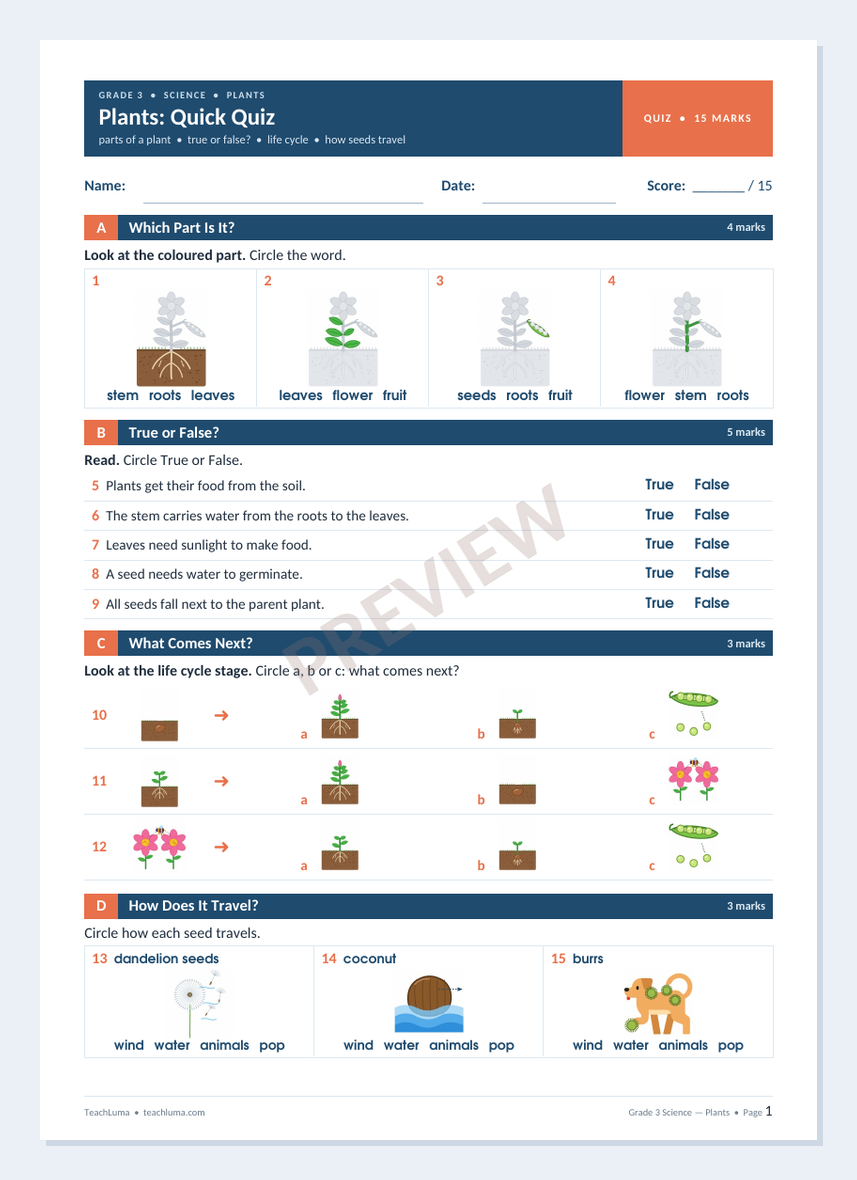
A 1-page, 15-mark quick quiz in 4 parts — which part is coloured?, true or false?, what comes next in the life cycle? and how does each seed travel? — with an answer key and score guide.

Overview

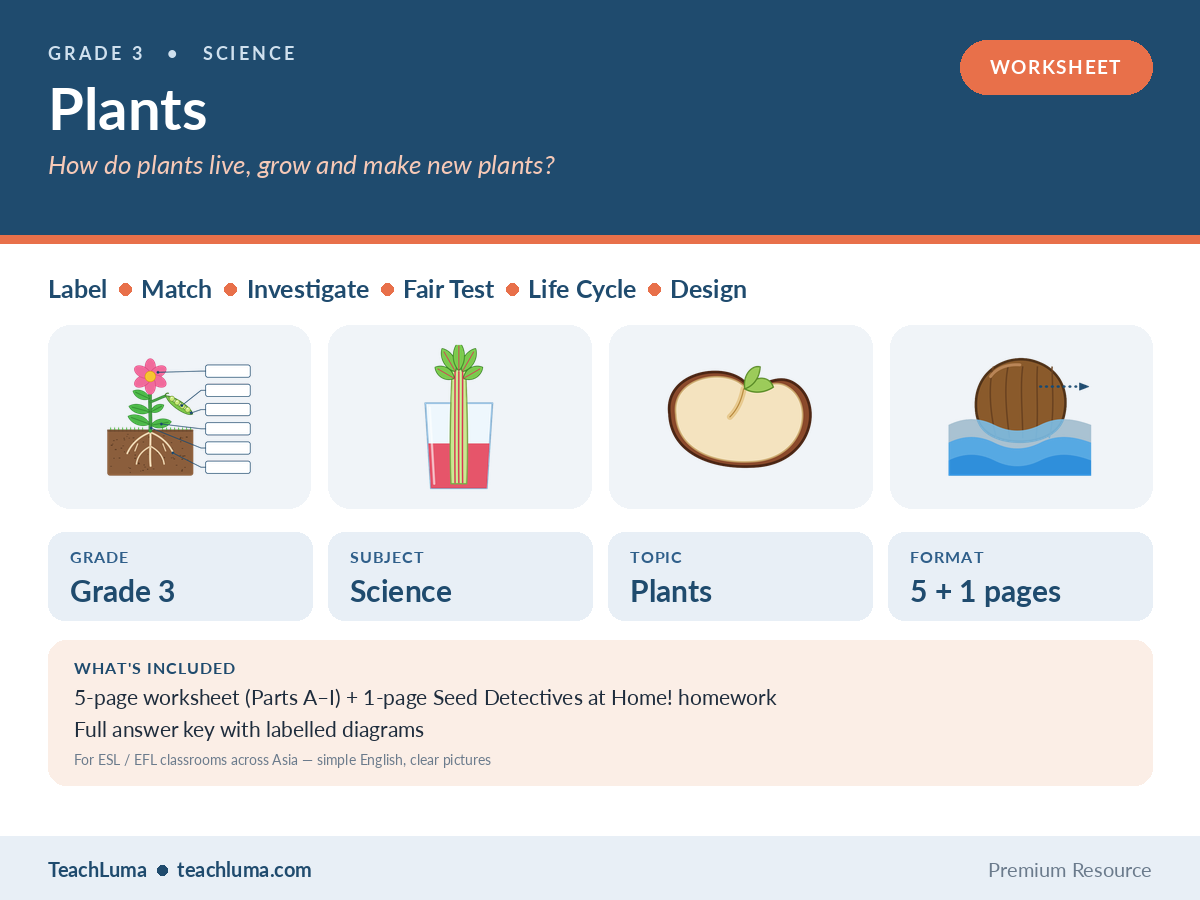
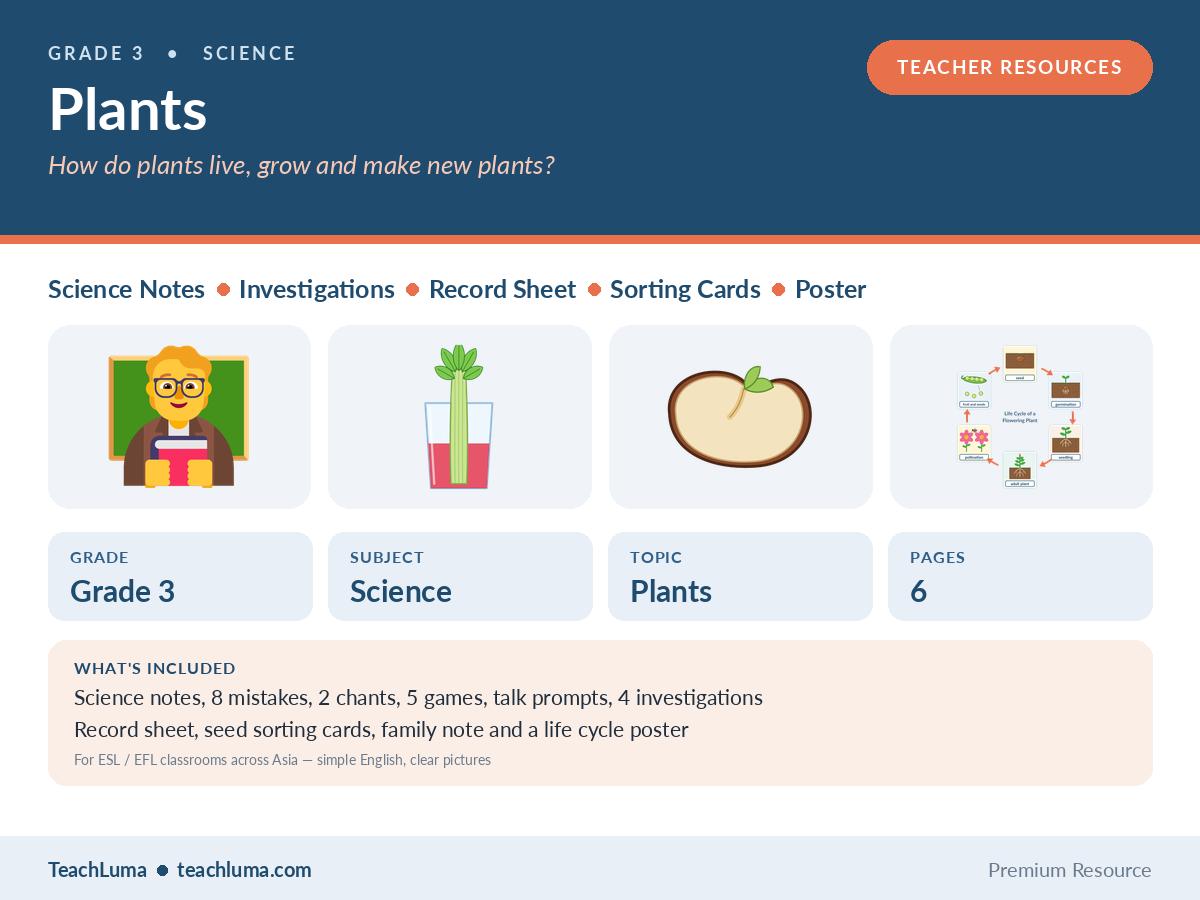
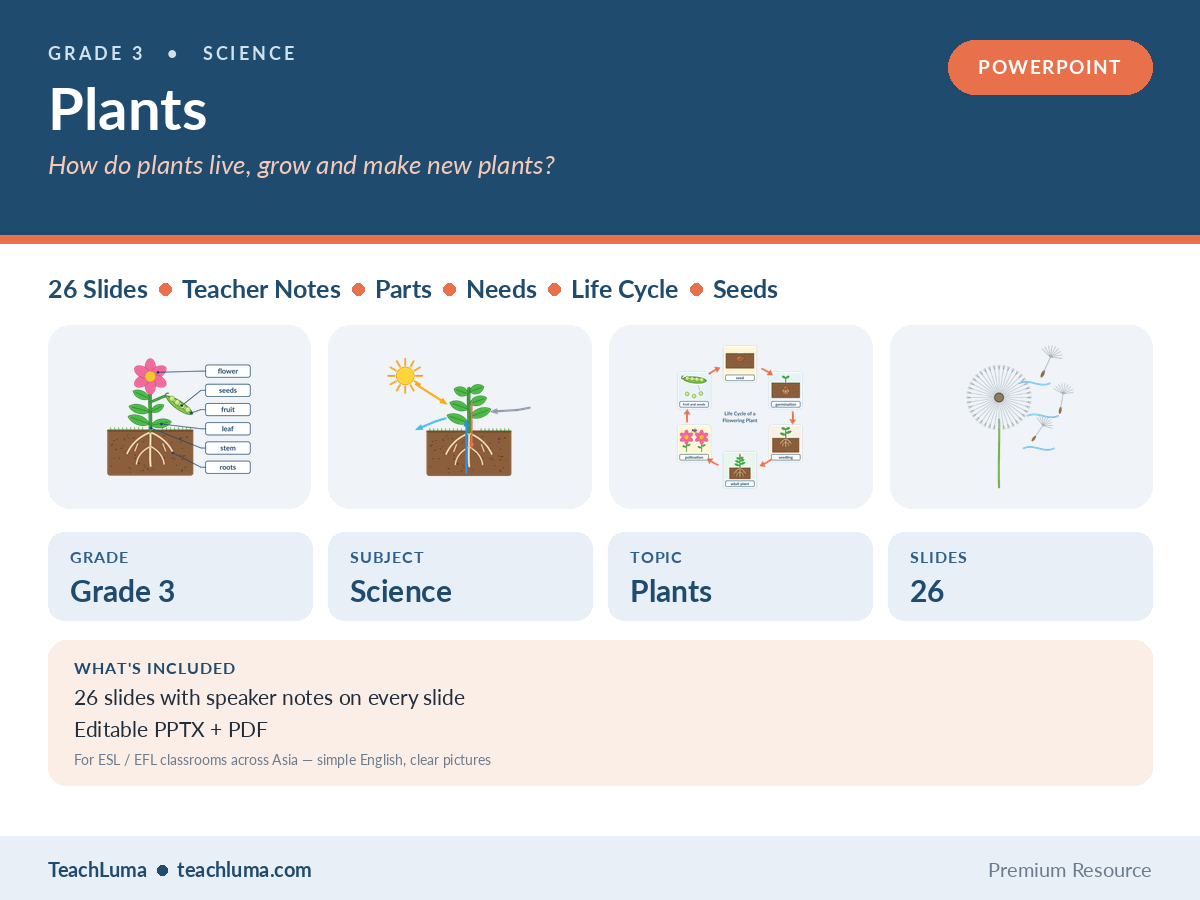
This pack teaches Grade 3 students how plants live, grow and make new plants, in clear, simple English for ESL / EFL learners. Students label 6 parts of a flowering plant (roots, stem, leaves, flower, fruit, seeds) and explain each job, see water travel up a stem, learn the 6 things plants need (light, water, air, nutrients, space and warmth) and discover that plants do not eat soil — the leaves make food from sunlight, water and air and give out oxygen. They run a real fair test (light + water / no water / no light) and learn that the tallest plant is not always the healthiest. They open a soaked bean to find the baby plant, learn the life cycle of a flowering plant (seed, germination, seedling, adult plant, pollination, fruit and seeds) and explain how seeds travel by wind, water, animals or by popping open. Four hands-on investigations are built in: Water Up the Stem, the 3-plant fair test, Inside a Seed and a Seed Travel Challenge. Every diagram is drawn for this pack in one clear style, and the examples are familiar to children across Asia (coconut, mango, lotus, rice, bean plants). It goes one step beyond the Grade 1 and Grade 2 plant resources on TeachLuma. This listing covers the Quiz only.

Resource Details

Subject
Science
Topic
Plants
Category
Plants
File Type
PDF
File Size
153.3 KB
Published
09 Oct 2026
Downloads
0

Members Only

Upgrade to Teacher Pro (from ฿199/month) to download this resource.

Share:

Looking for something different? Request a Resource.

Grade 3 45-55 Minutes Quiz Plant Science

Learning Objectives

  • Name and label 6 parts of a flowering plant (roots, stem, leaves, flower, fruit, seeds) and say what each part does.
  • Explain how water travels from the roots, up the stem, to the leaves, using the results of the Water Up the Stem investigation.
  • Name 6 things plants need to grow well (light, water, air, nutrients, space and warmth) and explain that leaves make the plant's food using sunlight, water and air.
  • Plan and carry out a simple fair test (change one thing, keep everything else the same), and use the results to say what plants need.
  • Put the 6 stages of the life cycle of a flowering plant in order (seed, germination, seedling, adult plant, pollination, fruit and seeds) and explain pollination.
  • Name the 3 parts inside a seed (seed coat, baby plant, food store) and say what a seed needs to germinate.
  • Explain why seeds travel and sort seeds by how they travel: wind, water, animals or pop.

How to Use This Resource

  • Give it at the end of Lesson 4 or in the review lesson. Read the instructions aloud and do the first item together if needed. Mark with the answer key: 1 mark per item.

Classroom Activity Ideas

  • Use it as a pre-test before the unit and again after it to show progress.
  • After marking, students correct their answers with the flashcards.

Differentiation

Support: Use the flashcards and a real plant for every new word, and keep the word bank on the board for the whole unit. Teach the 4 big parts first (roots, stem, leaves, flower), then add fruit and seeds. Accept short answers ("Stem — water!") and model the full sentence for the child to repeat ("The stem carries water to the leaves."). In Part E (fair test) and the life cycle, give the picture cards so children can move them before they write. Pair a weaker reader with a stronger reader for the investigations and let them draw results instead of writing.
Extension: Children explain the "why": why the plant in the dark grew tall (it is looking for light), why seeds travel (not enough light, water and space under the parent plant), and why a seed does not need light to germinate (it uses its food store). They learn the word photosynthesis and write the word equation: sunlight + water + air (carbon dioxide) → food (sugar) + oxygen. They design and test a new seed that travels by wind (paper helicopter or parachute), measure how long it takes to fall, and write a short report: "My seed fell in 3 seconds. I think bigger wings make it fall more slowly."

Assessment

The answer key gives every answer and a score guide (13–15, 10–12, 7–9, 0–6) with next steps.

Teacher Tips

Start two investigations in Lesson 1, because they need time. (1) Put a stick of celery (or a white flower, or a Chinese cabbage leaf) in a cup of water with red food colouring — next morning the red has climbed the stem and children can SEE that the stem carries water. (2) Soak 10 dry beans (mung, kidney or broad beans) in water overnight for Lesson 3: a soaked bean opens easily with a fingernail and children find the tiny baby plant inside. These two "wow" moments do more than any explanation. Also start the 3-plant fair test (light and water / no water / no light) at the end of Lesson 1 or 2 so the results are clear by Lesson 4 — the plant in the dark grows tall, thin and yellow, which surprises children who think "taller means healthier".

What's Included

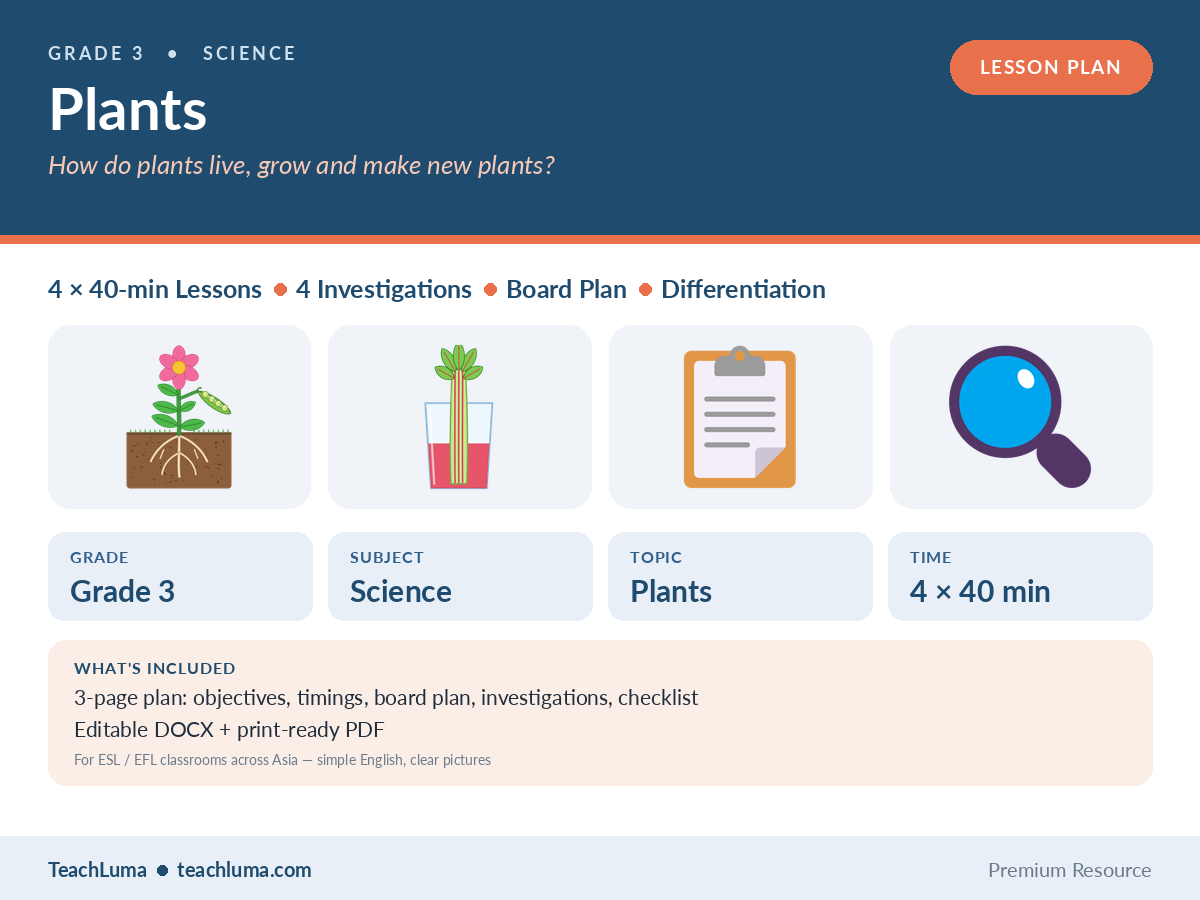
  • Quick quiz, 1 page, 15 questions in 4 parts (DOCX + PDF)
  • Answer key with score guide, 1 page (DOCX + PDF)

Additional Files

  • Grade 3 Science Quiz: Plants (15 Marks) (DOCX)
  • Answer Key (PDF)

Teacher Reviews

No ratings yet

Be the first teacher to review this resource.

Sign in to review this resource.

Related Resources

Advertisement