Skip to content
Preview
Members Only ESL Complete Lesson Pack Grade 2 (Year 3)
No ratings yet

City Mice and Giant Giraffes: Soft C and Soft G

About This Resource

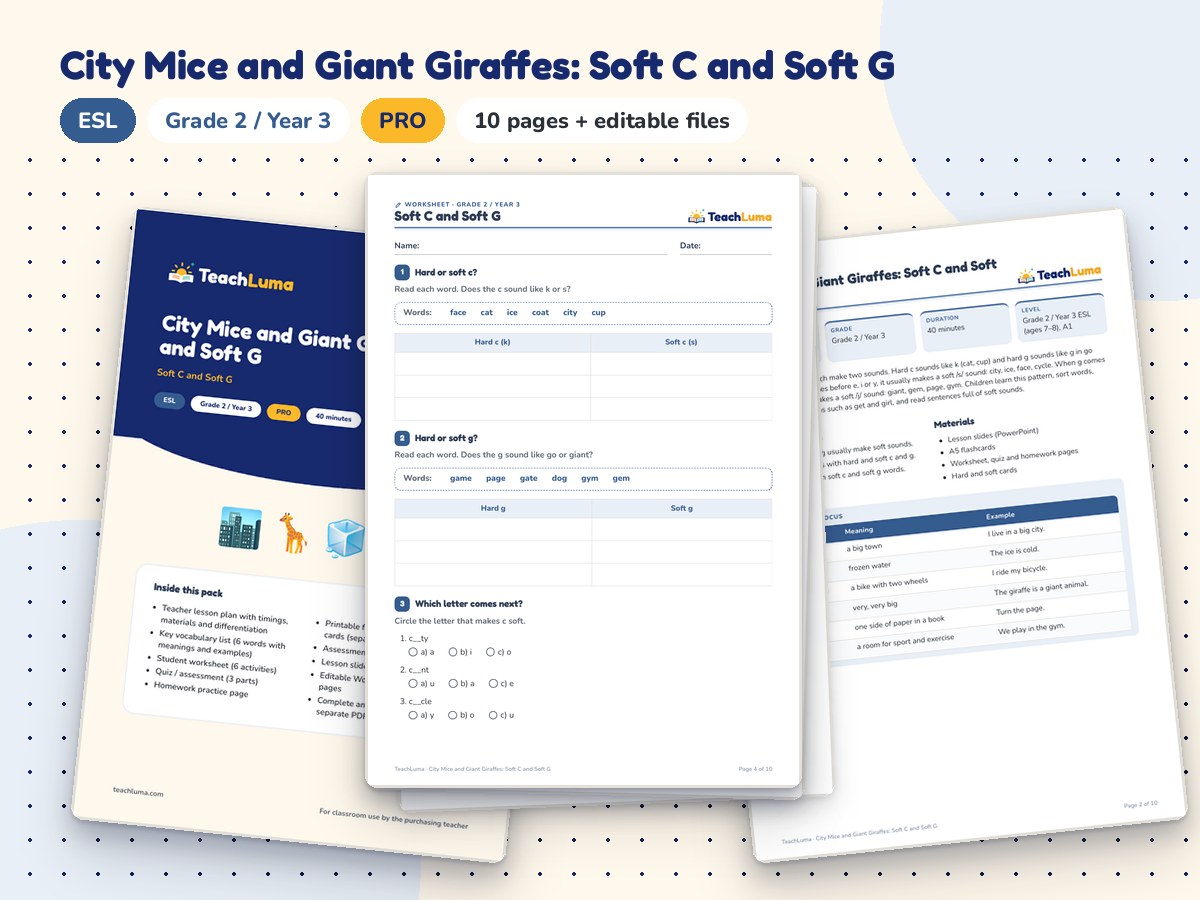
A complete Grade 2 ESL phonics pack on soft c and soft g. Children learn that c usually says /s/ before e, i and y (city, face, cycle) and g often says /j/ before e, i and y (giant, page, gym), compare hard and soft sounds, sort words and read short sentences. Includes slides, a lesson plan, worksheet, quiz, homework, A5 flashcards, a rubric, Word files and answer keys.

Overview

The letters c and g can each make two sounds. Hard c sounds like k (cat, cup) and hard g sounds like g in go (game, dog). When c comes before e, i or y, it usually makes a soft /s/ sound: city, ice, face, cycle. When g comes before e, i or y, it often makes a soft /j/ sound: giant, gem, page, gym. Children learn this pattern, sort words, notice common exceptions such as get and girl, and read sentences full of soft sounds.

Resource Details

Subject
ESL
Topic
Soft C and Soft G
Category
Phonics
File Type
PDF
File Size
450.6 KB
Published
20 Nov 2026
Downloads
0

Members Only

Create a free account to download this resource with one of your 3 Free Pro Previews, or upgrade to Teacher Pro (from ฿199/month) for the whole library.

Share:

Looking for something different? Request a Resource.

Grade 2 ESL (ages 7–8), A1 40 minutes Phonics reading spelling listening

Learning Objectives

  • Explain when c and g usually make soft sounds.
  • Read and sort words with hard and soft c and g.
  • Read sentences with soft c and soft g words.

How to Use This Resource

  • Write cat and city. Ask: "Do they start with the same sound?"
  • Teach the e, i, y rule with the slides, then do activities 1 and 2 together.
  • Children complete activities 3 to 6. Use the quiz and send the homework page home.

Classroom Activity Ideas

  • Hard or soft? Children hold up a hard card or a soft card for each word you say.
  • Word detectives: find soft c and soft g words in a class reader.
  • Rule check: children circle the letter after c or g to predict the sound.

Differentiation

Support: focus on soft c first. Challenge: sort longer words such as bicycle, pencil, orange and magic.

Assessment

Use the worksheet and quiz to check sorting and reading. Use the rubric during reading aloud.

Teacher Tips

The rule works very well for c. For g there are common exceptions (get, give, girl, gift), so teach the pattern as usually. Celebrate when children notice an exception.

What's Included

  • 10-page printable PDF lesson pack: teacher lesson plan with timings, materials and differentiation
  • Key vocabulary list (6 words with meanings and examples)
  • Student worksheet (6 activities)
  • Quiz / assessment (3 parts)
  • Homework practice page
  • Printable flashcards: 6 A5 picture cards (separate PDF)
  • Assessment rubric (4 levels)
  • Lesson slides (editable PowerPoint)
  • Editable Word version of all student pages
  • Complete answer key (also as a separate PDF)

Additional Files

  • Lesson Slides (PPTX)
  • Editable Student Pages and Lesson Plan (DOCX)
  • A5 Flashcards (PDF)
  • Answer Key (PDF)

Teacher Reviews

No ratings yet

Be the first teacher to review this resource.

Sign in to review this resource.

Related Resources

Advertisement