Skip to content
Preview
Free Science Worksheet Grade 5 (Year 6)
No ratings yet

Flowers, Cones and Spores: Classifying Plants

About This Resource

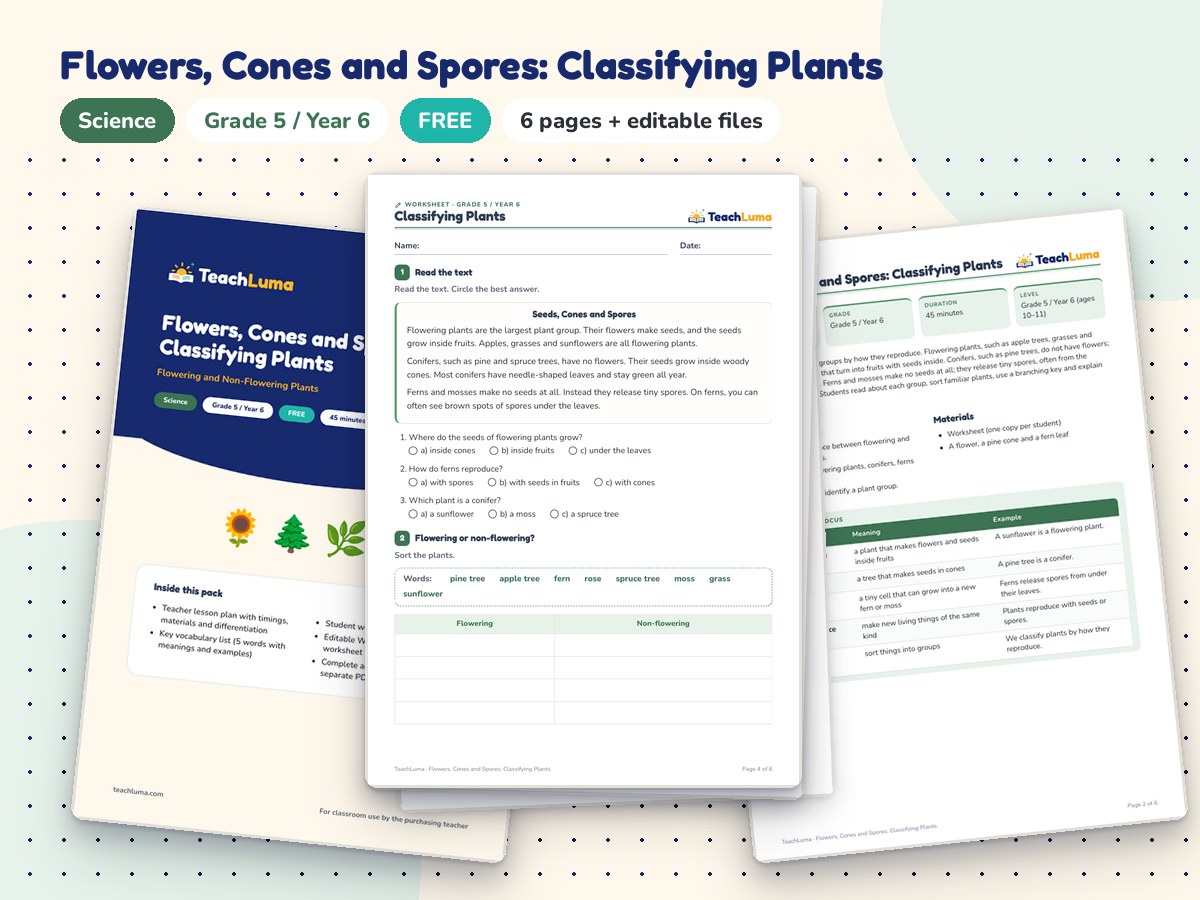
A free Grade 5 science worksheet on classifying plants. Students learn that flowering plants make seeds inside fruits, conifers make seeds in cones, and ferns and mosses reproduce with spores. They sort plants into groups, read a short comparison text and use a simple key to identify plants. Includes a timed lesson plan, an editable Word version and an answer key.

Overview

Scientists sort plants into groups by how they reproduce. Flowering plants, such as apple trees, grasses and sunflowers, make flowers that turn into fruits with seeds inside. Conifers, such as pine trees, do not have flowers; their seeds grow in cones. Ferns and mosses make no seeds at all; they release tiny spores, often from the underside of fern leaves. Students read about each group, sort familiar plants, use a branching key and explain the differences.

Resource Details

Subject
Science
Topic
Flowering and Non-Flowering Plants
Category
Plants
File Type
PDF
File Size
237.1 KB
Published
14 Nov 2026
Downloads
0
Download Free

Free with a TeachLuma account — it takes a minute.

Share:

Looking for something different? Request a Resource.

Grade 5 (ages 10–11) 45 minutes Classifying reading for information using keys

Student Task

  • Show a flower, a pine cone and a fern leaf. Ask: "How are these plants different?"
  • Read the text together, then do activities 1 and 2.
  • Students complete activities 3 to 5. Answers are in the answer key.

Classroom Use

  • Plant walk: students find and photograph one plant from each group in the school grounds.
  • Spore print: place a mature fern leaf face down on paper overnight to see the spore pattern.
  • Make a key: groups design their own key for five plants.

Differentiation

Support: provide picture cards and focus on flowering versus non-flowering. Challenge: students research how mosses and ferns need water to reproduce and explain why they grow in damp places.

Answer Key & Assessment

Activities 1 to 4 check classification (answer key included). Activity 5 shows whether students can explain the differences.

Learning Objectives

  • Describe the difference between flowering and non-flowering plants.
  • Sort plants into flowering plants, conifers, ferns and mosses.
  • Use a simple key to identify a plant group.

Teacher Tips

Many students think grasses and trees are non-flowering because their flowers are small or hard to see. Show close-up photos of grass flowers and oak flowers. Remind students to wash their hands after handling plants.

What's Included

  • 6-page printable PDF lesson pack: teacher lesson plan with timings, materials and differentiation
  • Key vocabulary list (5 words with meanings and examples)
  • Student worksheet (5 activities)
  • Editable Word version of the worksheet
  • Complete answer key (also as a separate PDF)

Additional Files


Teacher Reviews

No ratings yet

Be the first teacher to review this resource.

Sign in to review this resource.

Related Resources

Advertisement