Grade 10
45-55 Minutes
Worksheet
Personal Identity & Goals
Student Task
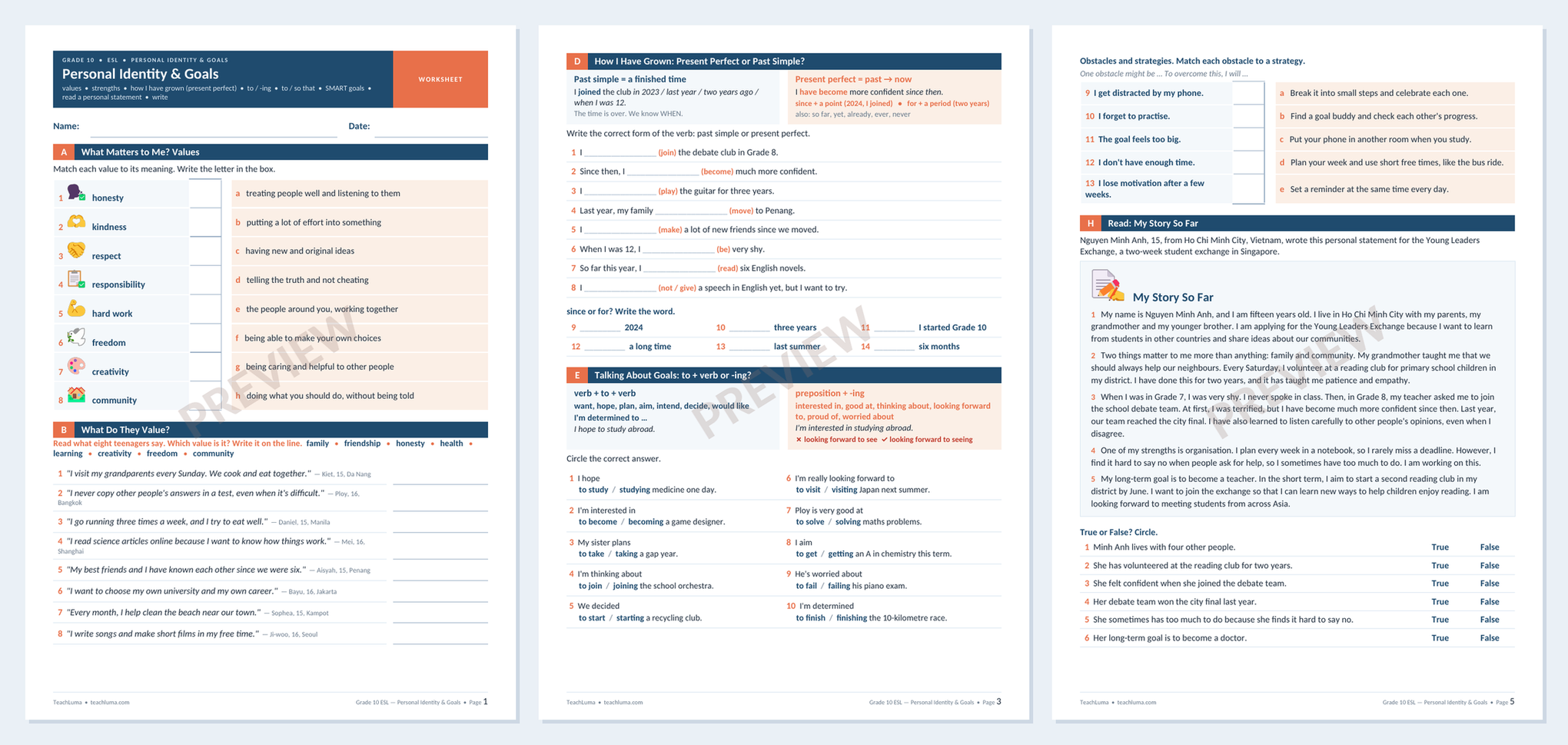
- Pages 1–2 (Parts A–C) fit Lessons 1–2, page 3 (Parts D–E) Lessons 2–3, pages 4–5 (Parts F–G) Lesson 3 and pages 5–7 (Parts H–I) Lesson 4. Read the rule boxes in Parts B–F together first, and do the matching slide orally before students write. Set the homework at the end of Lesson 3.
Classroom Use
- After Part C, students turn their own strengths into "claim + example" sentences and read them to a partner.
- After Part G, students rewrite one of their real goals as a SMART goal and share it with a Goal Buddy.
Differentiation
Support: Give students the sentence-frame strip from the Flashcards (frame card page) and let them keep it on the desk all unit: "___ matters to me because ___." / "One of my strengths is ___. For example, ___." / "Since I ___, I've ___." / "I aim to ___ by ___ so that ___." In Worksheet Parts B and C, let students work in pairs and use the picture cards. For Part D, colour the time words first (since, for, so far, yet = present perfect; ago, last, in 2023, when I was = past simple). For Part I, students can write 100–120 words using the plan table as paragraph starters, and practise the interview with the question list in front of them.
Extension: Students compare two values that sometimes conflict (freedom and family, honesty and kindness) and give a real example. They add a second SMART goal with a measurable milestone each month, use more advanced language (I'm committed to + -ing, I've been working on … since …, in order not to …), and write a 220–250-word personal statement for a real programme or university they know. In the interview, the "panel" asks one follow-up question for every answer (Why? Can you give me another example? What would you do differently?). Fast finishers interview a family member about a goal they achieved and write a short profile.
Answer Key & Assessment
The answer key covers Parts A–H with the same letters and numbers as the worksheet, with a model personal statement for Part I. Use the Grading Rubric (Writing row) for Part I and the homework.
Learning Objectives
- Name and explain 12 personal values and 12 personal strengths, and talk about them with I value …, … matters to me because …, One of my strengths is … and I'm good at + -ing.
- Support what they say about themselves with a real example, and talk honestly about an area to improve (I find it hard to …, I need to work on …).
- Use the present perfect with since and for — and tell it apart from the past simple — to describe how they have grown: Since I joined the debate team, I've become more confident.
- Set a long-term goal and a SMART short-term goal, and plan steps, a possible obstacle and a strategy.
- Talk about goals with verb + to-infinitive (hope to, aim to, plan to), preposition + -ing (interested in, looking forward to) and purpose (to, in order to, so that).
- Read a student's personal statement, write their own 150–180-word personal statement and answer "Tell me about yourself" interview questions.
Teacher Tips
Ask for evidence, not adjectives. Many students in Asian classrooms are taught to be modest, so "I am a hard-working leader" feels like boasting — and they either write nothing or copy an empty sentence from a template. Teach one habit instead: claim + example. Every time a student names a value or a strength, ask "For example?" and wait. "One of my strengths is organisation. For example, I plan every week in a notebook." A real example is not boasting — it is a fact, and it is exactly what scholarship and university readers look for. Model it first with your own value, one real weakness and one goal you are working on (learning to swim, cooking, a language). Students open up when the teacher does. Let students choose what they share: nobody has to talk about private family matters, and "I'd rather not say" is always an acceptable answer.
What's Included
- Student worksheet, 7 pages, Parts A–I (DOCX + PDF)
- Homework: Values Interview and Goal Action Plan, 1 page (DOCX + PDF)
- Answer key for the worksheet and homework, 1 page (DOCX + PDF)
Additional Files
-
Grade 10 ESL Personal Identity & Goals Worksheet + Homework and Answer Key (DOCX)
-
Answer Key (PDF)
-
Homework (PDF)