Skip to content
Preview
Free Math Grading Rubric Grade 2
No ratings yet

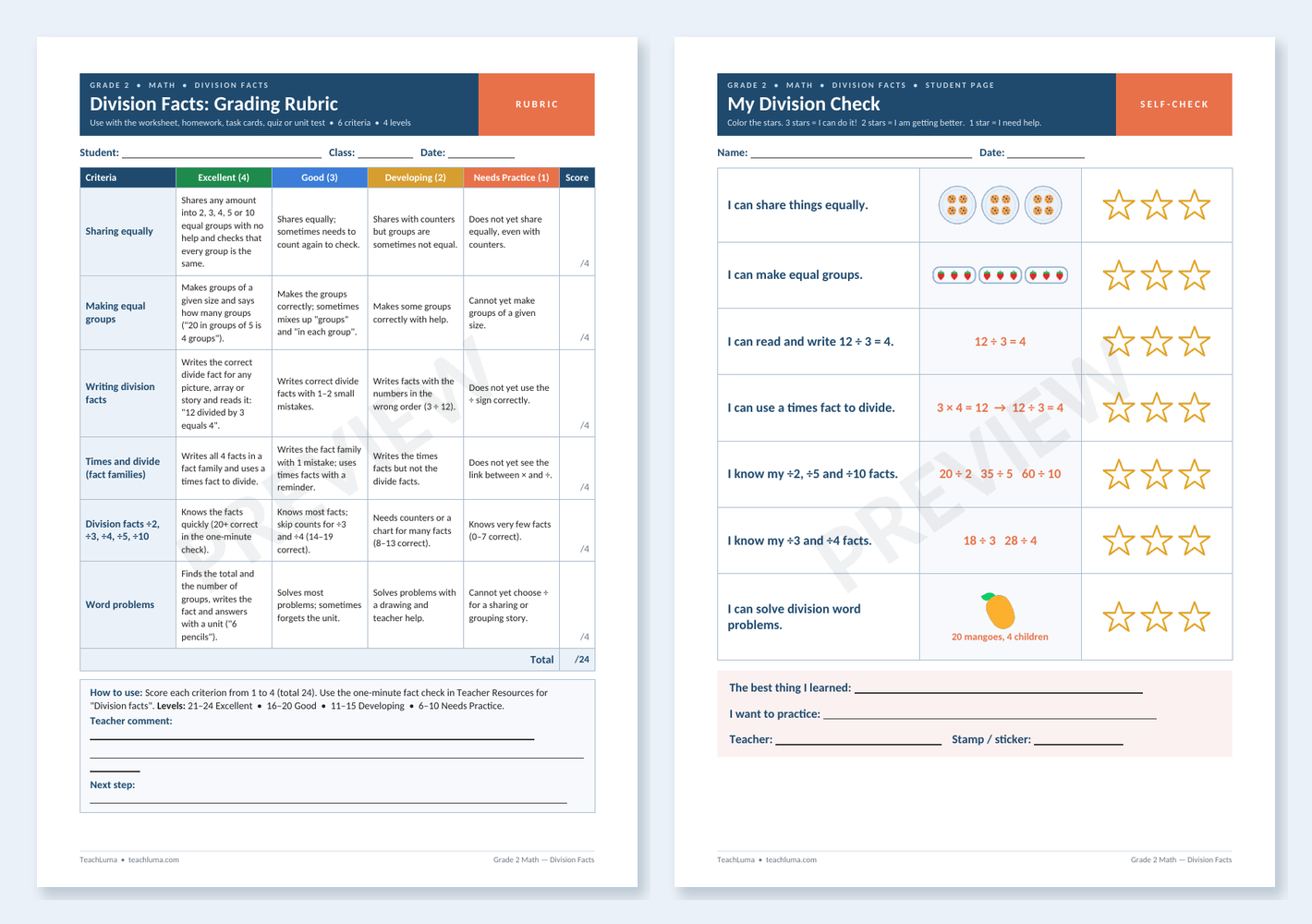
Grade 2 Math Grading Rubric: Division Facts — with Student Self-Check

About This Resource

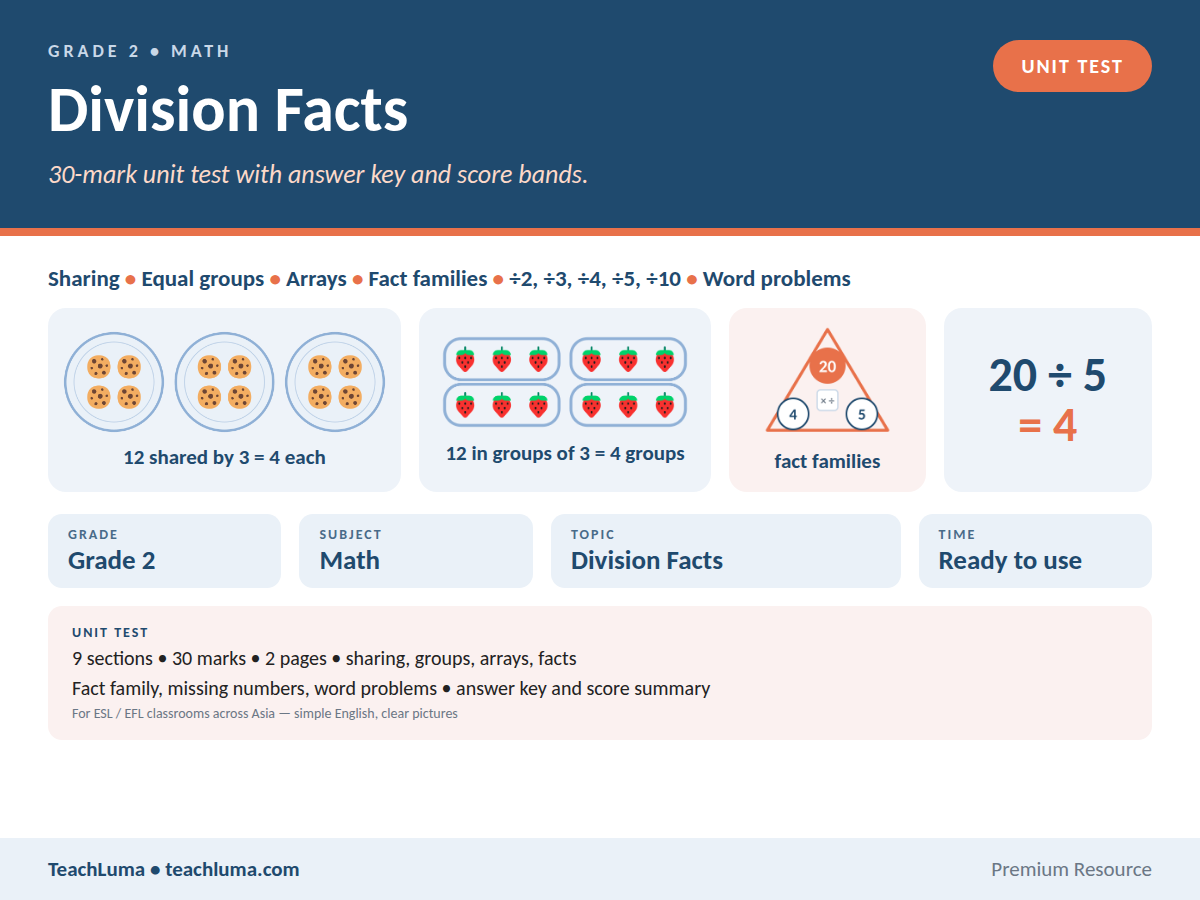
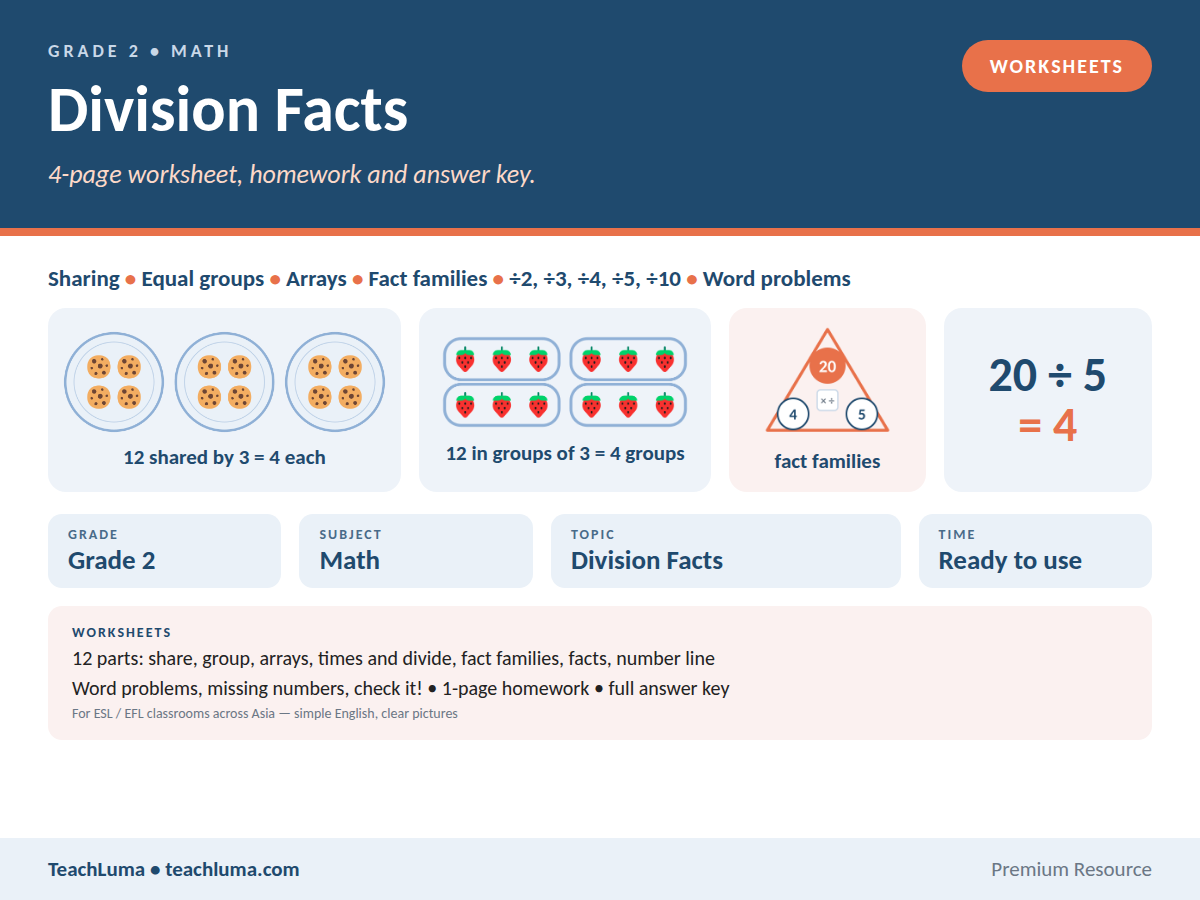
A 6-criterion, 4-level grading rubric for Grade 2 division (sharing, groups, writing facts, fact families, fact recall, word problems) plus a child-friendly "I can" self-check with stars.

Resource Details

Subject
Math
Topic
Division Facts
Category
Multiplication & Division
File Type
PDF
File Size
107.7 KB
Published
25 Sep 2026
Downloads
0
Download

Free download — no account required.

Teaching this in class? Try our free Random Name Picker & Timer.

Share:

Looking for something different? Request a Resource.


How to Use This Resource

  • Score each criterion 1–4 (total 24). Levels: 21–24 Excellent, 16–20 Good, 11–15 Developing, 6–10 Needs Practice. For the full lesson sequence see the Lesson Plan: Lesson 1 = sharing, Lesson 2 = groups, arrays and fact families, Lesson 3 = facts and word problems.

Classroom Activity Ideas

  • Fair Share Dice: roll for the number of plates, share 12 or 20 counters on the Sharing Mat and say the fact — only equal shares score a point.
  • Fact Family Triangles: one partner covers a corner; the other says the hidden number and a fact ("It is 4. 12 divided by 3 equals 4.").
  • Division Bingo: call "18 divided by 2"; children cover 9; three in a line wins.
  • Share Market: a shopkeeper shares "sweets" onto plates for each customer and says the fact.
  • Fact of the Day: one fact shown four ways — share it, make groups, draw an array and write the times fact.

Differentiation

Support: Let children share real counters onto plates or cups for every question. Start with ÷2, ÷5 and ÷10 and add ÷3 and ÷4 only when these are secure. Give the Division Facts Chart and sentence frames ("___ shared by ___ is ___ each."). Pair a child who is new to English with a partner who models the key sentences.

Extension: Share with a "left over" (13 shared by 4 is 3 each and 1 left over), solve two-step problems (3 packs of 8 crayons shared by 4 tables), write a sharing story and a grouping story for 20 ÷ 5, or play Fair Share! in Mix mode with all five tables.

Assessment

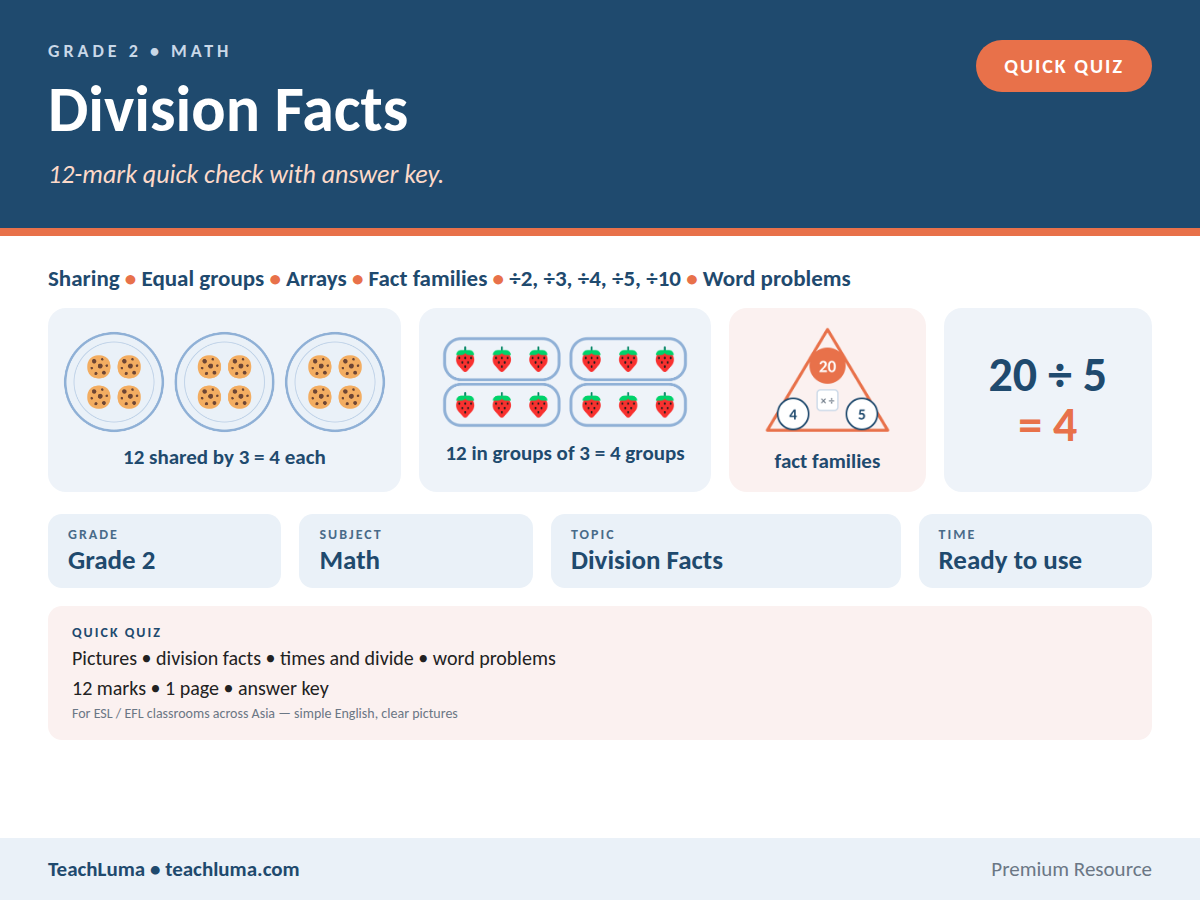
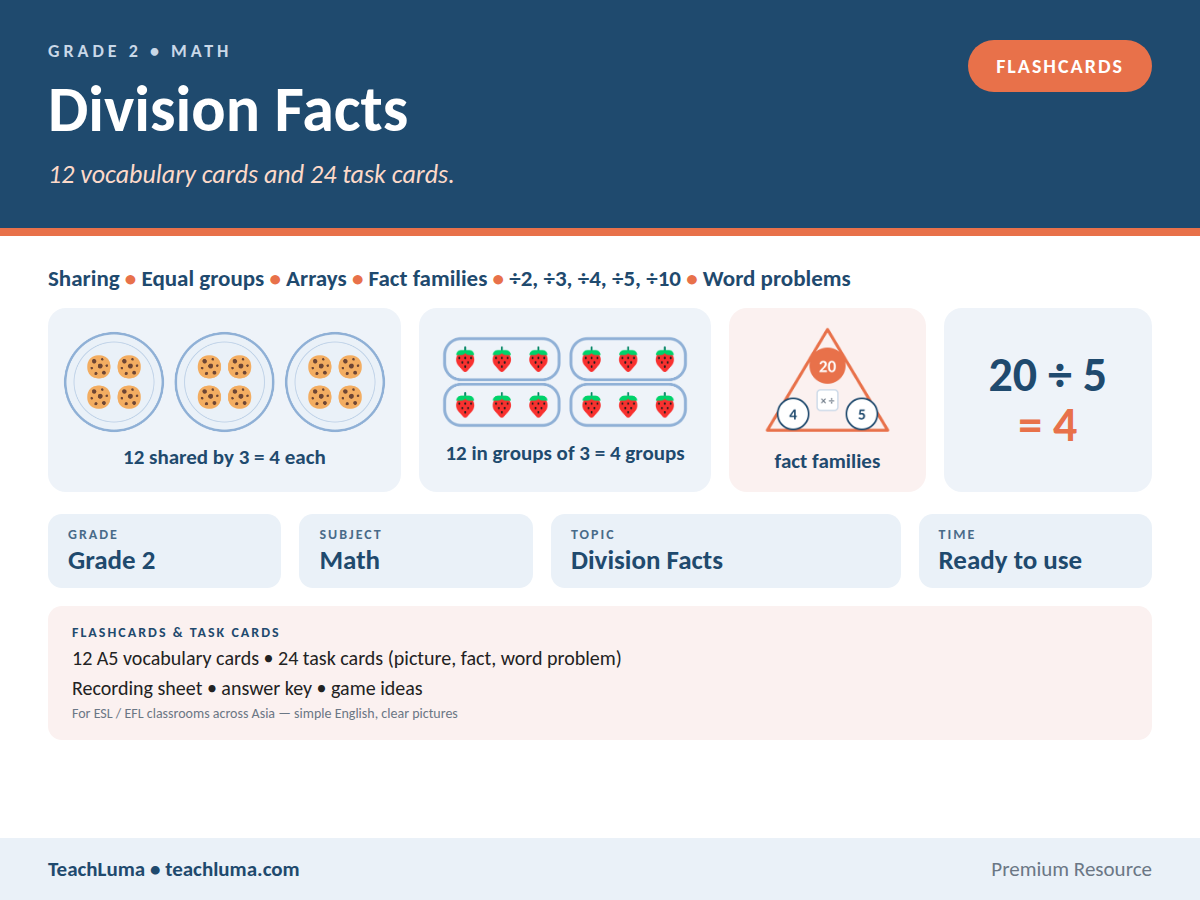
Use the 12-mark Quick Quiz for a fast check and the 30-mark Unit Test (9 sections, with a score summary and performance bands) for a formal grade. Both have complete, numbering-matched answer keys. The worksheet, homework, all 24 task cards and the one-minute fact check have answer keys. The Grading Rubric scores 6 criteria on a 4-level scale (Excellent / Good / Developing / Needs Practice) and includes a child-friendly "I can" self-check with stars

Teacher Tips

The most common mistake is writing the numbers in the wrong order (3 ÷ 12 = 4). Ask "What is the total? Write it first," and have children circle the total in the story before they write. Always practice the full sentence "12 divided by 3 equals 4" — not just the answer. Some textbooks in Asia read 12 ÷ 3 as "12 divided into 3 equal parts" or "How many 3s are in 12?"; both give the same answer, so choose one way for your class and accept the others in children's work.

What's Included

  • Grading rubric: 6 criteria × 4 levels, score column, teacher comment (DOCX + PDF)
  • Student self-check: 7 "I can" statements with stars (same file), 2 pages

Additional Files


Teacher Reviews

No ratings yet

Be the first teacher to review this resource.

Sign in to review this resource.

Related Resources

Advertisement