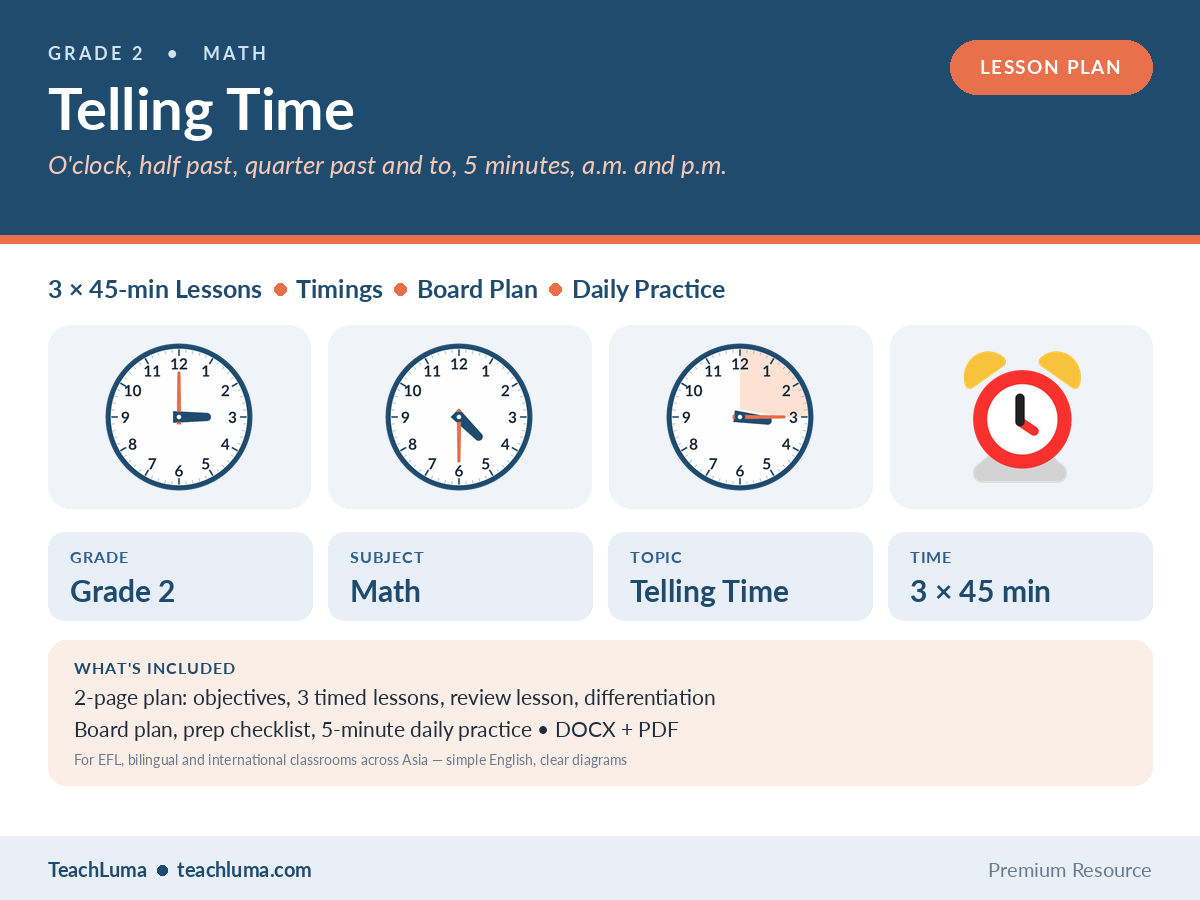
Grade 2 Math Lesson Plan: Telling Time — 3 Lessons with Timings
A 2-page, minute-by-minute plan for three 45-minute Grade 2 lessons on telling time — o'cl...
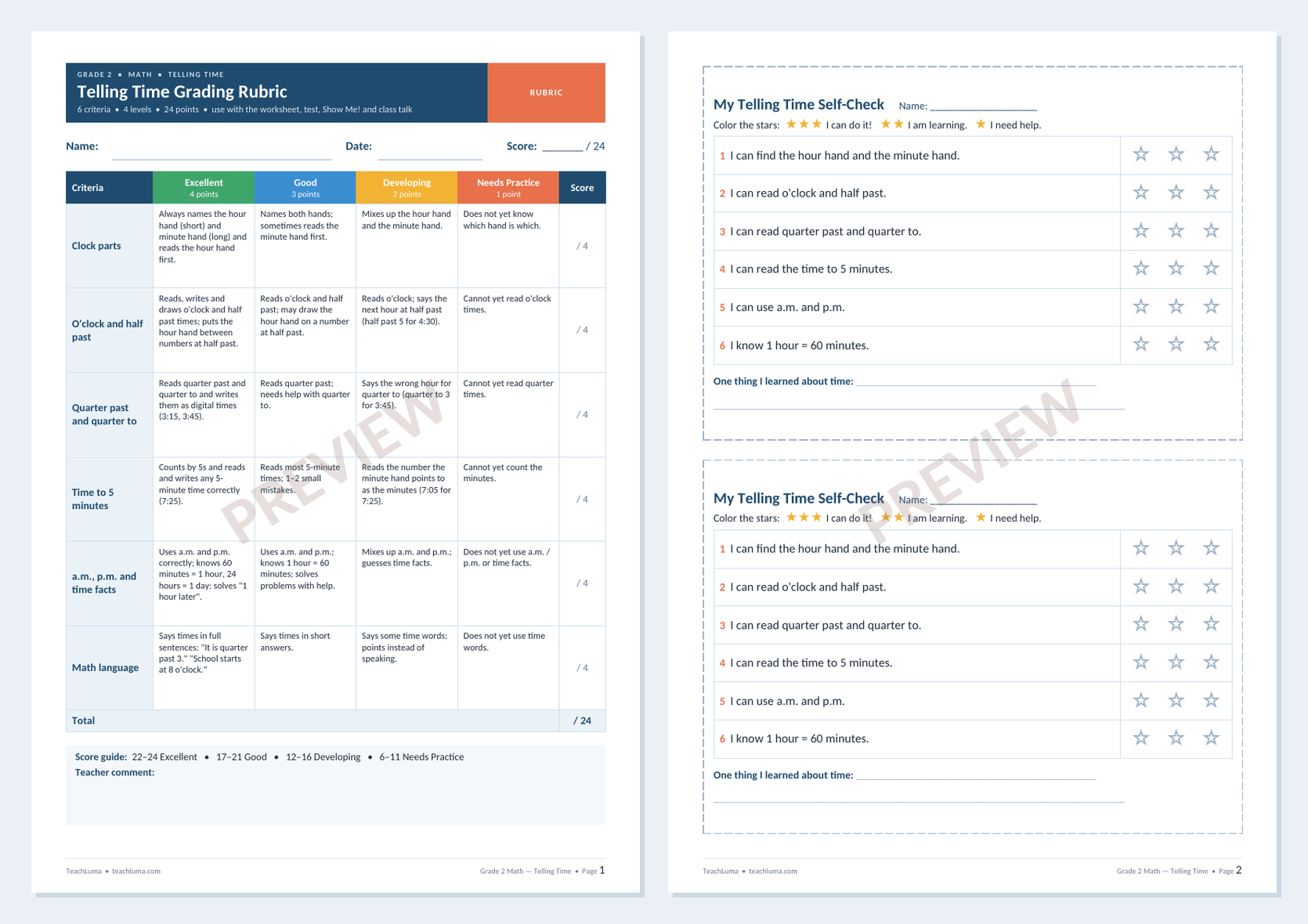
View Resource : Grade 2 Math Lesson Plan: Telling Time — 3 Lessons with TimingsA 1-page rubric that scores 6 skills (clock parts, o'clock and half past, quarter past and quarter to, time to 5 minutes, a.m. / p.m. and time facts, math language) on 4 levels, plus a child "I can" self-check with stars, 2 per page.
This pack teaches Grade 2 children to tell the time on a clock with hands and on a digital clock. Children learn the short hour hand and the long minute hand, then read, write and draw o'clock and half past times. They count by 5s around the clock, read quarter past and quarter to, and read and write any time to 5 minutes (7:25). Finally they use a.m. and p.m. for their own day, learn that 60 minutes = 1 hour and 24 hours = 1 day, and solve simple "1 hour later" problems. Every clock is drawn with exact angles, so at half past the hour hand sits exactly halfway between two numbers, and the same colors are used everywhere: navy hour hand, coral minute hand. The English is short and the same every time, for ESL / EFL learners, and the examples come from a school day in Asia (school bus, bento lunch, football after school). This listing covers the Grading Rubric only.
Free download — no account required.
Teaching this in class? Try our free Random Name Picker & Timer.
Looking for something different? Request a Resource.
Support: Let children keep their paper clock on the desk and move the hands for every question. Teach o'clock and half past well before quarter times and 5-minute times. Use the clock with the minute numbers (5, 10, 15 …) printed round the outside. Give sentence frames ("It is ___ o'clock." "It is half past ___.") and pair a child who is new to English with a partner who models the sentences.
Extension: Read times to 1 minute (7:23), find times 2 or 3 hours later, work out how long an activity takes (3:00 to 4:30), and make a timetable for a school day. Fast finishers can play Clock Challenge! in Mix mode.
6 criteria × 4 levels (Excellent 4, Good 3, Developing 2, Needs Practice 1) = 24 points, with a score guide and space for a teacher comment.
The most common mistake is at half past: children see the hour hand close to the next number and say "half past 5" for 4:30. Make one question a habit: "Has the hour hand got to 5 yet?" Move a paper clock slowly from 4:00 to 5:00 so children watch the hour hand travel. The second big mistake is reading the number under the minute hand as the minutes (7:05 for 7:25), so count by 5s with a finger every time until it is automatic. Many Asian textbooks say "half past" and "quarter to", while others say "three thirty"; teach both and accept both. Ask "What time is it now?" at the same moments every day (start of class, break, lunch) so time becomes everyday class English.
No ratings yet
Be the first teacher to review this resource.
A 2-page, minute-by-minute plan for three 45-minute Grade 2 lessons on telling time — o'cl...
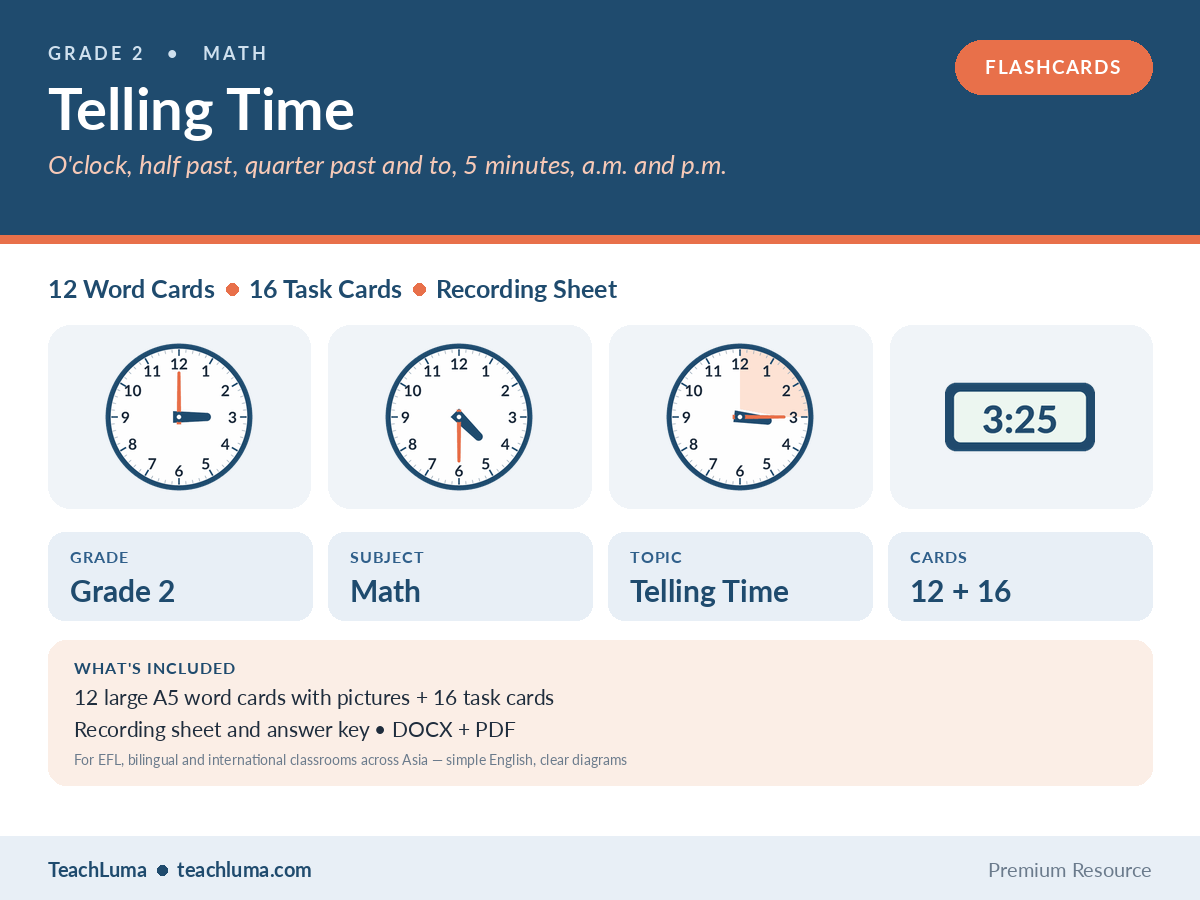
View Resource : Grade 2 Math Lesson Plan: Telling Time — 3 Lessons with Timings12 large A5 word cards (clock, hour hand, minute hand, o'clock, half past, quarter past, q...
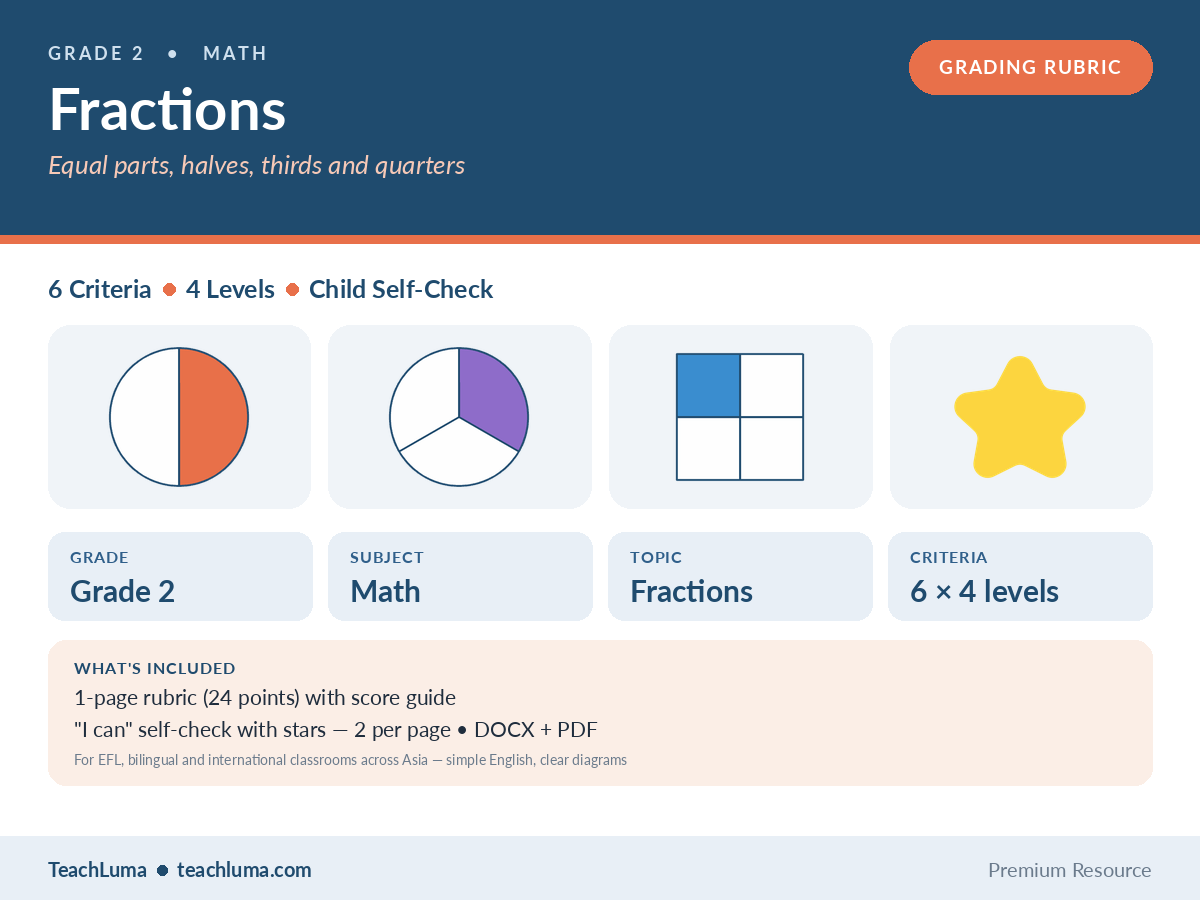
View Resource : Grade 2 Math Flashcards and Task Cards: Telling TimeA 6-criteria, 4-level rubric (24 points) for Grade 2 fractions — equal parts, naming fract...
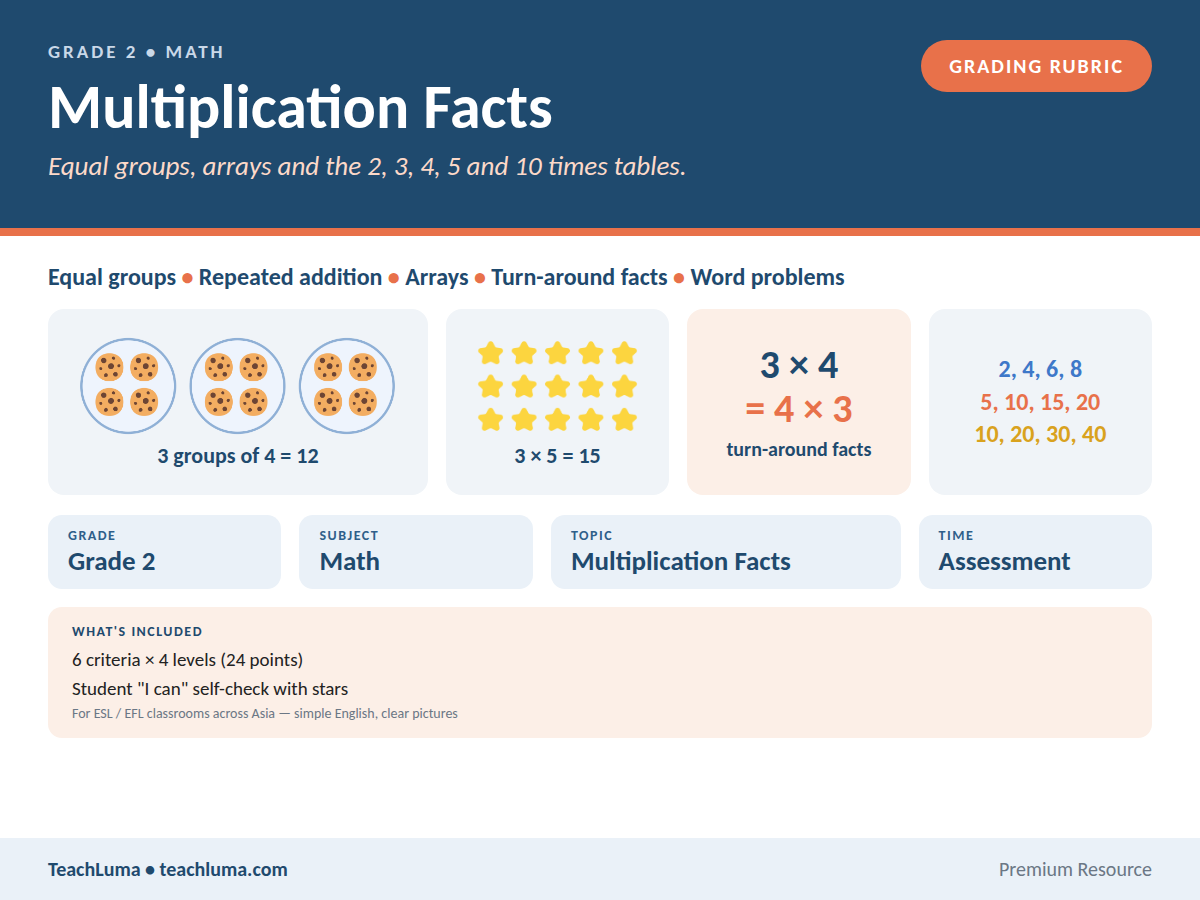
View Resource : Grade 2 Math Grading Rubric: Fractions + Student Self-CheckA 6-criteria, 4-level rubric (24 points) for multiplication — equal groups, arrays, 2s/5s/...
View Resource : Grade 2 Math Grading Rubric: Multiplication Facts + Student Self-CheckA 6-criterion, 4-level grading rubric for Grade 2 division (sharing, groups, writing facts...
View Resource : Grade 2 Math Grading Rubric: Division Facts — with Student Self-CheckA 6-criteria, 4-level rubric (24 points) for 3-digit addition and subtraction, with a teac...
View Resource : Grade 2 Math Grading Rubric: Add and Subtract within 1,000 + Student Self-CheckAdvertisement