Skip to content
Preview
Free Math Lesson Plan Grade 2
No ratings yet

Grade 2 Math Lesson Plan: Measuring Length — 3 Lessons with Timings

About This Resource

A 2-page, minute-by-minute plan for three 45-minute Grade 2 lessons on measuring length — compare and measure, use a ruler, and metres and length problems — plus a review and test lesson, board plan, prep checklist and a 5-minute daily routine.

Overview

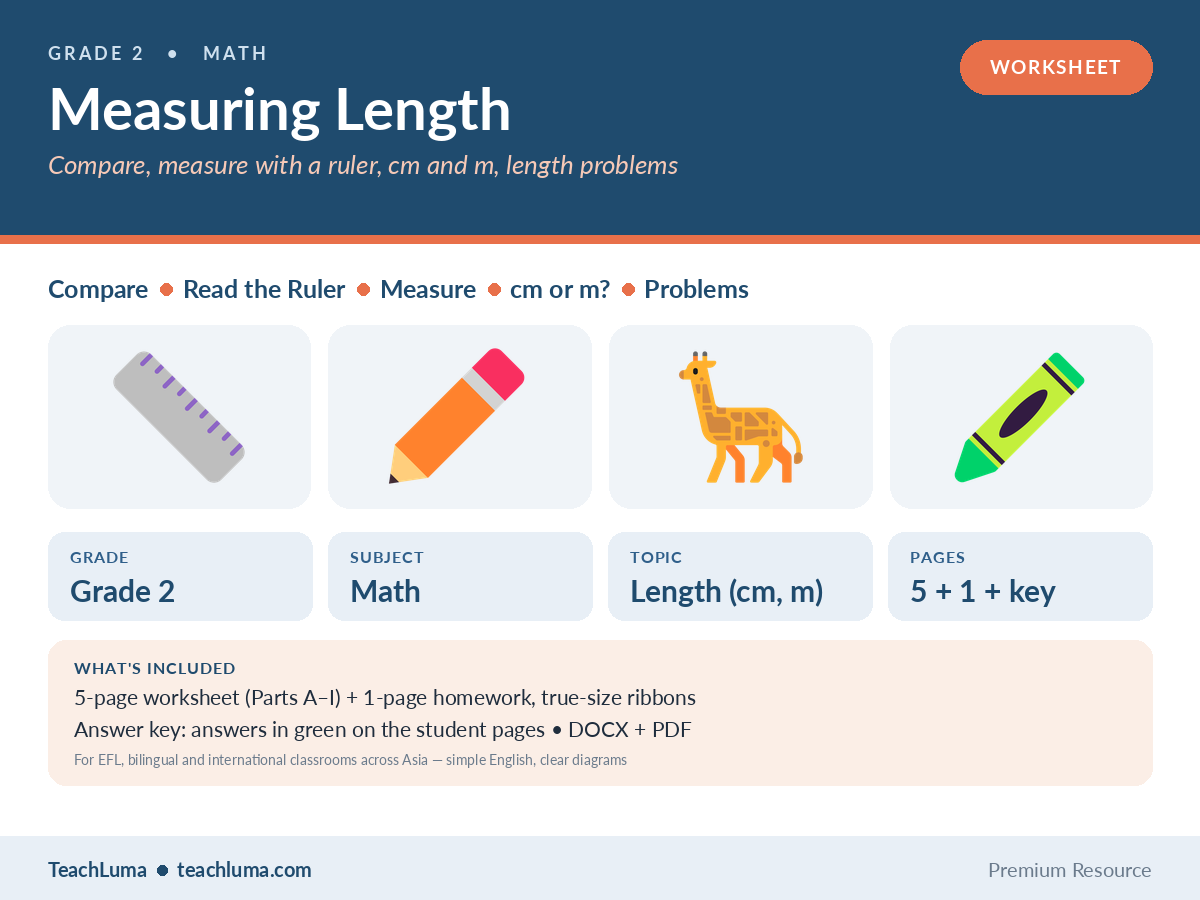
This pack teaches Grade 2 children to measure length in centimetres (cm) and metres (m). Children compare and order lengths (longer, shorter, taller, longest, shortest) and learn to line up the ends, measure with cubes and paper clips with no gaps, and see why we need the same unit. They then measure with a ruler by starting at 0, find the length of things that do not start at 0 (count the spaces, or end − start), measure and draw lines with a real ruler, and estimate in cm. Finally they learn that 1 m = 100 cm, choose cm or m, make sensible estimates, find how much longer one thing is than another, and solve add and take-away length problems. Every ruler picture is drawn to scale, and the ribbons to measure in the worksheet print at true size. The English is short and repeated, for ESL / EFL learners. This listing covers the Lesson Plan only.

Resource Details

Subject
Math
Topic
Measuring Length
Category
Measurement
File Type
PDF
File Size
53.9 KB
Published
07 Oct 2026
Downloads
0
Download

Free download — no account required.

Teaching this in class? Try our free Random Name Picker & Timer.

Share:

Looking for something different? Request a Resource.
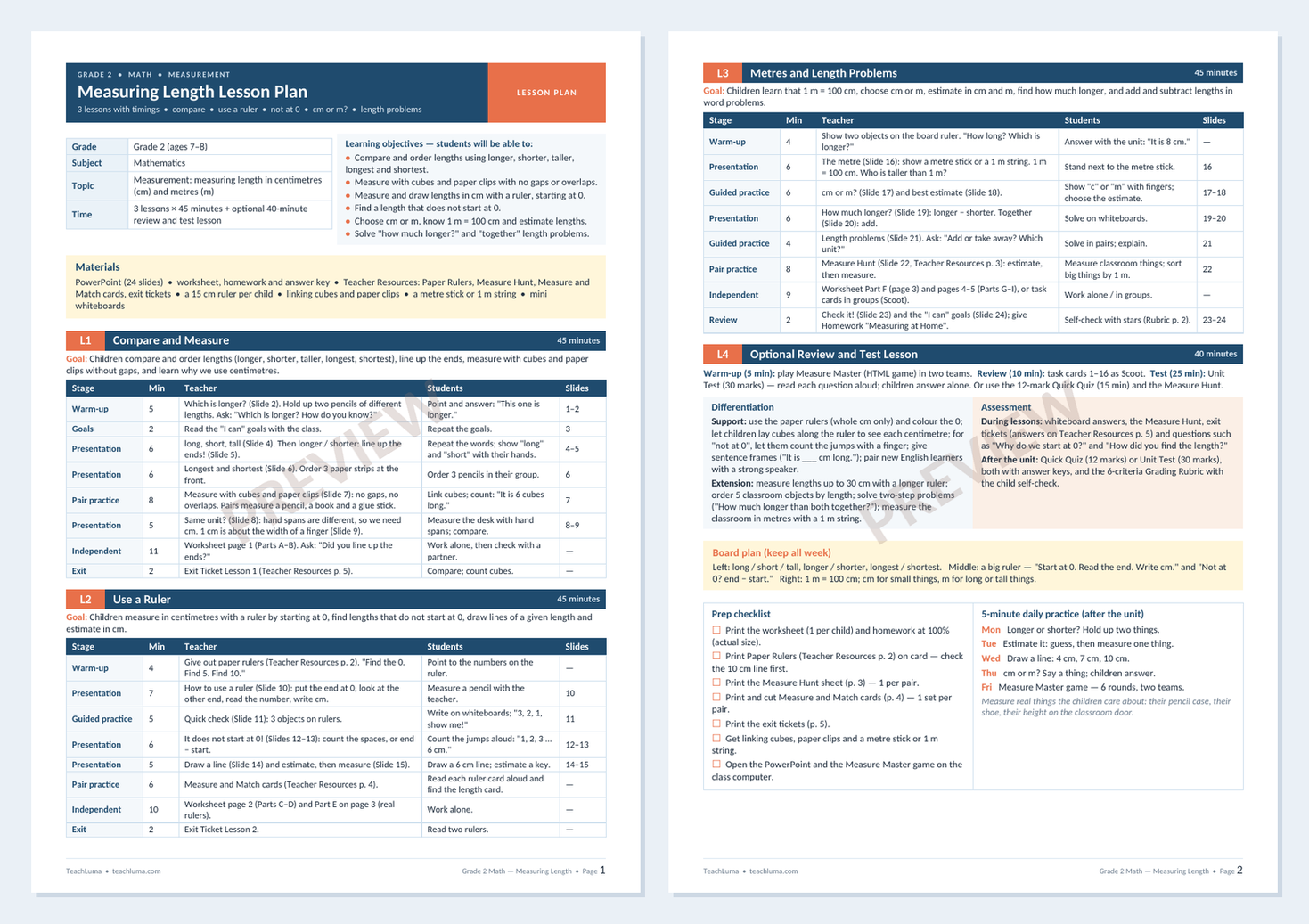

Grade 2 Lesson Plan Measuring Length

Learning Objectives

  • Compare and order lengths using longer, shorter, taller, longest and shortest, lining up the ends.
  • Measure with cubes and paper clips with no gaps or overlaps.
  • Measure and draw lengths in centimetres with a ruler, starting at 0.
  • Find a length that does not start at 0 by counting the spaces or end − start.
  • Choose cm or m, know that 1 m = 100 cm and make sensible estimates.
  • Find how much longer one length is than another.
  • Solve one-step add and take-away length problems and write the unit.

Lesson Procedure

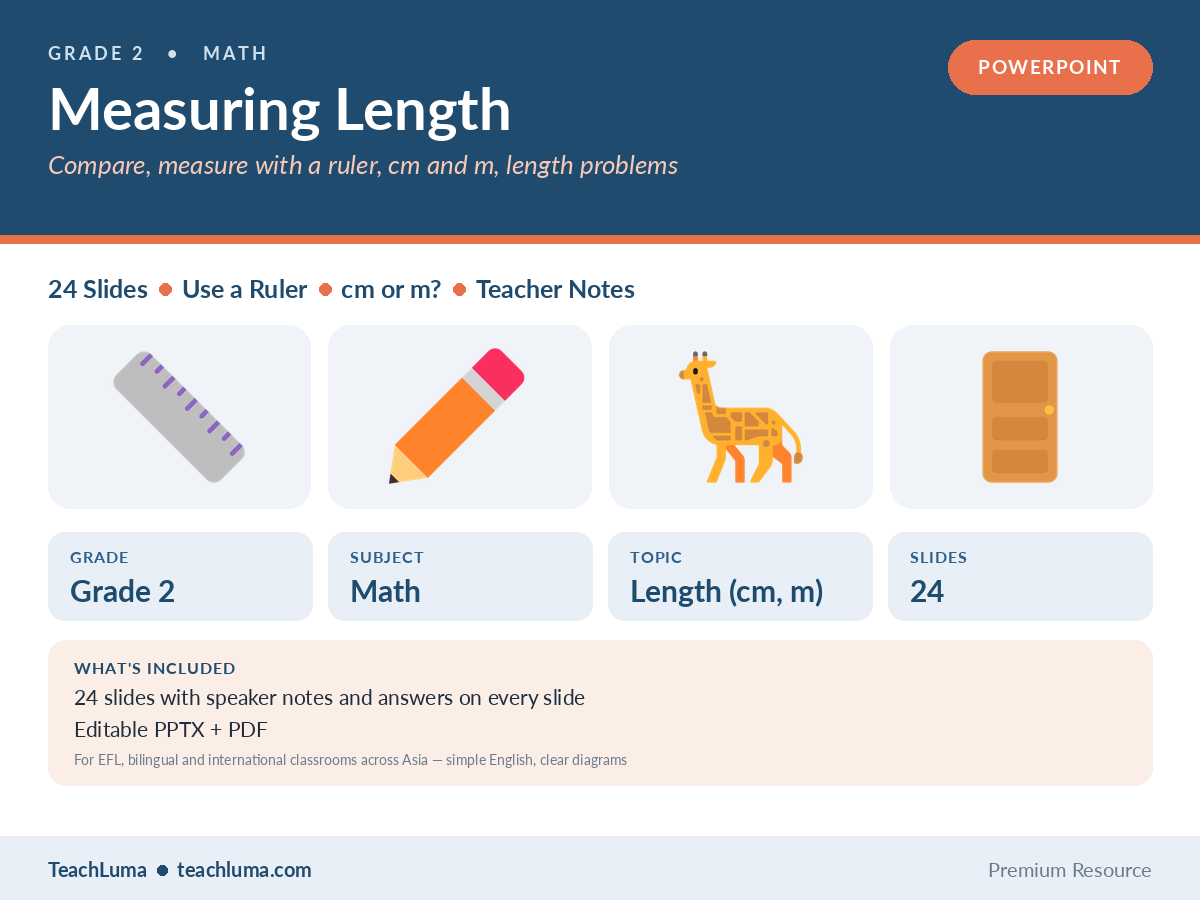
  • Teach the three lessons in order. Each lesson table shows the stage, minutes, what the teacher does, what students do and the matching PowerPoint slides. Lesson 1: longer and shorter, line up the ends, measuring with cubes and paper clips, why we use cm. Lesson 2: using a ruler from 0, lengths that do not start at 0, drawing lines and estimating. Lesson 3: 1 m = 100 cm, cm or m?, estimates, how much longer? and length problems. Use the optional fourth lesson for review and the test. Print the materials on the prep checklist the day before.

Assessment

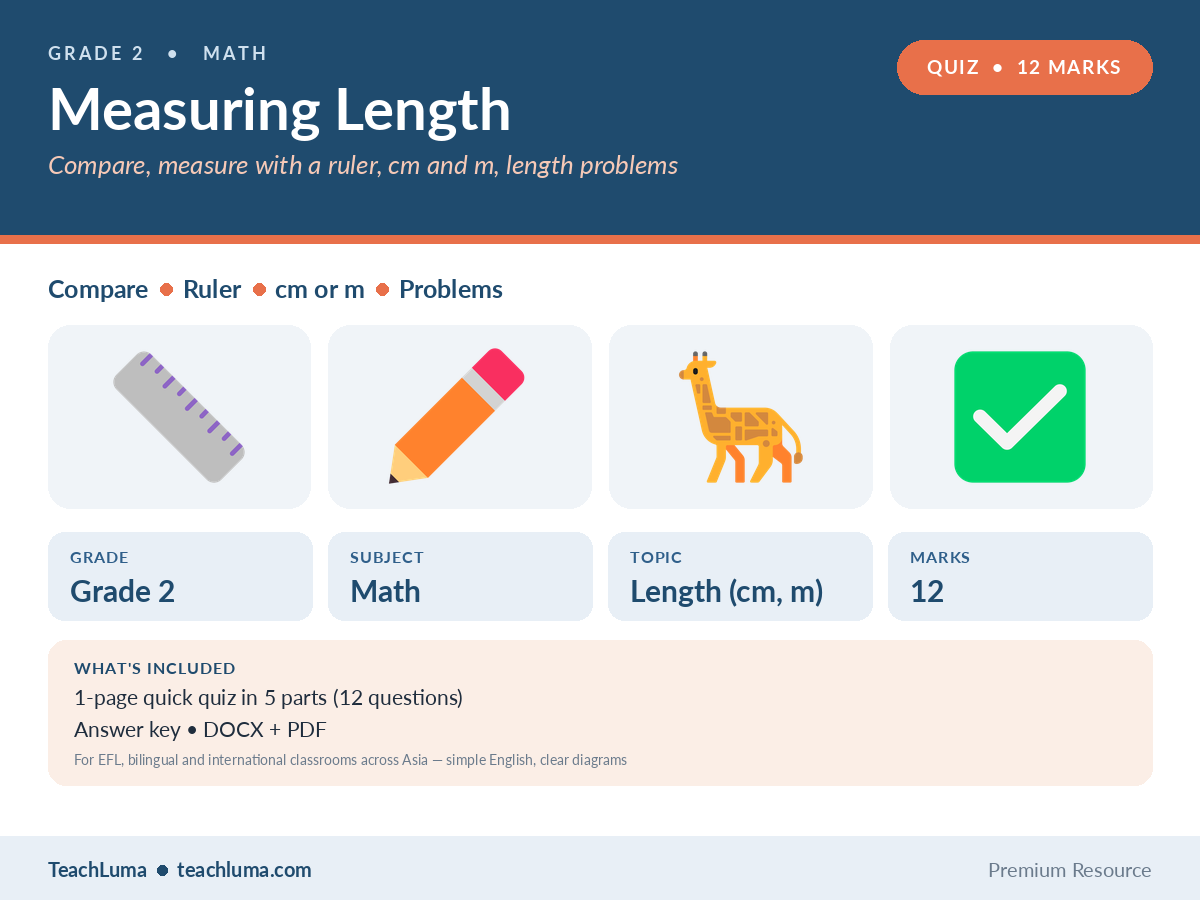
Use the exit tickets after each lesson, whiteboard answers during lessons, and the Quick Quiz or Unit Test after the unit.

Differentiation

Support: Use the paper rulers (whole centimetres only) and colour the 0. Let children lay cubes along the ruler to see each centimetre, and count the jumps with a finger when an object does not start at 0. Give sentence frames ("It is ___ cm long." "The ___ is longer than the ___." "We use cm / m."). Pair a child who is new to English with a partner who models the sentences.
Extension: Measure lengths up to 30 cm with a longer ruler, order 5 classroom objects by length, solve two-step problems, or measure the classroom in metres with a 1 m string. Fast finishers can play Measure Master (Length Problems mode) or do the My Body measuring task.

Classroom Activity Ideas

  • Line-up challenge: two children compare their pencils on the table edge and say which is longer.
  • Measure Hunt: pairs estimate, then measure classroom things.
  • Metre check: children stand next to a 1 m string — taller or shorter than 1 m?

Teacher Tips

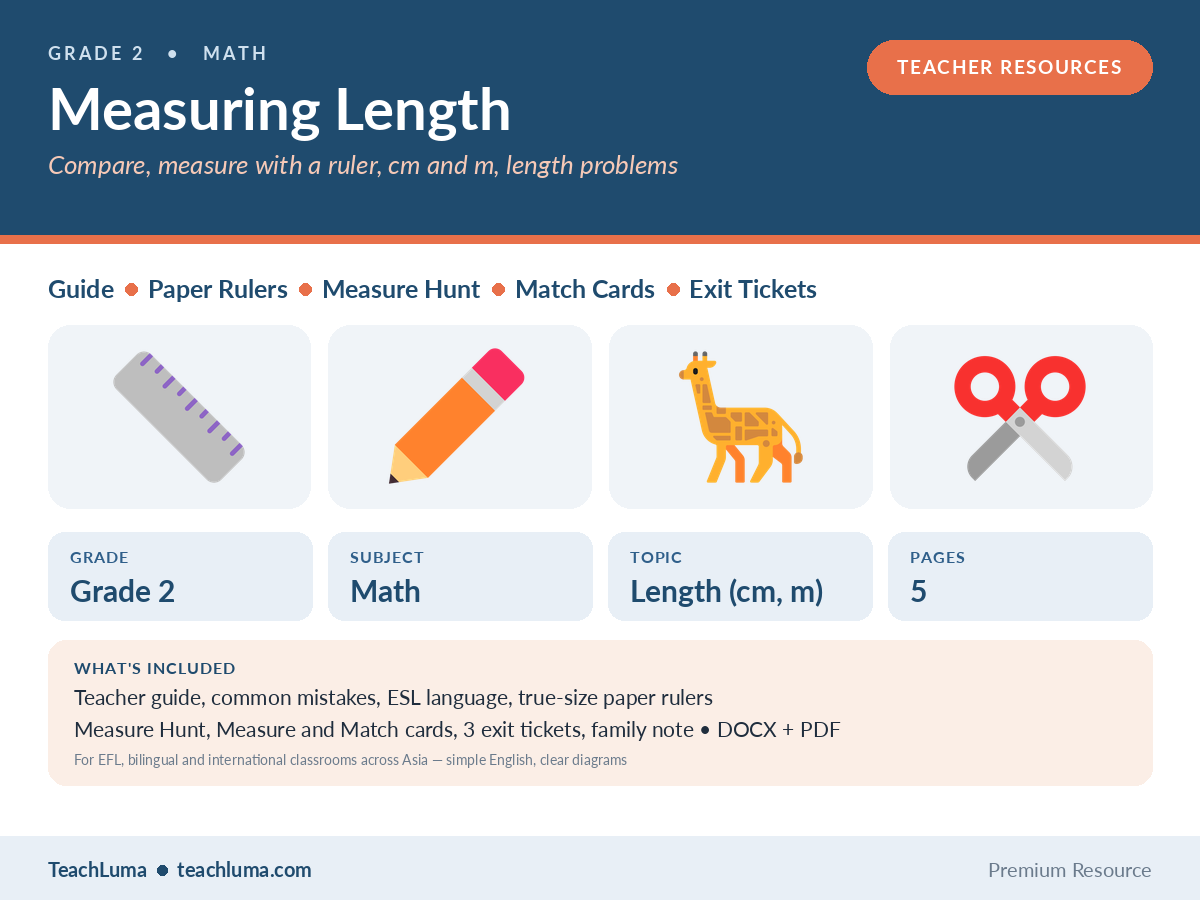
The two biggest ruler mistakes are starting at the edge of the ruler (or at 1) instead of 0, and writing the end number when the object does not start at 0. Before the first ruler lesson, let every child find the 0 on their own ruler and mark it with a dot of colour, and use the paper rulers in Teacher Resources for the first practice — they start exactly at 0 and show only whole centimetres. For "not at 0", have children put a finger on the start and count the jumps aloud: "1, 2, 3 … 6 — 6 cm." Ask "7 what?" every time a child forgets the unit. Print the worksheet at 100% (actual size) so the ribbons in Part E measure correctly with a real ruler.

What's Included

  • Lesson plan, 2 pages: objectives, 3 timed lessons, optional review and test lesson, differentiation, assessment, board plan, prep checklist and 5-minute daily routine (DOCX + PDF)

Additional Files


Teacher Reviews

No ratings yet

Be the first teacher to review this resource.

Sign in to review this resource.

Related Resources

Advertisement