Skip to content
Preview
Free Math Quiz Grade 2
No ratings yet

Grade 2 Math Quick Quiz: Telling Time (12 Marks)

About This Resource

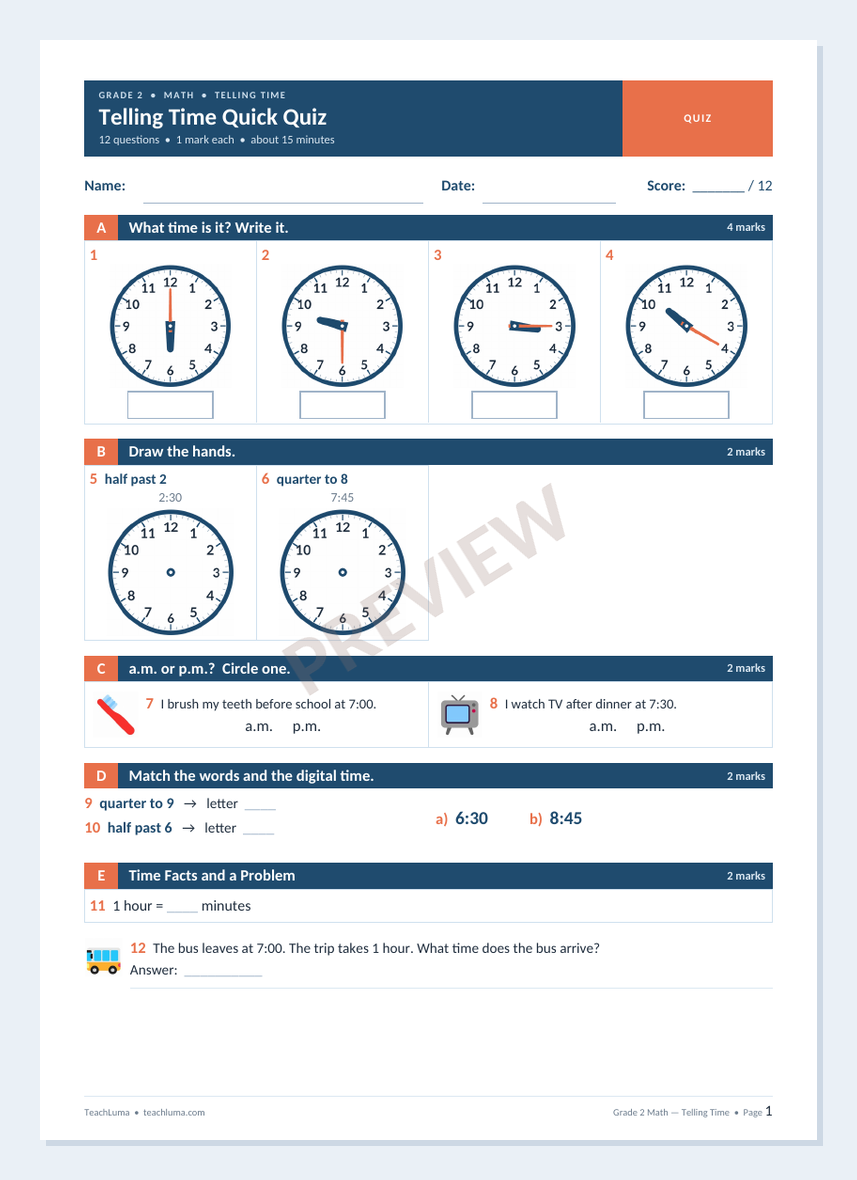
A 1-page, 12-mark quick quiz: write the time, draw the hands, a.m. or p.m., match words and digital times, and a time fact and problem — with a full answer key.

Overview

This pack teaches Grade 2 children to tell the time on a clock with hands and on a digital clock. Children learn the short hour hand and the long minute hand, then read, write and draw o'clock and half past times. They count by 5s around the clock, read quarter past and quarter to, and read and write any time to 5 minutes (7:25). Finally they use a.m. and p.m. for their own day, learn that 60 minutes = 1 hour and 24 hours = 1 day, and solve simple "1 hour later" problems. Every clock is drawn with exact angles, so at half past the hour hand sits exactly halfway between two numbers, and the same colors are used everywhere: navy hour hand, coral minute hand. The English is short and the same every time, for ESL / EFL learners, and the examples come from a school day in Asia (school bus, bento lunch, football after school). This listing covers the Quiz only.

Resource Details

Subject
Math
Topic
Telling Time
Category
Time & Money
File Type
PDF
File Size
123.5 KB
Published
05 Oct 2026
Downloads
0
Download

Free download — no account required.

Teaching this in class? Try our free Random Name Picker & Timer.

Share:

Looking for something different? Request a Resource.

Learning Objectives

  • Name the hour hand (short) and the minute hand (long), and read the hour hand first.
  • Read, write and draw o'clock and half past times (3:00, 3:30).
  • Read quarter past and quarter to times and write them as digital times (3:15, 3:45).
  • Count by 5s to read and write the time to 5 minutes on a clock and a digital clock (7:25).
  • Use a.m. and p.m. correctly for daily activities.
  • Know that 60 minutes = 1 hour, 30 minutes = half an hour and 24 hours = 1 day.
  • Solve simple problems: what time is it 1 hour, half an hour or 2 hours later?

How to Use This Resource

  • Use the quiz after Lesson 2 or Lesson 3 as a quick check. Read each part aloud with the class, then children answer alone. Mark with the answer key (1 mark per question).

Classroom Activity Ideas

  • Use it as a pre-test before the unit and again after it to show progress.
  • Let children swap and mark each other's quizzes while you read the answers.

Differentiation

Support: Let children keep their paper clock on the desk and move the hands for every question. Teach o'clock and half past well before quarter times and 5-minute times. Use the clock with the minute numbers (5, 10, 15 …) printed round the outside. Give sentence frames ("It is ___ o'clock." "It is half past ___.") and pair a child who is new to English with a partner who models the sentences.
Extension: Read times to 1 minute (7:23), find times 2 or 3 hours later, work out how long an activity takes (3:00 to 4:30), and make a timetable for a school day. Fast finishers can play Clock Challenge! in Mix mode.

Assessment

12 marks, 1 per question, with a complete, numbering-matched answer key. For questions 5–6 both hands must be right.

Teacher Tips

The most common mistake is at half past: children see the hour hand close to the next number and say "half past 5" for 4:30. Make one question a habit: "Has the hour hand got to 5 yet?" Move a paper clock slowly from 4:00 to 5:00 so children watch the hour hand travel. The second big mistake is reading the number under the minute hand as the minutes (7:05 for 7:25), so count by 5s with a finger every time until it is automatic. Many Asian textbooks say "half past" and "quarter to", while others say "three thirty"; teach both and accept both. Ask "What time is it now?" at the same moments every day (start of class, break, lunch) so time becomes everyday class English.

What's Included

  • Quick quiz, 1 page, 12 questions in 5 parts (DOCX + PDF)
  • Answer key, 1 page (DOCX + PDF)

Additional Files


Teacher Reviews

No ratings yet

Be the first teacher to review this resource.

Sign in to review this resource.

Related Resources

Advertisement