Grade 2
30-45 Minutes
Assessment
Area
Question Types & Suggested Use
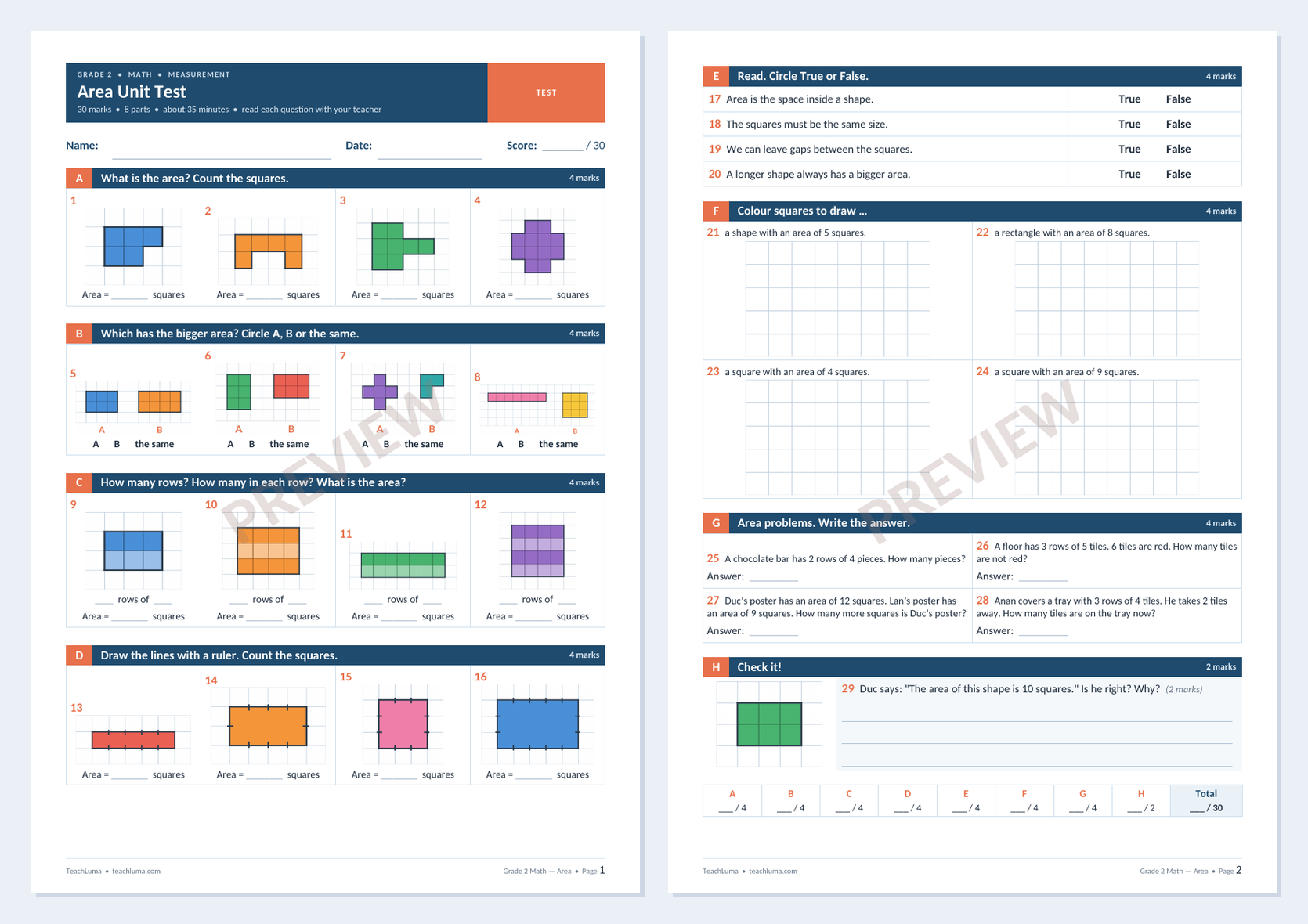
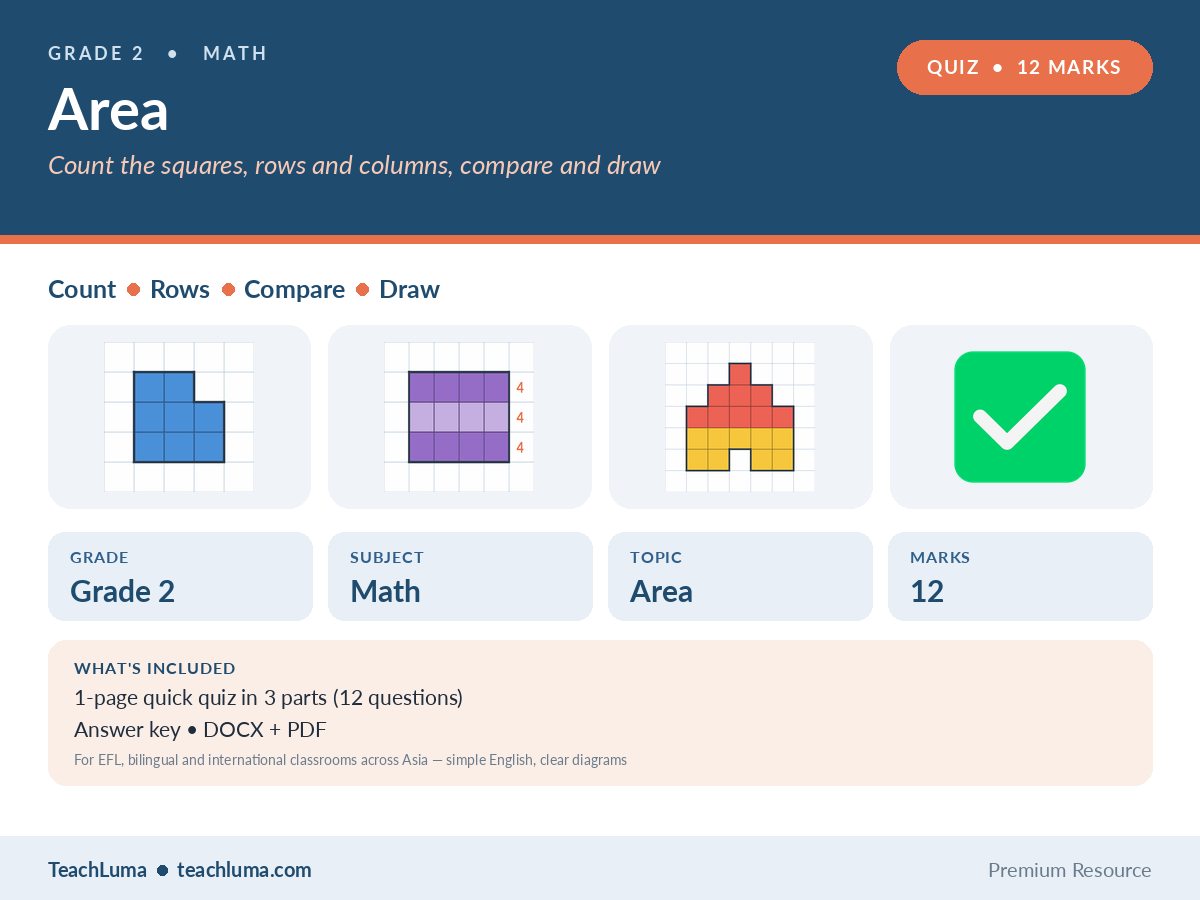
30 marks in 8 parts (29 questions; question 29 is worth 2 marks), with a score strip, performance bands, marking notes for the drawing questions and a complete, numbering-matched answer key.
Skills Assessed
- Say that area is the space inside a flat shape.
- Measure area fairly with same-size squares: no gaps and no overlaps.
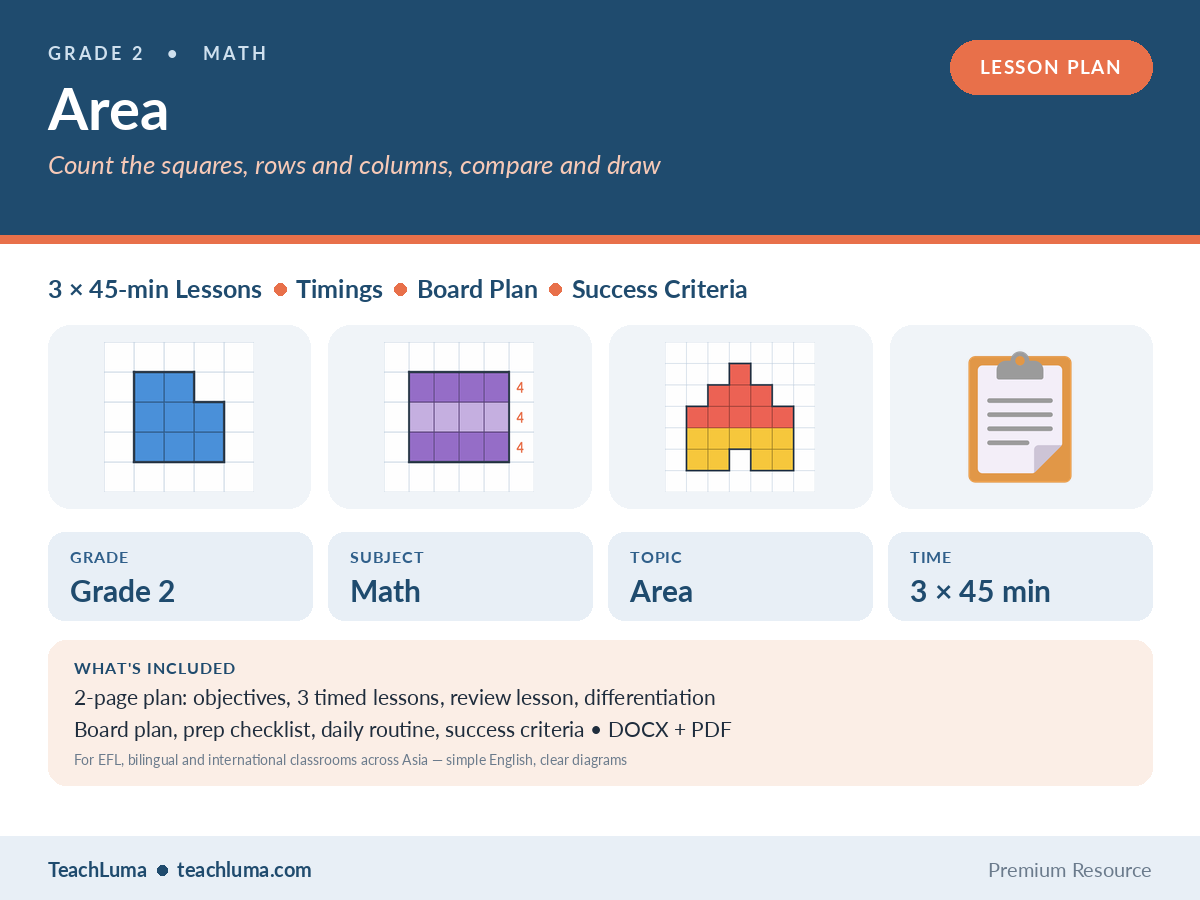
- Find the area of a shape by counting squares.
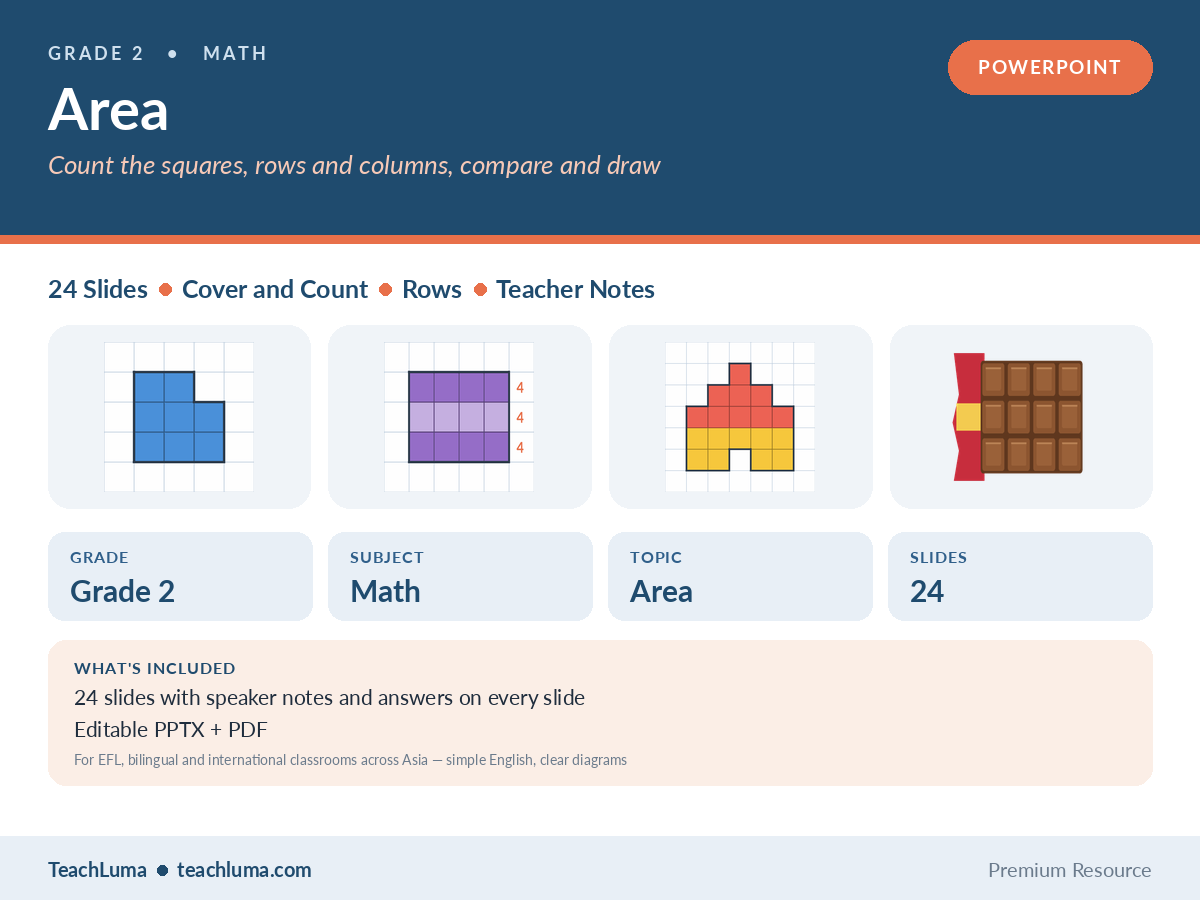
- Find the area of a rectangle by adding the rows (3 rows of 4 = 4 + 4 + 4 = 12).
- Split a rectangle into rows and columns of same-size squares and count them.
- Compare and order shapes by area, and know that different shapes can have the same area.
- Draw shapes with a given area and solve simple area problems.
How to Administer
- Use the test at the end of the unit (optional Lesson 4). Read each question aloud; children answer alone. Give each child a ruler for Part D. Mark with the answer key and fill in the score strip at the bottom of page 2
Differentiation
Support: Give paper squares or sticky notes to cover and count. Let children put a dot on each square as they count, and start with shapes of fewer than 10 squares. Keep the Area Helper poster on the desk. Give sentence frames ("The area is ___ squares." "It has ___ rows of ." " has the bigger area."). Pair a child who is new to English with a partner who models the sentences.
Extension: Find all the rectangles with an area of 12 squares (1 row of 12, 2 rows of 6, 3 rows of 4), draw 3 different shapes with an area of 7, estimate and then measure the area of a desk in sticky notes, or make a pixel picture with an area of exactly 20 squares. Fast finishers can play Area Explorer (Rows and Columns or Area Problems mode).
Follow-Up Activities
- Use the performance bands in the answer key to make small groups for reteaching.
- Part H shows quickly which children still count around the edge instead of the squares inside.
Teacher Tips
The most common Grade 2 area mistake is counting the little lines around the edge instead of the squares inside (this gives the perimeter, not the area). Ask children to put a dot in every square they count, and to trace the edge with a finger only to show what area is NOT. Start with real covering — sticky notes or paper squares on a book — before squared paper, so children see why the squares must be the same size with no gaps and no overlaps. When rectangles get bigger, move children from counting one by one to adding the rows: "4, 8, 12" is faster and is the first step towards multiplication.
What's Included
- Unit test, 2 pages, 8 parts, 30 marks, score strip (DOCX + PDF)
- Answer key with marking notes and performance bands, 2 pages (DOCX + PDF)
Additional Files
-
Grade 2 Math Unit Test: Area (30 Marks) (DOCX)
-
Answer Key (PDF)