Skip to content
Preview
Free ESL Grading Rubric Grade 4 (Year 5)
No ratings yet

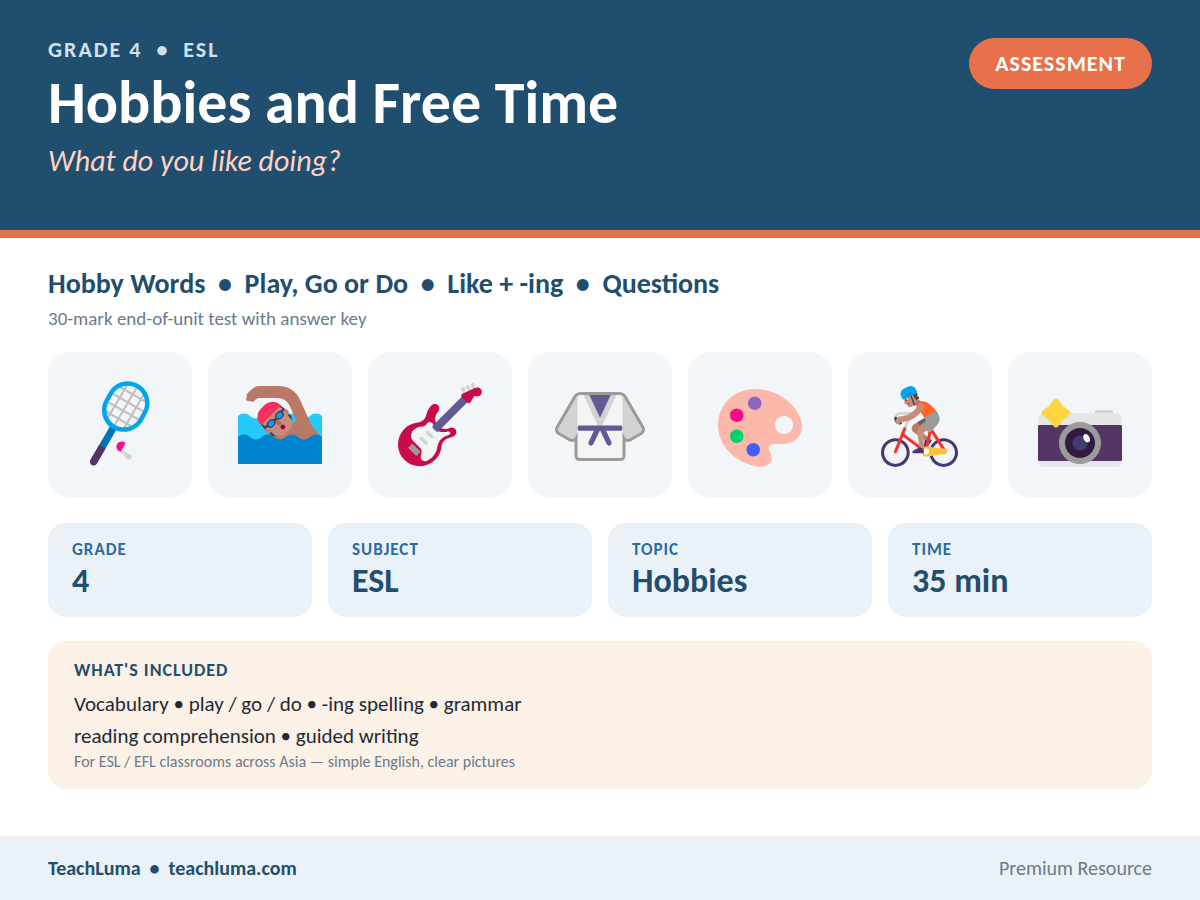
Grade 4 ESL Grading Rubric: Hobbies and Free Time — Writing and Speaking

About This Resource

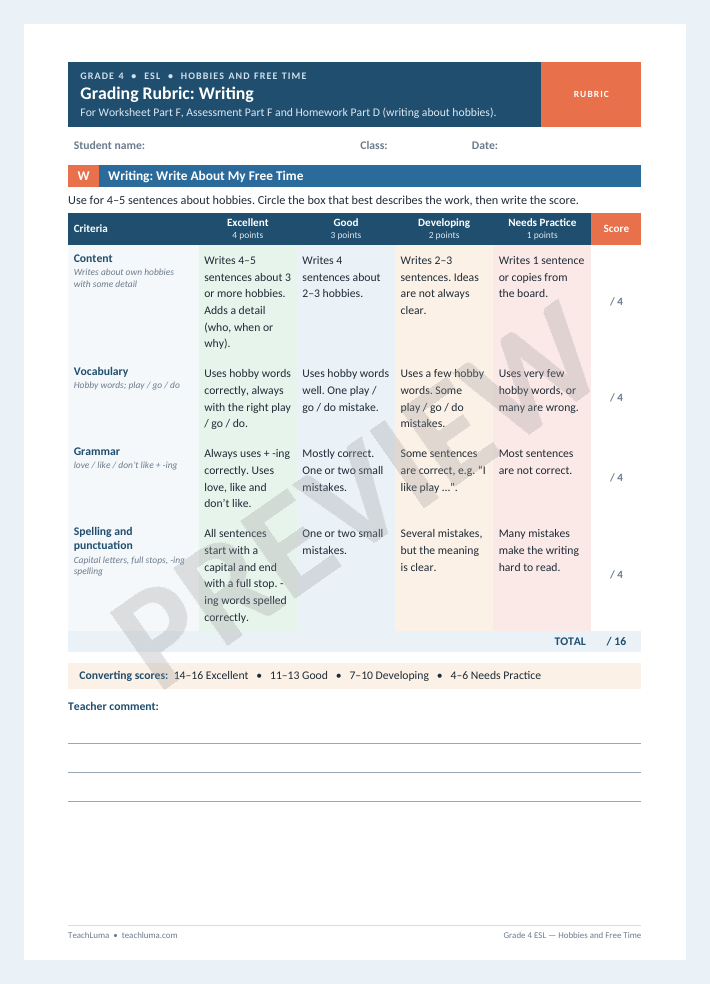
Two one-page rubrics for the hobbies unit: writing (content, vocabulary, grammar, spelling) and speaking (asking, answering, pronunciation, reporting), each on a 4-level scale out of 16.

Resource Details

Subject
ESL
Topic
Hobbies and Free Time
Category
Assessments
File Type
PDF
File Size
75.1 KB
Published
23 Sep 2026
Downloads
10
Download

Free download — no account required.

Teaching this in class? Try our free Random Name Picker & Timer.

Share:

Looking for something different? Request a Resource.


Grade 4 Grading Rubric Hobbies and Free Time

How to Use This Resource

  • Print one copy per student. Circle the box that best describes the work in each row, add the scores, and use the score guide to give a level. The writing rubric fits Worksheet Part F, Assessment Part F and Homework Part D; the speaking rubric fits the Find Someone Who survey.

Classroom Activity Ideas

  • Show students the "Excellent" column before they write, so they know what a good answer looks like.
  • Use the speaking rubric for a quick 1-to-1 check while the class works on the worksheet.

Differentiation

Support: Give weaker students the word bank with the first letter of each answer circled; let them keep the PLAY / GO / DO rule box and face cards on their desk; use the sentence frame "In my free time, I love ____. I like ____. I don't like ____." for writing.

Extension: Ask students to add a reason with "because"; add a time phrase from the Daily Routines unit ("I go cycling every Sunday."); challenge them to find 3 new hobbies with play / go / do (e.g. play basketball, go camping, do yoga).

Assessment

Each rubric gives a score out of 16 and a level: Excellent, Good, Developing or Needs Practice

Teacher Tips

The most common mistake in this unit is "I like play football." Many learners in Asia translate directly from their first language, where the verb does not change. Give the -ing ending a hand signal: when you say "like", stretch your hands apart as you say "play-iiing". Students copy the signal when they speak, and they quickly start to correct each other.

Additional Files


Teacher Reviews

No ratings yet

Be the first teacher to review this resource.

Sign in to review this resource.

Related Resources

Advertisement