Grade 5 Travel and Transportation Lesson Plan: How Do You Get There?
About This Resource
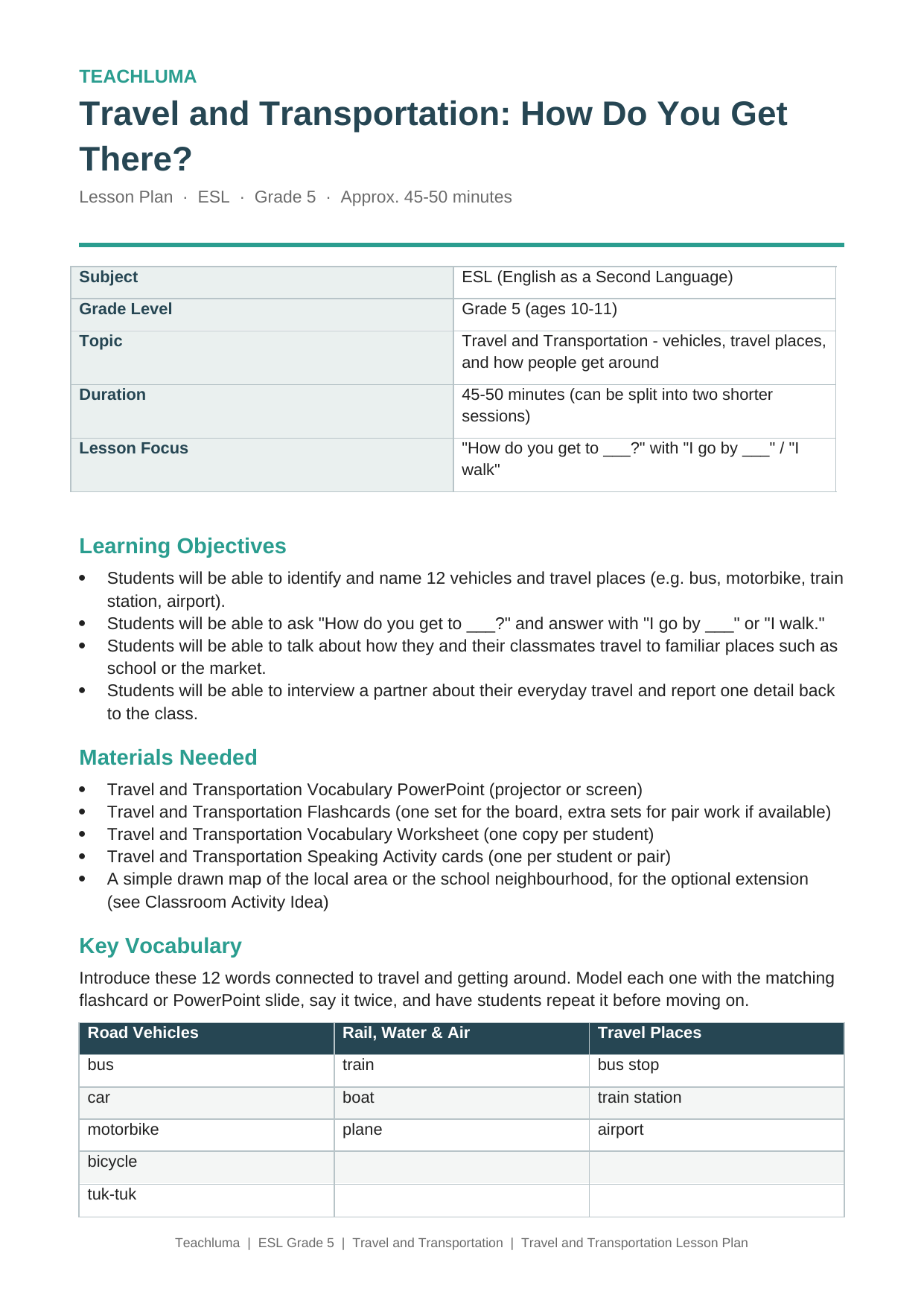
A complete 45-50 minute lesson plan for introducing vehicle and travel-place vocabulary and the question "How do you get to ___?" to Grade 5 English learners. It walks a teacher step by step from warm-up through vocabulary presentation, guided practice, a paired interview activity, and a wrap-up review, and it is written for classrooms where English is a second or foreign language, so every step includes exactly what to say and do.
Overview
This lesson plan brings together the other Travel and Transportation resources (the Vocabulary PowerPoint, Flashcards, Vocabulary Worksheet, and Speaking Activity) into a single, ready-to-teach sequence. It is built around 12 core words for vehicles and travel places - from "motorbike" to "airport" - and the question pattern "How do you get to ___?" together with its two kinds of answer: "I go by ___" for a vehicle and "I walk" / "I go on foot" for travelling without one. Each stage of the lesson has a clear time allocation, a short list of teacher actions, and built-in checks for understanding, so a teacher can pick it up and teach directly from the page. A differentiation table and an assessment section are included, along with a teacher's tip, a classroom activity idea, and a blank reflection-notes section at the end.
Resource Details
- Subject
- ESL
- Topic
- Travel and Transportation
- Category
- Lesson Plans
- File Type
- File Size
- 69.5 KB
- Published
- 05 Sep 2026
- Downloads
- 0
Free download — no account required.
Learning Objectives
- Students will be able to identify and name 12 vehicles and travel places.
- Students will be able to ask "How do you get to ___?" and answer with "I go by ___" or "I walk."
- Students will be able to talk about how they and their classmates travel to familiar places such as school or the market.
- Students will be able to interview a partner about their everyday travel and report one detail back to the class.
Lesson Procedure
- Read through the lesson plan once before class and gather the materials listed (the Vocabulary PowerPoint, a set of Flashcards, copies of the Vocabulary Worksheet, and Speaking Activity cards - all sold separately as part of this Travel and Transportation collection). Teach the five stages in order: Warm-Up, Vocabulary Presentation, Guided Practice, Main Activity, and Wrap-Up/Review. The lesson is designed for a single 45-50 minute class period but can be split across two shorter sessions if your school's timetable requires it. Use the differentiation table to adjust support for English learners who need extra scaffolding and for students ready for an extra challenge. Fill in the Teacher Reflection Notes section after teaching to help plan your next lesson on this topic.
Assessment
Assessment is built into the lesson through teacher observation during Guided Practice and the Speaking Activity, plus the completed Vocabulary Worksheet as an informal written check. For a more formal record of student performance on this topic, use the companion Travel and Transportation Grading Rubric.
Differentiation
SUPPORT: Pair English learners with a supportive partner, keep the flashcards visible on the board as a picture word bank throughout the lesson, and allow students to point to the matching flashcard before saying the full question or answer.
ON-LEVEL: Students complete the Speaking Activity and Vocabulary Worksheet as planned, using the sentence frames "How do you get to ___?" and "I go by ___" / "I walk."
CHALLENGE: Ask students to add a reason to each answer (for example, "I go by bicycle because it is fast and I like it.") or to compare two vehicles aloud (for example, "The train is faster than the bus, but the bus stops nearer my house.").
Classroom Activity Ideas
- Try "Class Travel Map": draw a simple map of the school neighbourhood on the board with a few labelled places (school, market, bus stop, river or coast if relevant). In small groups, students take turns choosing two places and asking a partner "How do you get from the school to the market?", answering with a vehicle word. This extends the lesson with a light mapping element and works well when there is a little extra time at the end of class.
Teacher Tips
Keep the flashcards for the vehicles and the travel places in two separate groups on the board for the whole lesson. Seeing the two groups side by side helps students notice, without being told directly, that vehicle words pair with "by" and that on-foot travel does not - a small pattern that is easy to say once but takes several repetitions for English learners to use correctly on their own.
What's Included
- 3-page lesson plan (editable and print-ready)
- Editable DOCX version
- Print-ready PDF version
Additional Files
Teacher Reviews
No ratings yet
Be the first teacher to review this resource.
Related Resources
Lesson Plan | ESL | Grade 6 | Unit 2: School Life & Learning Skills
Lesson Plan · School Life & Learning Skills
A five-lesson teaching sequence mapping all eleven other Unit 2 resources into approximate...
View ResourceUnit 1 Lesson Plan — Personal Identity & Communication
Lesson Plan · Personal Identity & Communication - Lesson Plan
A five-lesson teaching sequence mapping all eleven other Unit 1 resources into approximate...
View ResourceUnit 2 Teacher's Guide — School Life & Learning Skills
Teacher Resource · School Life & Learning Skills
A reference document covering a resource-by-resource guide, common student grammar errors ...
View ResourceUnit 1 Teacher's Guide — Personal Identity & Communication
Teacher Resource · Teacher's Guide
A reference document covering a resource-by-resource guide, common student grammar errors ...
View ResourceGrade 5 Free Time and Hobbies Lesson Plan
Lesson Plan · Free Time and Hobbies
A complete 40–45 minute lesson plan that introduces 12 free-time activities and hobbies, t...
View ResourceGrade 4 Jobs and Community Helpers Lesson Plan
Lesson Plan · Jobs and Community Helpers
A complete 40-45 minute lesson plan that teaches 12 jobs and community helpers alongside t...
View Resource