Grade 7
45-55 Minutes
Assessment
Conversation Skills
Question Types & Suggested Use
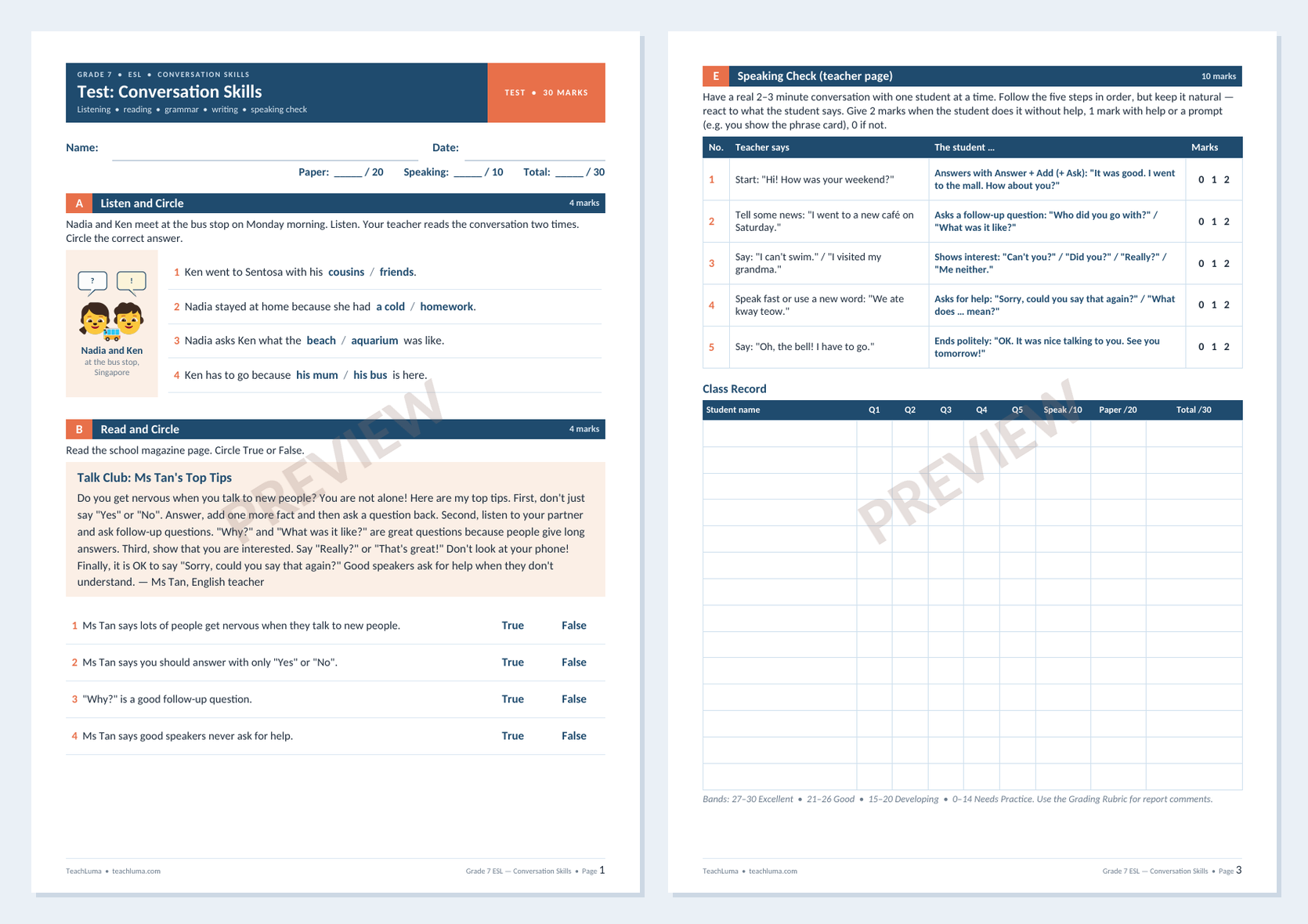
The answer key gives every answer, short reasons for the False items, a 3-part writing guide (conversation skills, grammar, layout) with a model answer, a 0 / 1 / 2 guide for each speaking step and grade bands (27–30, 21–26, 15–20, 0–14).
Skills Assessed
- Start a conversation with a classmate or a new student, and reply naturally to common openers ("How was your weekend?" – "It was great! I went to the beach. How about you?").
- Tell open and closed questions apart and turn yes / no questions into open questions that keep a conversation going.
- Use the Answer + Add + Ask pattern and ask follow-up questions with Who, What, Where, When, Why and How.
- Show interest with reactions (Really? / That's great! / Oh no!), reply questions (Are you? / Did you? / Can't you?) and Me too / Me neither.
- Ask for help when they do not understand (Sorry, could you say that again? / What does … mean? / How do you spell that?), take turns and finish a conversation politely.
- Read two conversations and say why one works better, then write and perform a conversation of 12–14 lines.
How to Administer
- Read the listening script (in the answer key) two times at a natural, slow speed — two voices if you can. While the class does the paper, call students one at a time for the speaking check on page 3: follow the five steps, react naturally and record scores on the class record sheet.
Differentiation
Support
Give students the phrase cards (or a printed copy of the 20 key phrases) to keep on the desk for every speaking activity and for Worksheet Parts A, E and G. Teach Answer + Add + Ask with a fixed frame first: "Yes, I do. I ___. How about you?" For follow-up questions, start with only Who? Where? and What was it like?, then add When, Why and How. For reply questions, give the "same verb" hint: I'm → Are you? / I went → Did you? Let weaker students be the observer in the Speed Chat first, so they hear the language before they use it, and pair them with a patient partner for the role cards.
Extension
Students try to keep a Speed Chat going for two minutes without a silence longer than three seconds, and use at least two reply questions and one "What does … mean?". They add longer reactions (That sounds amazing! / Lucky you! / What a shame!) and more ways to finish (Anyway, I'd better go. / Catch you later!). Strong writers write a "bad" and a "good" version of the same conversation, like the Two Conversations reading, and perform both for the class, who must name the skills in the good version. Fast finishers write three new topic cards with an opener and two follow-up questions each.
Follow-Up Activities
- Practise the five speaking steps in pairs the lesson before the test.
- Students who finish early do Speed Chat quietly with the challenge cards.
Teacher Tips
Many students in Asian classrooms were taught that a short, correct answer is the polite answer — so "Yes." and "It's OK." feel safe, even when they kill the conversation. Say this out loud in Lesson 1: in English conversation, a one-word answer can sound unfriendly, and adding one more sentence is the polite thing to do. Then make Answer + Add + Ask a classroom habit, not just a lesson: hold up three fingers whenever a student gives a one-word answer, and wait. Within a week, students start adding the second and third finger themselves. Keep a "conversation tally" on the board in every lesson (follow-up questions, reactions, reply questions) and let groups compete — what you count, they practise.
What's Included
- Test, 3 pages: paper (2 pages), speaking check + class record (DOCX + PDF)
- Answer key with listening script and writing guide, 1 page (DOCX + PDF)
Additional Files
-
Grade 7 ESL Test: Conversation Skills — Paper and Speaking Check (30 Marks) (DOCX)
-
Answer key (PDF)