Skip to content
Preview
Members Only ESL Worksheet Grade 9
No ratings yet

Grade 9 Giving Opinions and Persuasive Language Worksheet

About This Resource

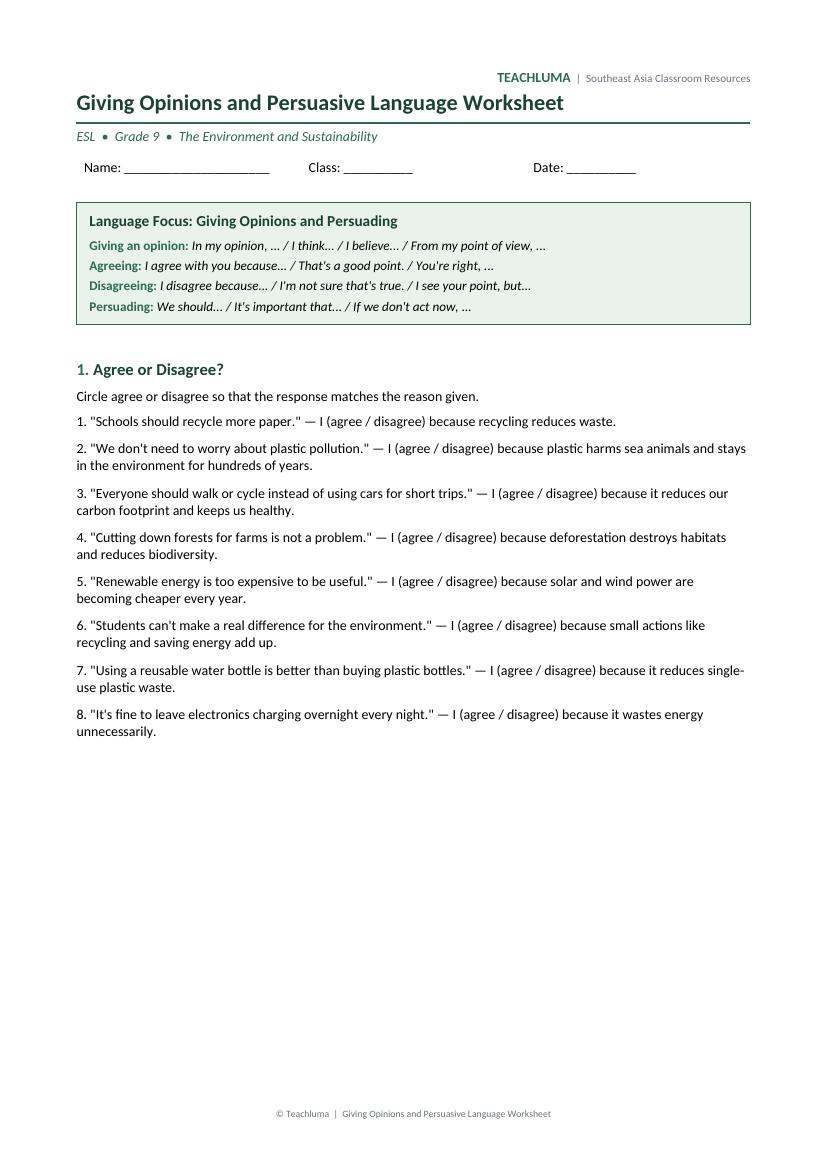
A three-page grammar and functional-language worksheet teaching Grade 9 ESL students how to give opinions, agree, disagree, and persuade in English, with practice ranging from guided recognition to freer persuasive writing.

Overview

This worksheet teaches the sentence frames students need for opinion-giving and simple persuasion: phrases for stating an opinion (In my opinion / I think / I believe), agreeing, disagreeing, and persuading (We should... / It's important that...). After a clear rule box introducing each category, students move through four exercises of increasing difficulty: deciding whether they agree or disagree with a series of statements, choosing the best phrase to complete six sentences, rewriting six blunt statements to make them more persuasive, and responding to three short real-world case studies using the target language. The progression from recognition to guided practice to freer writing gives students multiple chances to internalise the language before using it independently.

Resource Details

Subject
ESL
Topic
Giving Opinions and Persuasive Language
Category
Grammar
File Type
PDF
File Size
45.8 KB
Published
06 Sep 2026
Downloads
0

Members Only

Upgrade to Teacher Pro (from ฿199/month) to download this resource.

Share:

Looking for something different? Request a Resource.


Student Task

  • Present the rule box on page 1 first, modelling each phrase category with a simple example of your own before students begin. Exercises 1 and 2 work well as independent or pair work with clear right answers to check. Exercise 3 (Make It More Persuasive) is more open-ended — circulate while students work and be ready to accept a range of correct rewrites, not just one model answer. Exercise 4's case studies are best done in pairs or small groups so students can discuss their response before writing it down.

Classroom Use

  • Turn Exercise 4's case studies into a mingling activity: give each student one case study and have them find a partner, share their opinion out loud using a phrase from the rule box, then swap case studies and find a new partner.

Differentiation

SUPPORT: Allow students to keep the rule box visible while completing Exercises 3 and 4, and accept shorter, simpler rewrites in Exercise 3 as long as the persuasive language is used correctly.
ON-LEVEL: Students complete all four exercises independently or in pairs as designed.
CHALLENGE: Ask students to add a second persuasive sentence to each of their Exercise 3 rewrites, or to write a one-sentence counter-argument to their own response in Exercise 4.

Answer Key & Assessment

Check Exercises 1 and 2 against the answer key for accuracy. Review Exercises 3 and 4 for correct and natural use of opinion or persuasive language rather than a single fixed answer — award credit for any response that uses the target structures appropriately.

Learning Objectives

  • Students will be able to identify and use phrases for giving an opinion.
  • Students will be able to agree or disagree with a statement using appropriate language.
  • Students will be able to rewrite a blunt statement as a persuasive one.
  • Students will be able to respond to a real-world scenario using opinion and persuasive language.

Teacher Tips

When checking Exercise 1 (Agree or Disagree), ask a few students to explain why they chose agree or disagree, not just which one they chose — it's a natural, low-pressure way to get spoken opinion language flowing before the writing exercises.

What's Included

  • 3-page student worksheet
  • Editable DOCX version
  • Print-ready PDF version
  • Answer key (where answers are fixed)

Additional Files

  • Giving Opinions and Persuasive Language Worksheet.docx (DOCX)
  • Answer Key (Printable) (PDF)

Teacher Reviews

No ratings yet

Be the first teacher to review this resource.

Sign in to review this resource.

Related Resources

Advertisement