Skip to content
Preview
Members Only ESL Complete Lesson Pack Grade 6 (Year 7)
No ratings yet

Hear the Beat: Rhyme and Rhythm in Poetry

About This Resource

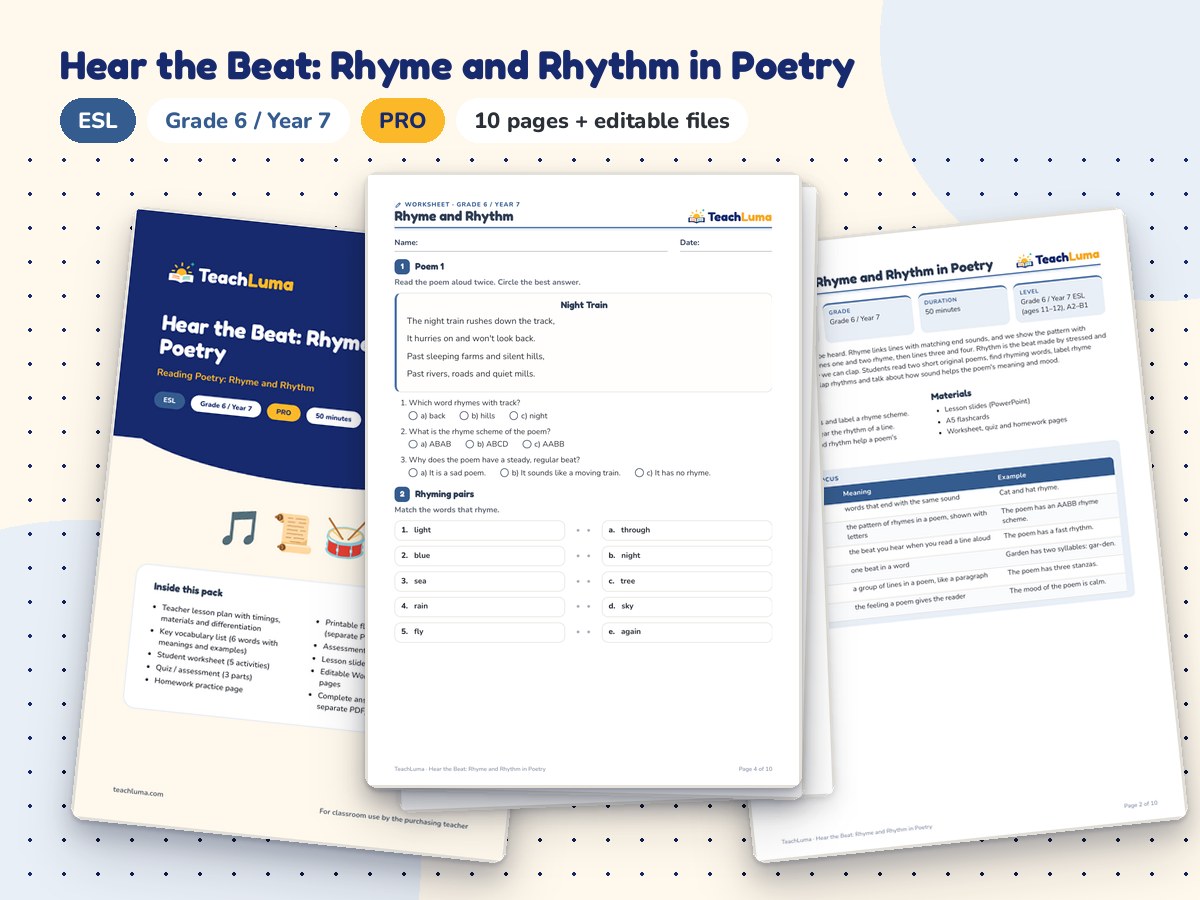
A complete Grade 6 ESL reading pack on how poems use sound. Students learn about rhyme, rhyme scheme (AABB and ABAB), stanzas, syllables and rhythm, then read two original poems, label their rhyme schemes, clap the beat and answer questions about meaning. Includes slides, a lesson plan, worksheet, quiz, homework, A5 flashcards, a rubric, Word files and answer keys.

Overview

Many poems are written to be heard. Rhyme links lines with matching end sounds, and we show the pattern with letters: in an AABB poem, lines one and two rhyme, then lines three and four. Rhythm is the beat made by stressed and unstressed syllables, which we can clap. Students read two short original poems, find rhyming words, label rhyme schemes, count syllables, clap rhythms and talk about how sound helps the poem's meaning and mood.

Resource Details

Subject
ESL
Topic
Reading Poetry: Rhyme and Rhythm
Category
Reading
File Type
PDF
File Size
316.1 KB
Published
13 Nov 2026
Downloads
0

Members Only

Create a free account to download this resource with one of your 3 Free Pro Previews, or upgrade to Teacher Pro (from ฿199/month) for the whole library.

Share:

Looking for something different? Request a Resource.

Grade 6 ESL (ages 11–12), A2–B1 50 minutes Reading listening speaking pronunciation

Learning Objectives

  • Identify rhyming words and label a rhyme scheme.
  • Count syllables and hear the rhythm of a line.
  • Explain how rhyme and rhythm help a poem's meaning and mood.

How to Use This Resource

  • Clap a simple rhythm and ask students to copy it. Ask: "Where do we hear beats like this in language?"
  • Teach rhyme scheme and rhythm with the slides. Read the first poem aloud together.
  • Students complete activities 3 to 6. Use the quiz and send the homework page home.

Classroom Activity Ideas

  • Clap and read: the class reads a poem while clapping on the strong beats.
  • Rhyme chains: students take turns adding a rhyming word until someone gets stuck.
  • Poem performance: groups perform a poem with actions and different voices.

Differentiation

Support: give students the rhyming pairs highlighted in color and let them label the letters. Challenge: students write a four-line stanza in ABAB rhyme and explain the effect of its rhythm.

Assessment

Use the worksheet and quiz to check rhyme schemes and syllables. Use the rubric for the poem performance.

Teacher Tips

Rhyme is about sound, not spelling: blue and through rhyme, but cough and though do not. Read each poem aloud several times before analysis; ESL students need to hear the beat before they can describe it.

What's Included

  • 10-page printable PDF lesson pack: teacher lesson plan with timings, materials and differentiation
  • Key vocabulary list (6 words with meanings and examples)
  • Student worksheet (5 activities)
  • Quiz / assessment (3 parts)
  • Homework practice page
  • Printable flashcards: 6 A5 picture cards (separate PDF)
  • Assessment rubric (4 levels)
  • Lesson slides (editable PowerPoint)
  • Editable Word version of all student pages
  • Complete answer key (also as a separate PDF)

Additional Files

  • Lesson Slides (PPTX)
  • Editable Student Pages and Lesson Plan (DOCX)
  • A5 Flashcards (PDF)
  • Answer Key (PDF)

Teacher Reviews

No ratings yet

Be the first teacher to review this resource.

Sign in to review this resource.

Related Resources

Advertisement