Skip to content
Preview
Free Math Worksheet Grade 6 (Year 7)
No ratings yet

How Far Is It Really? Map Scales

About This Resource

A free Grade 6 math worksheet on map scales: reading scales written as 1 cm = 5 km and as ratios such as 1 : 50,000, finding real distances from map distances, finding map distances from real distances, converting centimeters to kilometers, and choosing a sensible scale for a map or plan. Students work through real-life route and plan problems and explain their method. Includes a timed lesson plan, a six-activity worksheet, an editable Word version and answer key.

Overview

Students learn that maps and plans are drawn smaller than real life, and that the scale tells us how much smaller. A scale such as 1 cm = 5 km means every centimeter on the map stands for 5 kilometers in real life, so we multiply to find real distances and divide to find map distances. Students also meet ratio scales such as 1 : 50,000, where 1 cm on the map stands for 50,000 cm in real life, and convert that to kilometers. They solve route problems, compare scales and explain why a large area needs a smaller scale.

Resource Details

Subject
Math
Topic
Map Scales
Category
Problem Solving
File Type
PDF
File Size
251 KB
Published
09 Nov 2026
Downloads
0
Download

Free download — no account required.

Teaching this in class? Try our free Random Name Picker & Timer.

Share:

Looking for something different? Request a Resource.

Grade 6 math (ages 11–12) 45 minutes Ratio and proportion measurement unit conversion problem solving

Student Task

  • Show a map of your town or country with its scale. Ask: "How far is it from here to the coast? How can the map help?"
  • Do activities 1 and 2 together, writing the multiply or divide step each time.
  • Students complete activities 3 to 6 on their own. Answers are in the answer key.

Classroom Use

  • Classroom plan: students measure the classroom and draw a plan with the scale 1 cm = 1 m.
  • Route planner: students measure a route on a printed map with string, then use the scale to find the real distance.
  • Scale comparison: compare the same place on maps with different scales and discuss which shows more detail.

Differentiation

Support: use only scales with whole numbers of kilometers and give a multiply/divide reminder. Challenge: students find the scale when they know a map distance and the real distance, and compare 1 : 25,000 with 1 : 50,000.

Answer Key & Assessment

Activities 1 to 5 check finding real and map distances and reading ratio scales (answer key included). Activity 6 shows whether students can explain their method and choose a sensible scale.

Learning Objectives

  • Use a scale to find a real distance from a map distance.
  • Use a scale to find a map distance from a real distance.
  • Interpret ratio scales such as 1 : 50,000 and convert between centimeters and kilometers.

Teacher Tips

For ratio scales, remind students that both numbers are in the same unit. 1 : 50,000 means 1 cm stands for 50,000 cm, which is 500 m or 0.5 km. A conversion chart (100 cm = 1 m, 1,000 m = 1 km) helps.

What's Included

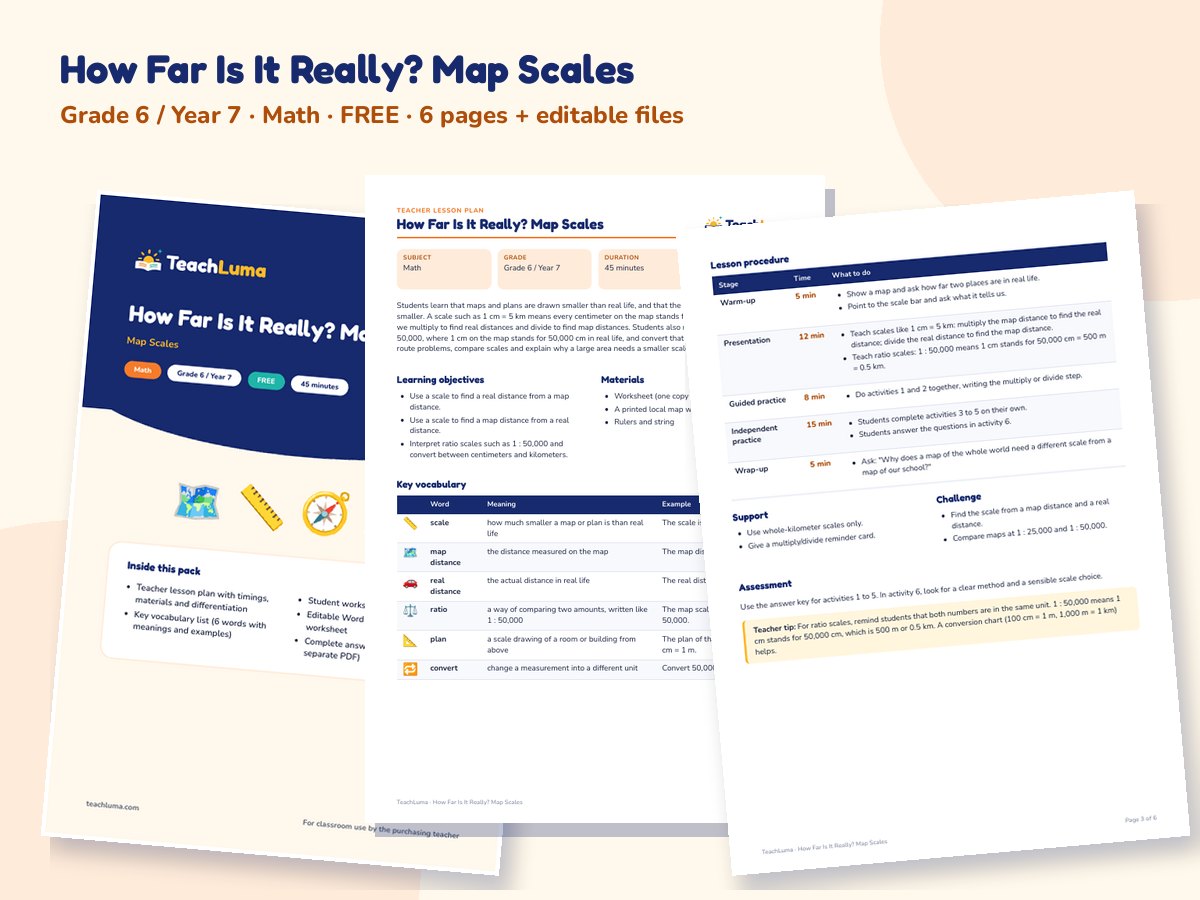
  • 6-page printable PDF lesson pack: teacher lesson plan with timings, materials and differentiation
  • Key vocabulary list (6 words with meanings and examples)
  • Student worksheet (6 activities)
  • Editable Word version of the worksheet
  • Complete answer key (also as a separate PDF)

Additional Files


Teacher Reviews

No ratings yet

Be the first teacher to review this resource.

Sign in to review this resource.

Related Resources

Advertisement