Skip to content
Preview
Members Only ESL Complete Lesson Pack Grade 9 (Year 10)
No ratings yet

Is It Convincing? Evaluating Arguments

About This Resource

A complete Grade 9 ESL reading pack on evaluating arguments: finding the claim, reasons and evidence, judging whether evidence is relevant, reliable and sufficient, and spotting weak reasoning such as overgeneralization, the bandwagon effect, attacking the person, exaggeration. Students analyze an article about car-free city centers, rate its arguments and rewrite weak points. Includes slides, a lesson plan, worksheet, quiz, homework, flashcards, a rubric and answer keys.

Overview

Students learn to read arguments critically rather than simply accepting them. Every argument has a claim (what the writer wants us to believe), reasons (why) and evidence (facts, statistics, examples or expert views that support the reasons). Students learn three questions to test evidence: Is it relevant? Is it reliable? Is there enough of it? They also learn to spot common types of weak reasoning: overgeneralization, the bandwagon effect (everyone thinks so), attacking the person instead of the argument, and exaggerated predictions. They analyze a short article about car-free city centers, judge which paragraphs are strong and which are weak, and rewrite a weak argument to make it convincing.

Resource Details

Subject
ESL
Topic
Evaluating Arguments
Category
Reading
File Type
PDF
File Size
388.1 KB
Published
09 Nov 2026
Downloads
0

Members Only

Upgrade to Teacher Pro (from ฿199/month) to download this resource.

Share:

Looking for something different? Request a Resource.

Grade 9 ESL (ages 14–15), B1–B2 55 minutes Critical reading evaluating evidence academic vocabulary discussion writing

Learning Objectives

  • Identify the claim, reasons and evidence in an argument.
  • Evaluate evidence by asking whether it is relevant, reliable and sufficient.
  • Recognize common types of weak reasoning and explain why they are weak.

How to Use This Resource

  • Start with the slides: show two adverts for the same product, one with facts and one that says "Everyone is buying it!" and ask which is more convincing.
  • Teach claim, reason, evidence and the three evidence questions with the slides and flashcards, then do worksheet activities 1 and 2 together.
  • Students complete activities 3 to 6, then use the quiz and send the homework page home.

Classroom Activity Ideas

  • Evidence ranking: groups rank five pieces of evidence for a claim from most to least reliable and justify the order.
  • Weak reasoning hunt: students find examples of bandwagon or exaggeration in adverts or social media posts.
  • Fix it: pairs rewrite a weak argument so that it has a clear reason and reliable evidence.

Differentiation

Support: give a color code (claim in blue, reason in green, evidence in yellow) for marking the article. Challenge: students write a short counter-argument from a shop owner's point of view, using strong evidence.

Assessment

Use the worksheet and quiz to check identifying claims and evidence and spotting weak reasoning. Use the rubric to assess the homework evaluation of a real text.

Teacher Tips

Remind students that an argument can be weak even if they agree with its claim, and strong even if they disagree. Evaluating arguments is about the quality of reasoning, not personal opinion.

What's Included

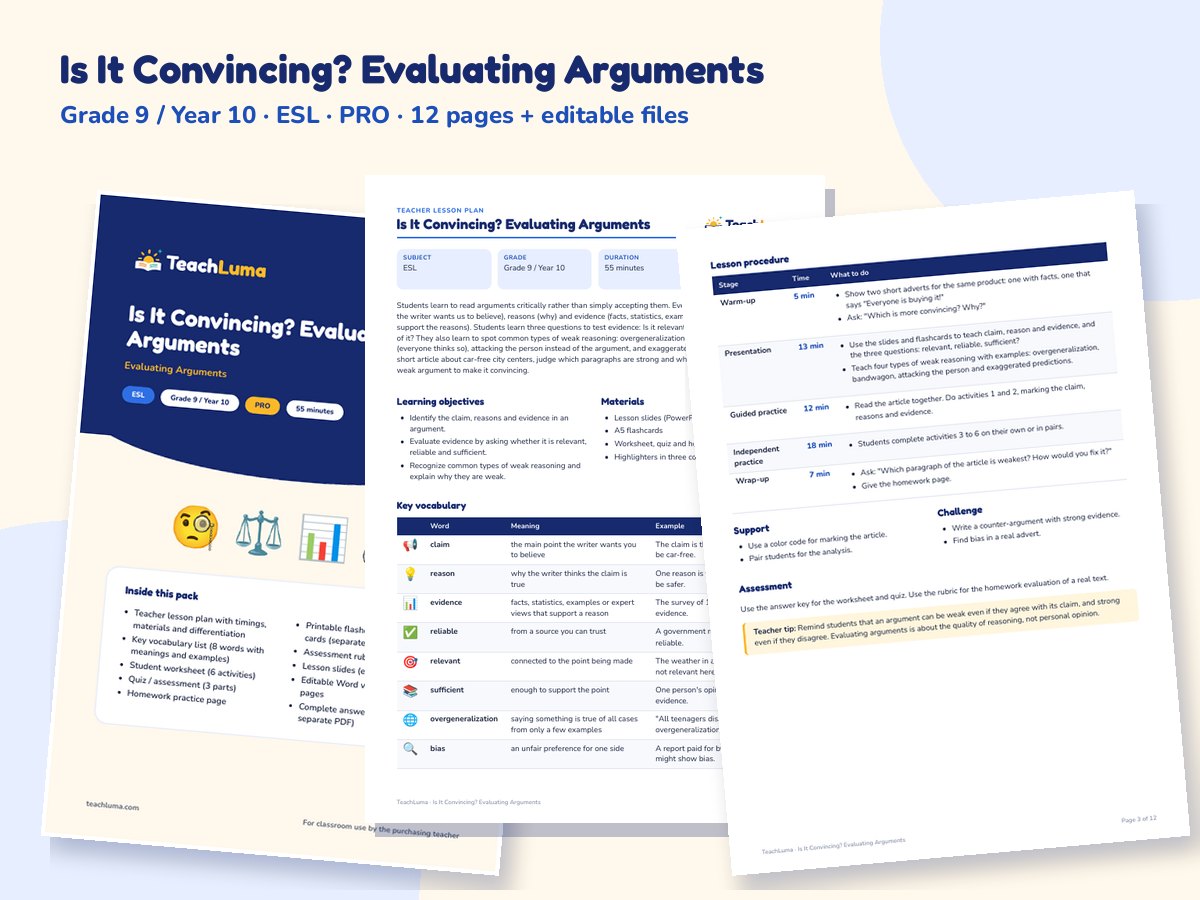
  • 12-page printable PDF lesson pack: teacher lesson plan with timings, materials and differentiation
  • Key vocabulary list (8 words with meanings and examples)
  • Student worksheet (6 activities)
  • Quiz / assessment (3 parts)
  • Homework practice page
  • Printable flashcards: 8 A5 picture cards (separate PDF)
  • Assessment rubric (4 levels)
  • Lesson slides (editable PowerPoint)
  • Editable Word version of all student pages
  • Complete answer key (also as a separate PDF)

Additional Files

  • Lesson Slides (PPTX)
  • Editable Student Pages and Lesson Plan (DOCX)
  • A5 Flashcards (PDF)
  • Answer Key (PDF)

Teacher Reviews

No ratings yet

Be the first teacher to review this resource.

Sign in to review this resource.

Related Resources

Advertisement