Skip to content
Preview
Members Only ESL Complete Lesson Pack Grade 8
No ratings yet

It Was Built in 1889: The Passive Voice

About This Resource

A complete Grade 8 ESL lesson pack on the passive voice: forming be + past participle in the present simple, past simple and future, changing active sentences into passive sentences, when to include the agent with by, why writers choose the passive (unknown, unimportant or obvious doer; facts and processes), and using the passive to describe how things are made. Includes slides, a timed lesson plan, flashcards, worksheet, quiz, homework, rubric and answer key.

Overview

Students learn that the passive voice puts the focus on the action or the receiver rather than the person who does it. They build the form (be + past participle) in the present simple (is made), past simple (was built) and future (will be opened), turn active sentences into passive ones by moving the object to the front, and decide when to keep or drop the agent with by. A short text about the making of chocolate shows the passive used to describe a process, and a quiz about famous landmarks and inventions gives meaningful practice. Students finish by writing their own process description.

Resource Details

Subject
ESL
Topic
Passive Voice
Category
Grammar
File Type
PDF
File Size
350.3 KB
Published
01 Nov 2026
Downloads
0

Members Only

Upgrade to Teacher Pro (from ฿199/month) to download this resource.

Share:

Looking for something different? Request a Resource.

Grade 8 (ages 13–14), intermediate ESL 60 minutes Grammar reading a process text sentence transformation writing speaking

Learning Objectives

  • Form the passive voice with be + past participle in the present simple, past simple and future with will.
  • Change active sentences into passive sentences and decide when to include the agent with by.
  • Explain why writers use the passive voice and use it to describe a process or historical facts.

How to Use This Resource

  • Open with slide 1: show a photo of a famous tower and ask "When was it built? Who built it?" Most students know the date but not the builder, which shows why we use the passive.
  • Teach the form, active to passive, the agent and the reasons for the passive with the slides, checking each step with the matching worksheet activity.
  • Students read the chocolate text, complete the worksheet and write a process paragraph, then use the quiz to check learning. Answers are in the answer key.

Classroom Activity Ideas

  • Landmark quiz: teams answer questions such as "Where was paper invented?" and "When was the first phone call made?" in full passive sentences.
  • How is it made?: groups research how something everyday is made (pencils, glass, cheese) and present the steps using the passive.
  • Headline rewrite: students turn active news headlines into passive ones and discuss how the focus changes.

Differentiation

Support: give a table of past participles and a sentence frame (The ___ was ___ by ___.), and limit practice to the present and past simple. Challenge: use the passive with modal verbs (must be done, can be recycled) and the present perfect (has been sold), and rewrite a paragraph switching between active and passive for effect.

Assessment

Worksheet activities and the quiz check form, transformation and choosing active or passive (answer key included). The process paragraph and the homework are marked with the four-level rubric.

Teacher Tips

Write a big arrow on the board showing the object of the active sentence moving to the front. Students who see the movement understand the passive much faster. Remind them that only verbs with an object (transitive verbs) can be made passive, so "The baby slept" has no passive form.

What's Included

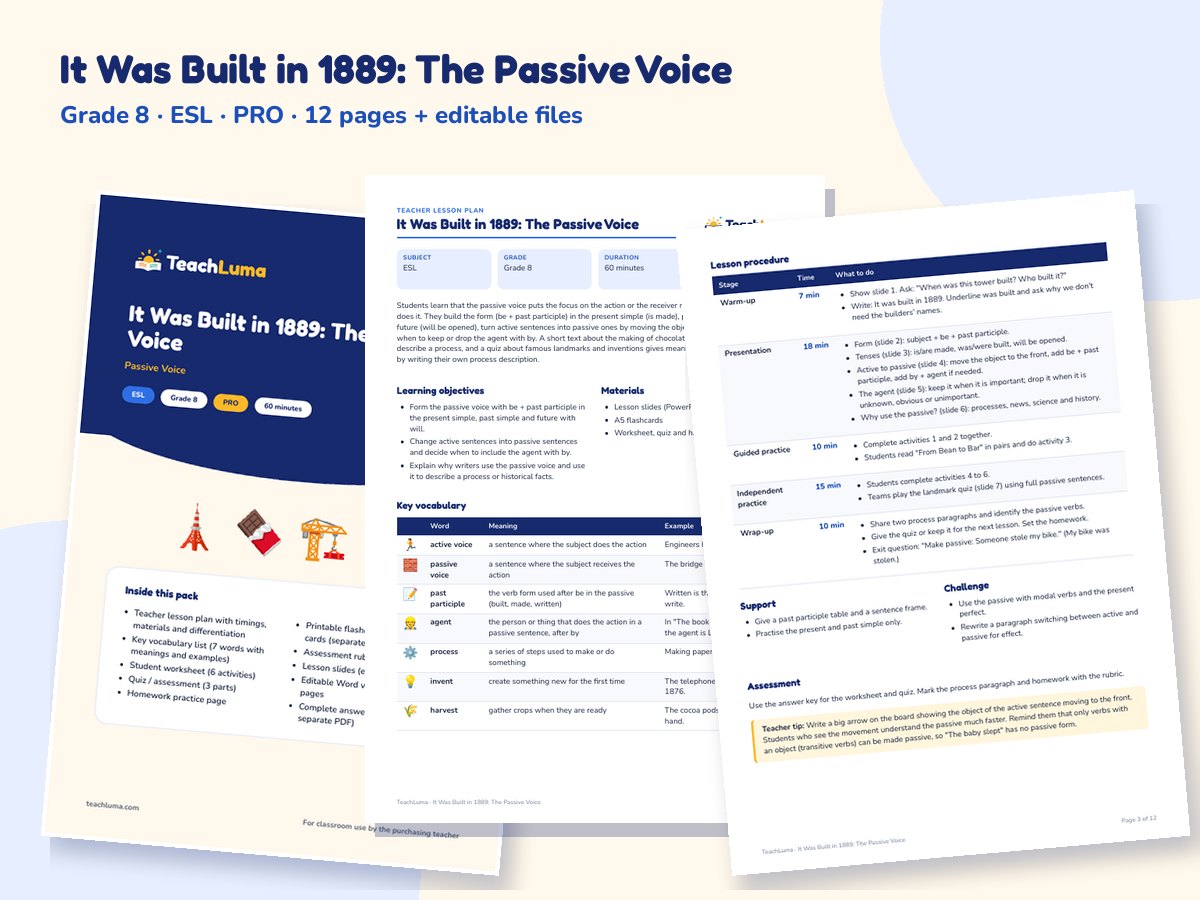
  • 12-page printable PDF lesson pack: teacher lesson plan with timings, materials and differentiation
  • Key vocabulary list (7 words with meanings and examples)
  • Student worksheet (6 activities)
  • Quiz / assessment (3 parts)
  • Homework practice page
  • Printable flashcards: 7 A5 picture cards (separate PDF)
  • Assessment rubric (4 levels)
  • Lesson slides (editable PowerPoint)
  • Editable Word version of all student pages
  • Complete answer key (also as a separate PDF)

Additional Files

  • Lesson Slides (PPTX)
  • Editable Student Pages and Lesson Plan (DOCX)
  • A5 Flashcards (PDF)
  • Answer Key (PDF)

Teacher Reviews

No ratings yet

Be the first teacher to review this resource.

Sign in to review this resource.

Related Resources

Advertisement