Skip to content
Preview
Members Only Science Complete Lesson Pack Grade 3 (Year 4)
No ratings yet

Look Up! Cirrus, Cumulus, Stratus and Storm Clouds

About This Resource

A complete Grade 3 science pack on clouds. Students learn how clouds form from tiny water droplets, identify four main types (cirrus, cumulus, stratus and cumulonimbus), describe their shape and height, and connect each type to the weather it often brings. Includes slides, a lesson plan, worksheet, quiz, homework, A5 flashcards, a rubric, Word files and answer keys.

Overview

Clouds form when warm, moist air rises and cools, and water vapor turns into billions of tiny droplets or ice crystals. Scientists name clouds by shape and height. Cirrus clouds are thin and wispy, high in the sky. Cumulus clouds are puffy and white, often seen on fair days. Stratus clouds are flat gray sheets that can bring drizzle. Cumulonimbus clouds are huge towers that bring thunderstorms. Students observe, sort and describe clouds and use them to make simple weather predictions.

Resource Details

Subject
Science
Topic
Types of Clouds
Category
Weather & Seasons
File Type
PDF
File Size
313.8 KB
Published
14 Nov 2026
Downloads
0

Members Only

Create a free account to download this resource with one of your 3 Free Pro Previews, or upgrade to Teacher Pro (from ฿199/month) for the whole library.

Share:

Looking for something different? Request a Resource.

Grade 3 (ages 8–9) 45 minutes Observing classifying predicting science vocabulary

Learning Objectives

  • Explain how clouds form.
  • Identify cirrus, cumulus, stratus and cumulonimbus clouds by shape and height.
  • Link cloud types to the weather they often bring.

How to Use This Resource

  • Take students outside or show a sky photo. Ask: "What shapes can you see? What are clouds made of?"
  • Teach cloud formation and the four types with the slides, then do activities 1 and 2 together.
  • Students complete activities 3 to 6. Use the quiz and send the homework page home.

Classroom Activity Ideas

  • Cloud diary: students sketch and name the clouds each day for a week.
  • Cotton wool clouds: students model each cloud type with cotton wool on dark paper.
  • Cloud in a jar: a teacher demonstration with warm water and ice to show condensation.

Differentiation

Support: give a cloud identification card with pictures. Challenge: add nimbostratus and altocumulus and explain the prefixes.

Assessment

Use the worksheet and quiz to check identification. Use the rubric for the cloud diary.

Teacher Tips

Cloud names come from Latin words: cirrus means curl of hair, cumulus means heap, stratus means layer and nimbus means rain cloud. Sharing these meanings helps students remember. Remind students never to look directly at the sun when observing clouds.

What's Included

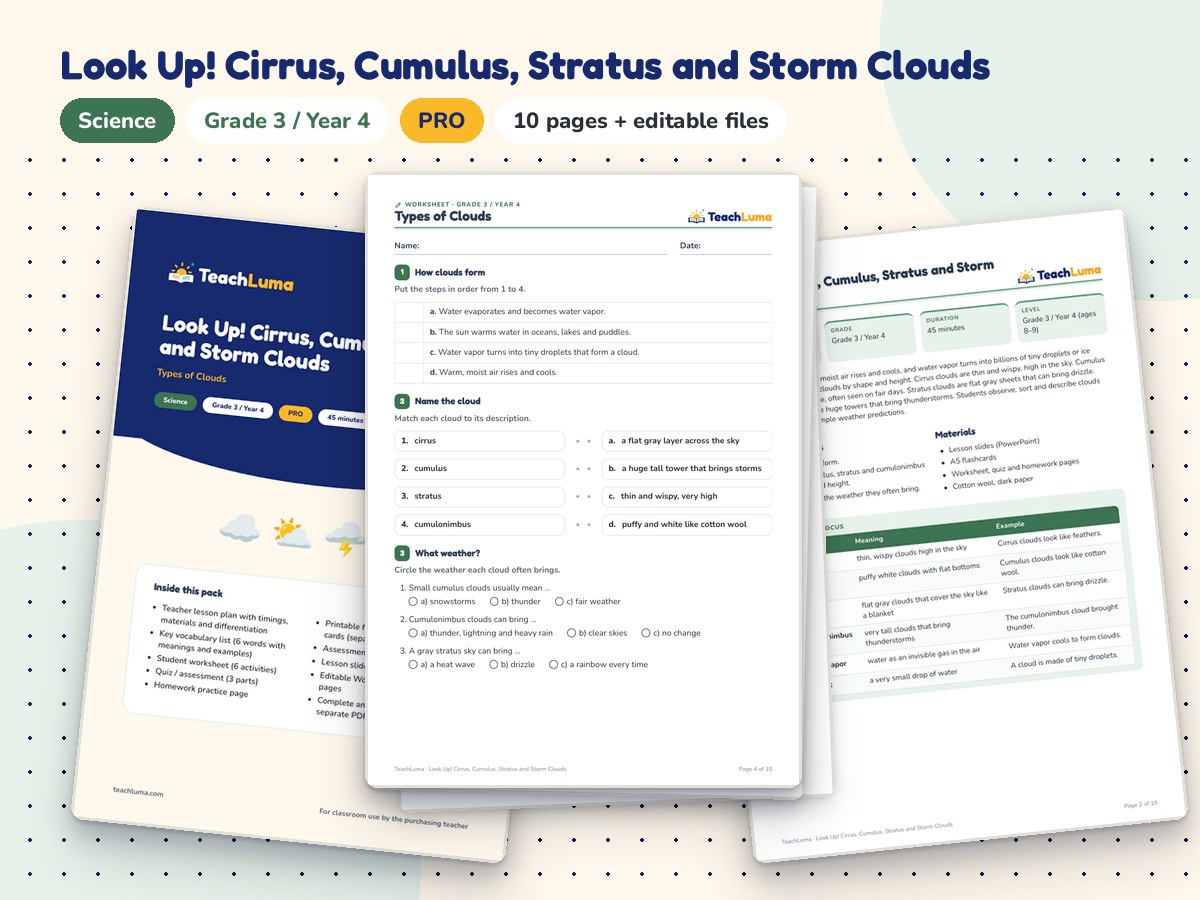
  • 10-page printable PDF lesson pack: teacher lesson plan with timings, materials and differentiation
  • Key vocabulary list (6 words with meanings and examples)
  • Student worksheet (6 activities)
  • Quiz / assessment (3 parts)
  • Homework practice page
  • Printable flashcards: 6 A5 picture cards (separate PDF)
  • Assessment rubric (4 levels)
  • Lesson slides (editable PowerPoint)
  • Editable Word version of all student pages
  • Complete answer key (also as a separate PDF)

Additional Files

  • Lesson Slides (PPTX)
  • Editable Student Pages and Lesson Plan (DOCX)
  • A5 Flashcards (PDF)
  • Answer Key (PDF)

Teacher Reviews

No ratings yet

Be the first teacher to review this resource.

Sign in to review this resource.

Related Resources

Advertisement