Unit 2 Speaking Activity — My Timetable
Members Only ESL Speaking Activity Grade 6
No ratings yet

Unit 2 Speaking Activity — My Timetable

About This Resource

A structured partner-interview speaking task about subjects, opinions, and timetables, with a note-taking grid, a report-back stage using a sentence frame, and a peer-assessment checklist.

Overview

Students interview a partner using six unit-vocabulary questions about favorite and least favorite subjects, timetable details, and routine frequency, record notes in a grid, then "report back" — introducing their partner to a small group using a third-person sentence frame ("This is ___. His/Her favorite subject is ___, because it's ___..."). A speaking-tips box and peer-assessment checklist keep both the speaking and the listening/feedback components of the activity structured and purposeful.
What's Included

Resource Details

Subject
ESL
Topic
My Timetable
Category
Speaking
File Type
DOCX
File Size
37.9 KB
Published
01 Sep 2026
Downloads
0

Members Only

Upgrade to Teacher Pro (from ฿199/month) to download this resource.

Share:

Grade 6 35-45 Minutes Speaking

Learning Objectives

  • Ask all six interview questions clearly and at a natural pace.
  • Answer interview questions using complete sentences, including a reason with "because" where relevant.
  • Accurately report a partner's information to a group using correct third-person pronouns (he/she, his/her).
  • Apply at least two speaking tips (eye contact, using "because," or a clarification request) during the activity, as observed by a peer.

How to Use This Resource

  • Use during Lesson 4 of the unit (see the Lesson Plan, Resource 11), ideally alongside Resource 8 (Listening / Teacher-Led Activity) in the same class period. Review the speaking tips first, then run Part A (interview) in pairs and Part B (report back) in groups of four.

Classroom Activity Ideas

  • After Part B, ask each group of four to identify one classmate (outside their immediate pair) whose favorite subject matches their own, based only on what they heard secondhand through another group member's report-back — this rewards active listening during the report-back stage, not just speaking.

Differentiation

Support: Allow Support students to write short-phrase notes rather than full sentences in the interview grid, and permit them to read directly from their notes during report-back.

On-Level: Complete both parts as designed, using the report-back sentence frame from memory where possible.

Challenge: During report-back, require Challenge students to add one extra detail about their partner's timetable not covered by the sentence frame, drawn from natural follow-up conversation during the interview.

Assessment

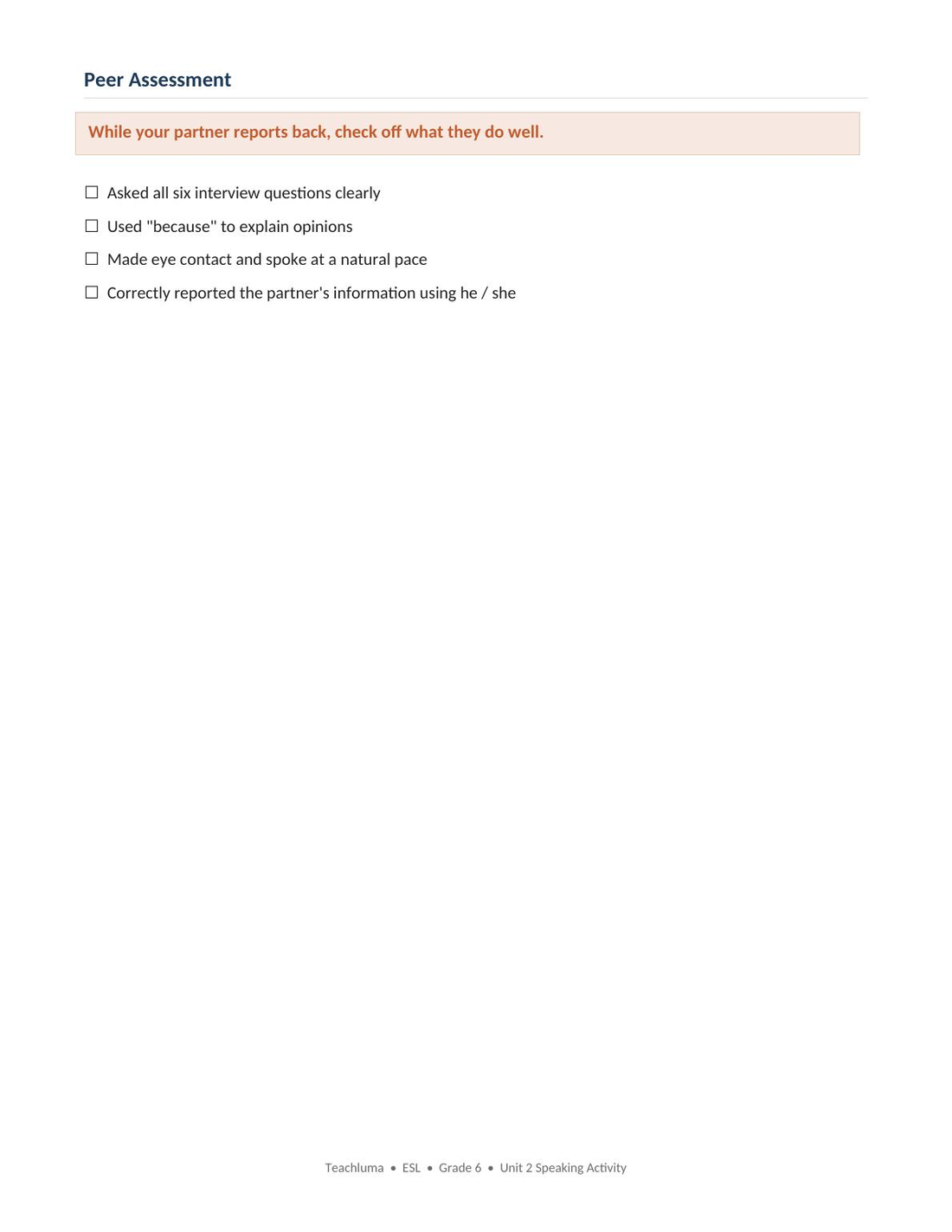
Use the built-in peer-assessment checklist (four criteria) during Part B as the primary evidence of speaking performance. Teachers may also circulate during Part A to informally note fluency and question-asking accuracy.

Teacher Tips

Model the report-back sentence frame yourself first, using a real (or invented) example about your own timetable — students consistently struggle more with switching from first-person interview answers to third-person report-back language than with the interview questions themselves, so a live model is worth the extra two minutes.

What's Included

  • 1 DOCX activity (2 pages: interview grid + speaking tips, report-back frame + peer assessment)
  • 1 matching PDF export

Additional Files

  • Download PDF Version

Teacher Reviews

No ratings yet

Be the first teacher to review this resource.

Log in and download this resource to write a review.

Related Resources

Members Grade 6

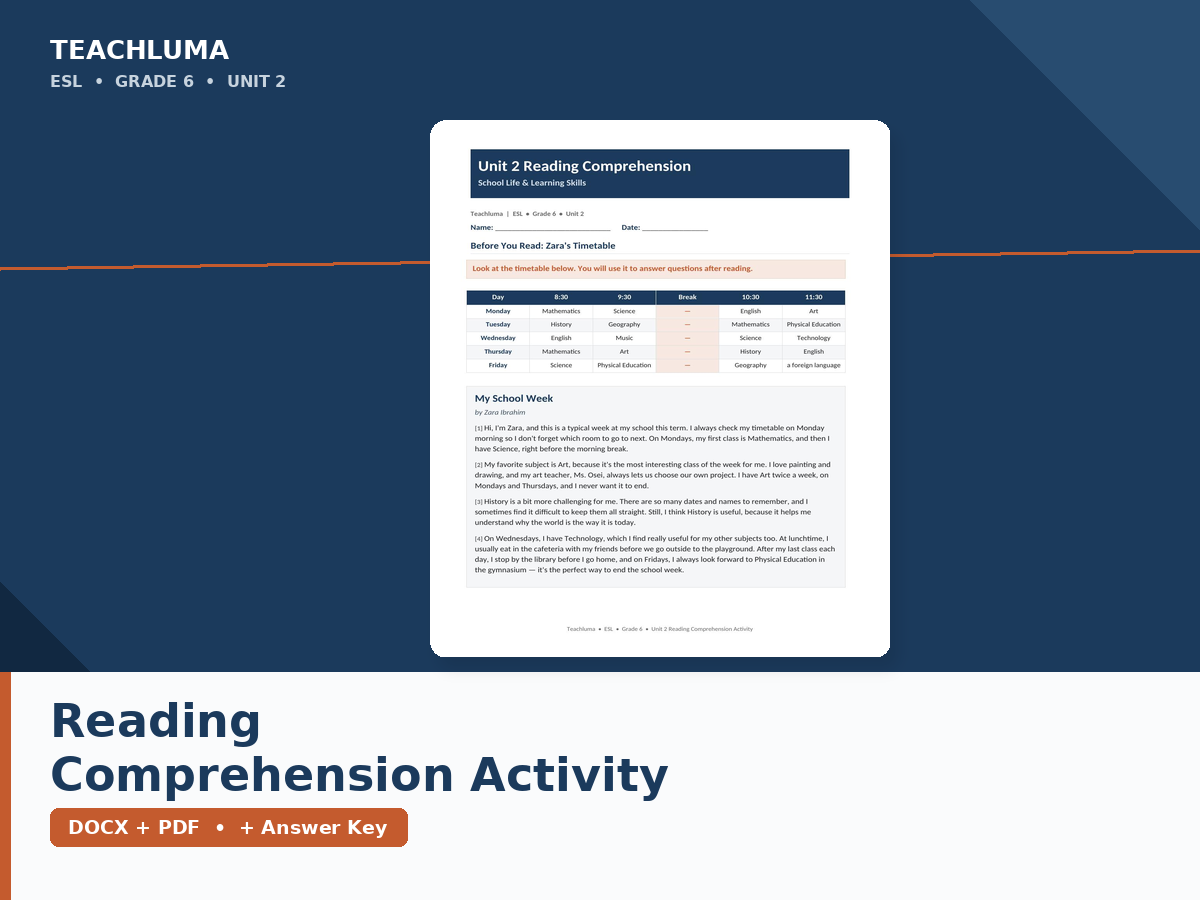
Unit 2 Reading Comprehension Activity — My School Week

Reading Activity · My School Week

A combined timetable-scanning and passage-reading activity built around an original blog-s...

View Resource