Skip to content
Preview
Members Only ESL Complete Lesson Pack Grade 5 (Year 6)
No ratings yet

Very, Quite, Really: Adverbs of Degree

About This Resource

A complete Grade 5 ESL grammar pack on adverbs of degree. Children use very, really, quite, a bit, extremely and too to make adjectives stronger or weaker, place them before adjectives and adverbs, learn the difference between very and too, and describe films, food and weather precisely. Includes slides, a lesson plan, worksheet, quiz, homework, A5 flashcards, a rubric, Word files and answer keys.

Overview

Adverbs of degree tell us how much. They usually go before an adjective or another adverb: very cold, quite good, really quickly. Some make the meaning stronger (extremely, really, very) and some make it weaker (quite, a bit). Too means more than we want or need: The tea is too hot to drink. Children rank adverbs on a scale, choose between very and too, place adverbs correctly and write precise descriptions.

Resource Details

Subject
ESL
Topic
Adverbs of Degree: Very, Quite and Really
Category
Grammar
File Type
PDF
File Size
315.8 KB
Published
21 Nov 2026
Downloads
0

Members Only

Create a free account to download this resource with one of your 3 Free Pro Previews, or upgrade to Teacher Pro (from ฿199/month) for the whole library.

Share:

Looking for something different? Request a Resource.

Grade 5 ESL (ages 10–11), A2–B1 45 minutes Grammar vocabulary speaking descriptive writing

Learning Objectives

  • Use adverbs of degree to make adjectives stronger or weaker.
  • Place adverbs of degree before adjectives and adverbs.
  • Explain the difference between very and too.

How to Use This Resource

  • Show a picture of hot soup. Ask: "Is it hot, very hot or too hot?"
  • Teach the adverb scale with the slides, then do activities 1 and 2 together.
  • Children complete activities 3 to 6. Use the quiz and send the homework page home.

Classroom Activity Ideas

  • Adverb thermometer: children place adverb cards on a scale from a bit to extremely.
  • Food critic: children rate snacks using adverbs of degree.
  • Very or too? Show pictures; children decide which word fits.

Differentiation

Support: focus on very, quite and too with picture prompts. Challenge: add extremely, fairly and a little, and explain shades of meaning.

Assessment

Use the worksheet and quiz to check meaning and position. Use the rubric during the food critic activity.

Teacher Tips

Very is neutral, but too has a negative result: too big to fit. Ask "Is it a problem?" to help children choose.

What's Included

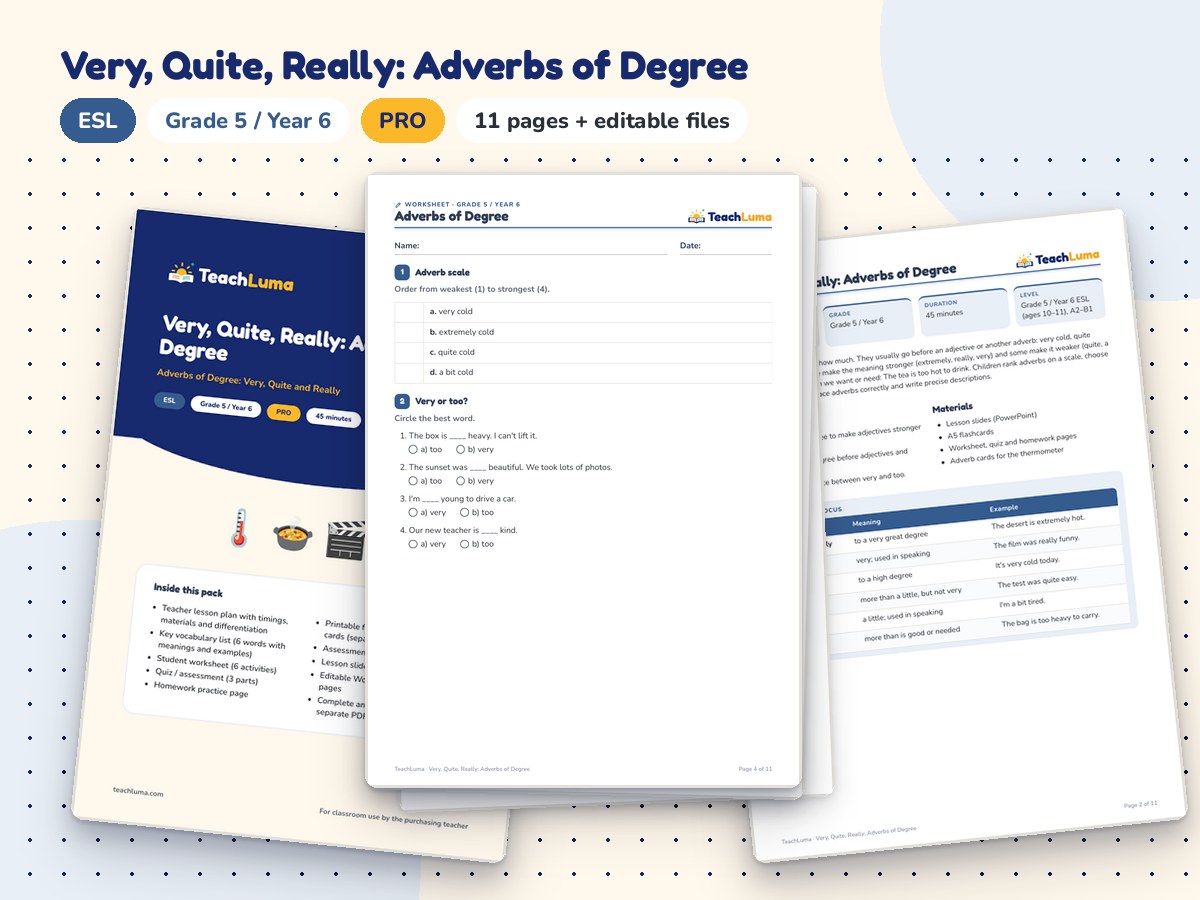
  • 11-page printable PDF lesson pack: teacher lesson plan with timings, materials and differentiation
  • Key vocabulary list (6 words with meanings and examples)
  • Student worksheet (6 activities)
  • Quiz / assessment (3 parts)
  • Homework practice page
  • Printable flashcards: 6 A5 picture cards (separate PDF)
  • Assessment rubric (4 levels)
  • Lesson slides (editable PowerPoint)
  • Editable Word version of all student pages
  • Complete answer key (also as a separate PDF)

Additional Files

  • Lesson Slides (PPTX)
  • Editable Student Pages and Lesson Plan (DOCX)
  • A5 Flashcards (PDF)
  • Answer Key (PDF)

Teacher Reviews

No ratings yet

Be the first teacher to review this resource.

Sign in to review this resource.

Related Resources

Advertisement