Skip to content
Preview
Members Only ESL Complete Lesson Pack Grade 9 (Year 10)
No ratings yet

Whose Side Is It On? Recognizing Bias in the Media

About This Resource

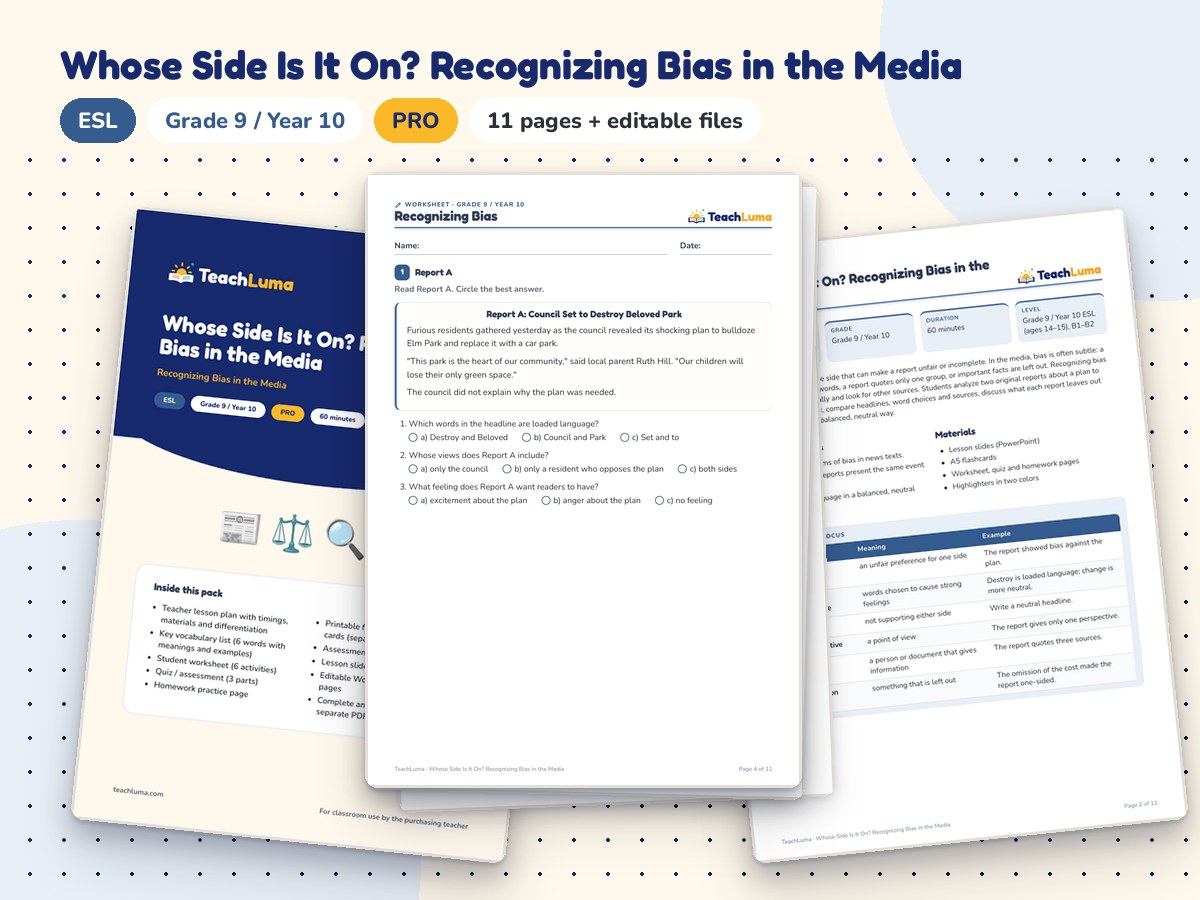
A complete Grade 9 ESL reading pack on media bias. Students learn how word choice, selection of facts, quotations, headlines and images can present a one-sided view. They compare two news reports about the same local event, identify loaded language and missing perspectives, and rewrite a biased paragraph in a balanced way. Includes slides, a lesson plan, worksheet, quiz, homework, A5 flashcards, a rubric, Word files and answer keys.

Overview

Bias is a preference for one side that can make a report unfair or incomplete. In the media, bias is often subtle: a headline uses emotional words, a report quotes only one group, or important facts are left out. Recognizing bias helps readers think critically and look for other sources. Students analyze two original reports about a plan to turn a park into a car park, compare headlines, word choices and sources, discuss what each report leaves out and practice writing in a balanced, neutral way.

Resource Details

Subject
ESL
Topic
Recognizing Bias in the Media
Category
Reading
File Type
PDF
File Size
346.7 KB
Published
20 Nov 2026
Downloads
0

Members Only

Create a free account to download this resource with one of your 3 Free Pro Previews, or upgrade to Teacher Pro (from ฿199/month) for the whole library.

Share:

Looking for something different? Request a Resource.

Grade 9 ESL (ages 14–15), B1–B2 60 minutes Critical reading media literacy analysis writing

Learning Objectives

  • Identify common forms of bias in news texts.
  • Compare how two reports present the same event differently.
  • Rewrite biased language in a balanced, neutral way.

How to Use This Resource

  • Show two headlines about the same event. Ask: "Do they tell the same story?"
  • Teach the forms of bias with the slides and read both reports, then do activities 1 and 2 together.
  • Students complete activities 3 to 6. Use the quiz and send the homework page home.

Classroom Activity Ideas

  • Headline lab: students write a positive, a negative and a neutral headline for one event.
  • Missing voices: groups list who else should be quoted in a report.
  • Bias detectives: students bring a short article and identify one example of loaded language.

Differentiation

Support: give a checklist of bias techniques with examples. Challenge: students evaluate which report is more reliable and justify their answer with evidence.

Assessment

Use the worksheet and quiz to check identification of bias. Use the rubric for the balanced rewrite.

Teacher Tips

Bias is not the same as lying: biased reports may contain true facts but choose and present them selectively. Encourage students to check more than one source. Keep the discussion focused on techniques rather than real political topics.

What's Included

  • 11-page printable PDF lesson pack: teacher lesson plan with timings, materials and differentiation
  • Key vocabulary list (6 words with meanings and examples)
  • Student worksheet (6 activities)
  • Quiz / assessment (3 parts)
  • Homework practice page
  • Printable flashcards: 6 A5 picture cards (separate PDF)
  • Assessment rubric (4 levels)
  • Lesson slides (editable PowerPoint)
  • Editable Word version of all student pages
  • Complete answer key (also as a separate PDF)

Additional Files

  • Lesson Slides (PPTX)
  • Editable Student Pages and Lesson Plan (DOCX)
  • A5 Flashcards (PDF)
  • Answer Key (PDF)

Teacher Reviews

No ratings yet

Be the first teacher to review this resource.

Sign in to review this resource.

Related Resources

Advertisement