Skip to content
Preview
Members Only Science Complete Lesson Pack Grade 2 (Year 3)
No ratings yet

Wiggly Helpers: All About Earthworms

About This Resource

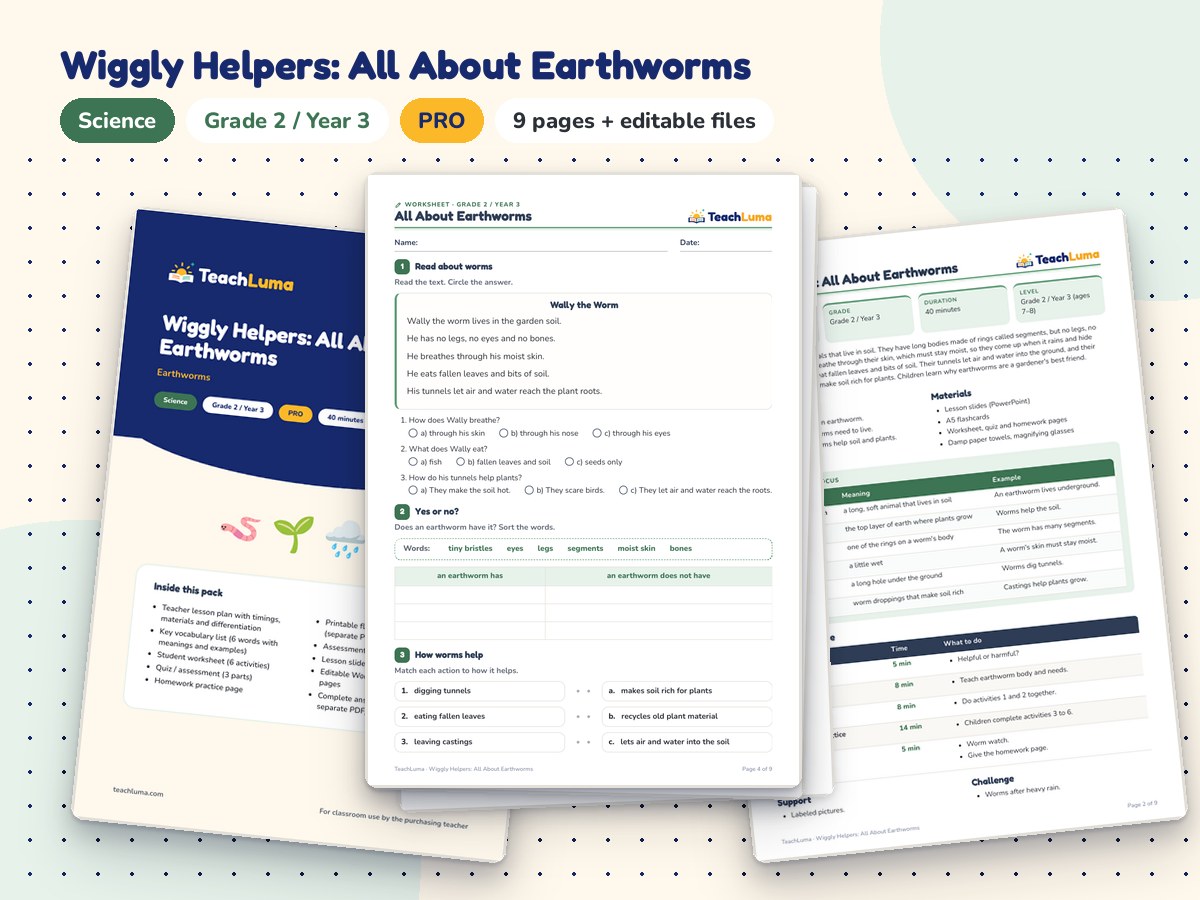
A complete Grade 2 science pack on earthworms. Children learn that earthworms have no legs, eyes or bones, breathe through their moist skin, move using tiny bristles and muscles, eat fallen leaves and soil, and help gardens by mixing soil and making it rich. They read a short text, label a worm, sort facts and plan a gentle worm observation. Includes slides, a lesson plan, worksheet, quiz, homework, A5 flashcards, a rubric, Word files and answer keys.

Overview

Earthworms are small animals that live in soil. They have long bodies made of rings called segments, but no legs, no eyes and no bones. They breathe through their skin, which must stay moist, so they come up when it rains and hide from the sun. Earthworms eat fallen leaves and bits of soil. Their tunnels let air and water into the ground, and their droppings, called castings, make soil rich for plants. Children learn why earthworms are a gardener's best friend.

Resource Details

Subject
Science
Topic
Earthworms
Category
Animals
File Type
PDF
File Size
322 KB
Published
26 Nov 2026
Downloads
0

Members Only

Create a free account to download this resource with one of your 3 Free Pro Previews, or upgrade to Teacher Pro (from ฿199/month) for the whole library.

Share:

Looking for something different? Request a Resource.

Grade 2 (ages 7–8) 40 minutes Observing reading explaining caring for animals

Learning Objectives

  • Describe the body of an earthworm.
  • Explain what earthworms need to live.
  • Explain how earthworms help soil and plants.

How to Use This Resource

  • Show a picture of an earthworm. Ask: "Is this animal helpful or harmful? Why?"
  • Teach earthworm facts with the slides, then do activities 1 and 2 together.
  • Children complete activities 3 to 6. Use the quiz and send the homework page home.

Classroom Activity Ideas

  • Worm watch: observe a worm on damp paper towel for five minutes.
  • Wormery: make a jar with layers of sand and soil and watch the mixing.
  • Segment count: count rings on a worm picture.

Differentiation

Support: use labeled pictures. Challenge: explain why worms come up after heavy rain.

Assessment

Use the worksheet and quiz to check knowledge. Use the rubric for the homework observation.

Teacher Tips

Keep worms damp and cool, handle them with wet hands and return them to the soil after a short observation.

What's Included

  • 9-page printable PDF lesson pack: teacher lesson plan with timings, materials and differentiation
  • Key vocabulary list (6 words with meanings and examples)
  • Student worksheet (6 activities)
  • Quiz / assessment (3 parts)
  • Homework practice page
  • Printable flashcards: 6 A5 picture cards (separate PDF)
  • Assessment rubric (4 levels)
  • Lesson slides (editable PowerPoint)
  • Editable Word version of all student pages
  • Complete answer key (also as a separate PDF)

Additional Files

  • Lesson Slides (PPTX)
  • Editable Student Pages and Lesson Plan (DOCX)
  • A5 Flashcards (PDF)
  • Answer Key (PDF)

Teacher Reviews

No ratings yet

Be the first teacher to review this resource.

Sign in to review this resource.

Related Resources

Advertisement