Skip to content
Preview
Members Only Math Complete Lesson Pack Grade 6
No ratings yet

Base Times Height: Area of Triangles and Parallelograms

About This Resource

A complete Grade 6 math pack on the area of parallelograms and triangles: why a parallelogram has the same area as a rectangle, why a triangle is half a parallelogram, using the perpendicular height, finding a missing base or height, and composite shapes. Includes a lesson plan, worksheet, quiz, homework, A5 flashcards, a rubric, detailed slides with speaker notes, Word files and answer keys.

Overview

Students discover the area formulas by cutting and rearranging paper shapes. A parallelogram can be cut and moved to make a rectangle, so its area is base × height. Two identical triangles make a parallelogram, so a triangle's area is half of base × height. Students practise choosing the perpendicular height (not the slanted side), find missing measurements, and work out the area of composite shapes such as a house shape.

Resource Details

Subject
Math
Topic
Area of Triangles and Parallelograms
Category
Shapes & Geometry
File Type
PDF
File Size
311.9 KB
Published
30 Oct 2026
Downloads
0

Members Only

Upgrade to Teacher Pro (from ฿199/month) to download this resource.

Share:

Looking for something different? Request a Resource.

Grade 6 (ages 11–12) 50 minutes Geometry area formulas multiplication reasoning problem solving

Learning Objectives

  • Find the area of a parallelogram using A = base × height.
  • Find the area of a triangle using A = 1/2 × base × height.
  • Use the perpendicular height, find missing measurements and calculate the area of composite shapes.

How to Use This Resource

  • Give each student a paper parallelogram to cut and rearrange into a rectangle.
  • Teach both formulas and the idea of perpendicular height with the slides, then use worksheet activities 1 to 6.
  • Use the quiz to check learning and send the homework page home.

Classroom Activity Ideas

  • Cut and rearrange: students cut a triangle off one end of a paper parallelogram and move it to make a rectangle.
  • Double the triangle: students trace a triangle twice, cut both out and join them to make a parallelogram.
  • Design a flag: students design a flag made of rectangles and triangles and calculate its total area.

Differentiation

Support: use grid paper and count squares to check each answer. Challenge: find the area of trapezoids by splitting them into a rectangle and triangles.

Assessment

Activities 1 and 2 and the quiz check the formulas; activities 3 to 6 check height, missing measurements and composite shapes. Use the rubric for activity 6.

Teacher Tips

Students often multiply by the slanted side. Draw the height as a dashed line with a small square to show the right angle every time.

What's Included

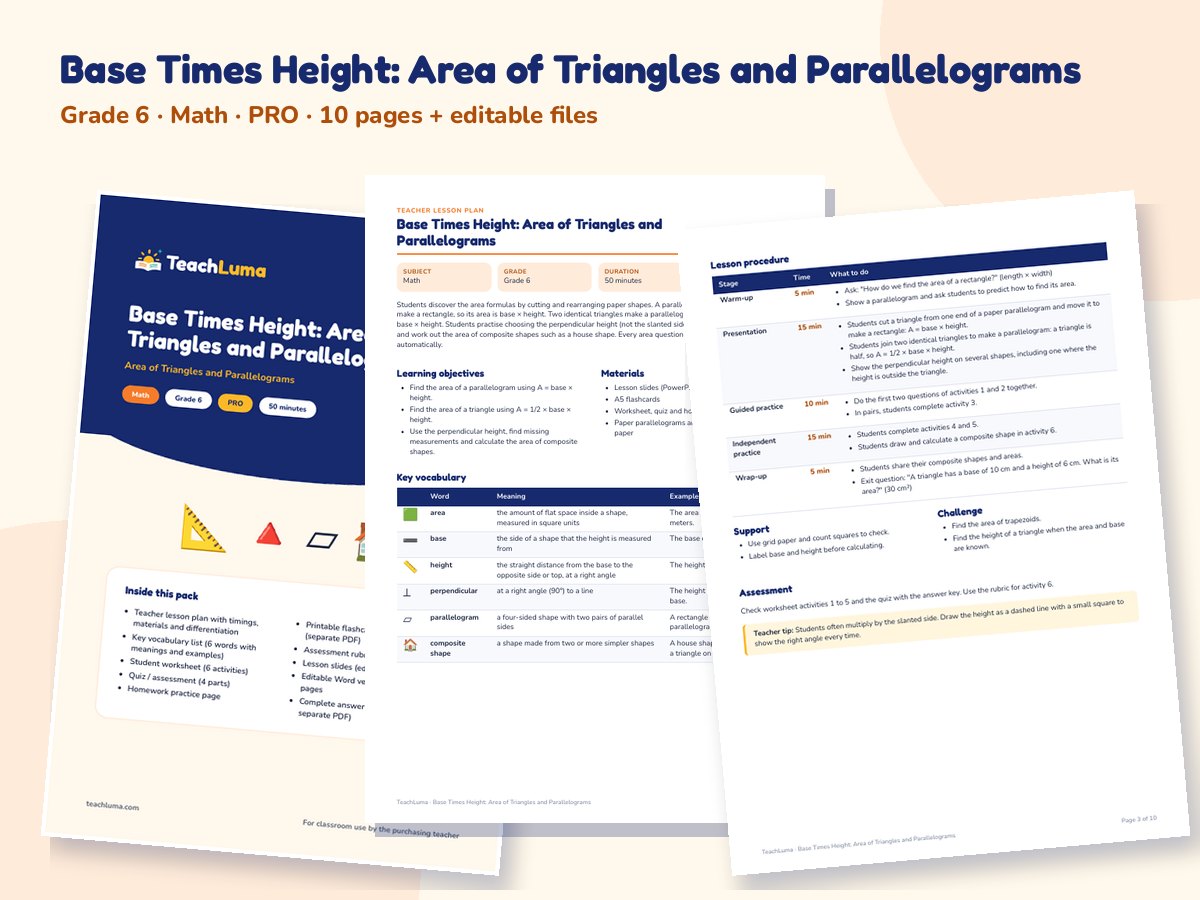
  • 10-page printable PDF lesson pack: teacher lesson plan with timings, materials and differentiation
  • Key vocabulary list (6 words with meanings and examples)
  • Student worksheet (6 activities)
  • Quiz / assessment (4 parts)
  • Homework practice page
  • Printable flashcards: 6 A5 picture cards (separate PDF)
  • Assessment rubric (4 levels)
  • Lesson slides (editable PowerPoint)
  • Editable Word version of all student pages
  • Complete answer key (also as a separate PDF)

Additional Files

  • Lesson Slides (PowerPoint, editable) (PPTX)
  • Editable Student Pages + Lesson Plan (Word) (DOCX)
  • Flashcards (PDF, A5, one card per page) (PDF)
  • Answer Key (PDF) (PDF)

Teacher Reviews

No ratings yet

Be the first teacher to review this resource.

Sign in to review this resource.

Related Resources

Advertisement