Skip to content
Preview
Members Only Science Complete Lesson Pack Grade 6
No ratings yet

Building Blocks of Matter: Atoms and Elements

About This Resource

A complete Grade 6 science lesson pack on atoms and elements: protons, neutrons and electrons, the nucleus, what makes each element different, chemical symbols, the periodic table, metals and nonmetals, and how atoms join to make molecules and compounds. Includes a lesson plan, worksheet, quiz, homework, A5 flashcards, a rubric, detailed slides with speaker notes, Word files and answer keys.

Overview

Students learn that all matter is made of tiny particles called atoms. They label the parts of an atom (protons and neutrons in the nucleus, electrons moving around it), learn that the number of protons decides which element an atom is, read chemical symbols such as H, O, C and Fe, explore how the periodic table is organized, compare metals and nonmetals and see how atoms join to form molecules (O₂) and compounds (H₂O, CO₂).

Resource Details

Subject
Science
Topic
Atoms and Elements
Category
Materials & Matter
File Type
PDF
File Size
355.5 KB
Published
31 Oct 2026
Downloads
0

Members Only

Upgrade to Teacher Pro (from ฿199/month) to download this resource.

Share:

Looking for something different? Request a Resource.

Grade 6 (ages 11–12) 60 minutes Physical science modeling classifying reading explaining

Learning Objectives

  • Describe the structure of an atom and the charges of its particles.
  • Explain that an element is made of only one kind of atom and identify common chemical symbols.
  • Distinguish between elements, molecules and compounds.

How to Use This Resource

  • Show the slides and build a simple atom model with colored counters.
  • Use the flashcards to learn symbols and key terms, then complete the worksheet.
  • Use the quiz to check learning and send the element profile homework; answers are in the answer keys.

Classroom Activity Ideas

  • Candy atoms: build a helium atom with two colors of candy for protons and neutrons and a third for electrons.
  • Symbol bingo: call out element names; students mark the symbol on their bingo card.
  • Element hunt: find items made mostly of one element in the classroom (aluminum foil, copper wire, pencil graphite).

Differentiation

Support: focus on the three particles and ten common symbols with picture cards. Challenge: use the periodic table to find the number of protons in five elements and draw their atom models.

Assessment

The worksheet and quiz check atomic structure, symbols and classification (answer keys included). Use the rubric for models and explanations.

Teacher Tips

Use a stadium analogy: if the nucleus were a marble in the center of a football stadium, the electrons would be like tiny flies around the outer seats. Atoms are mostly empty space.

What's Included

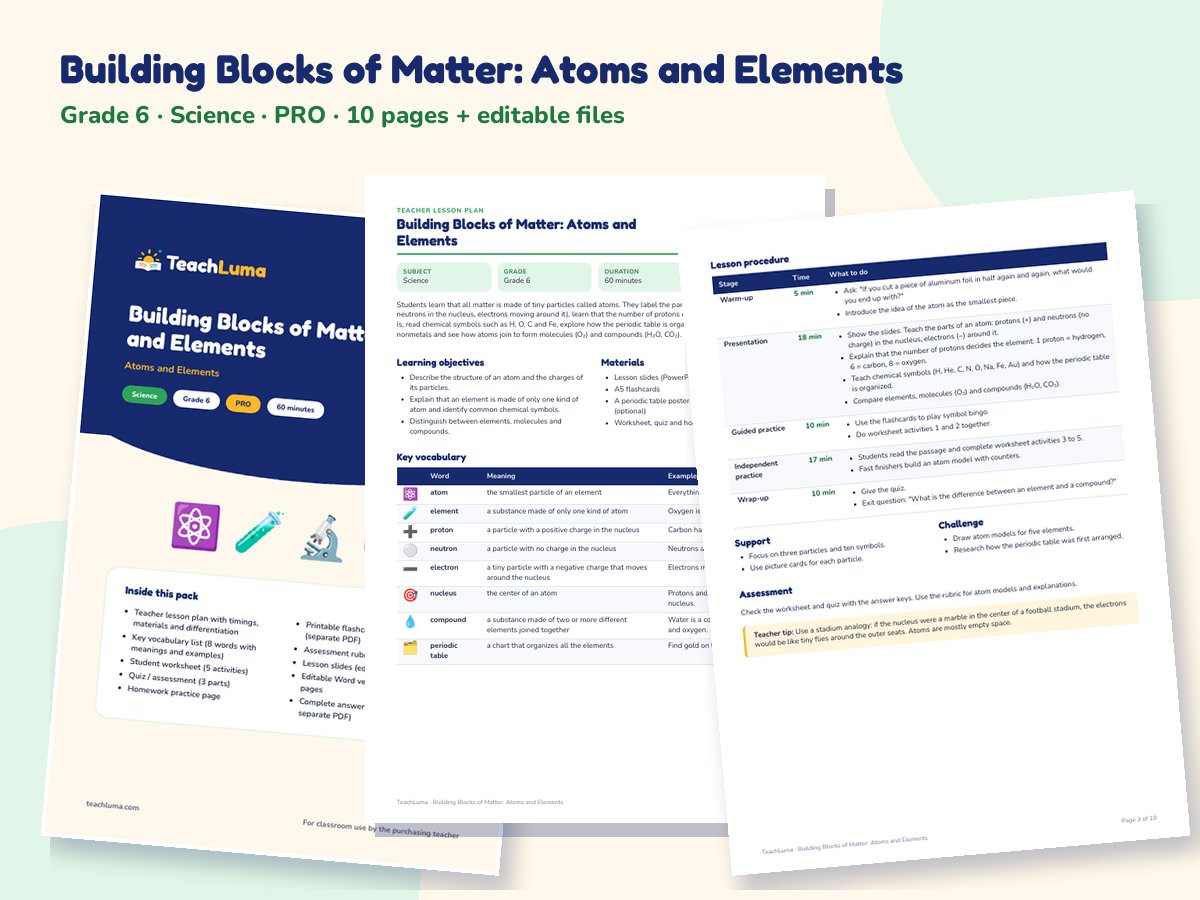
  • 10-page printable PDF lesson pack: teacher lesson plan with timings, materials and differentiation
  • Key vocabulary list (8 words with meanings and examples)
  • Student worksheet (5 activities)
  • Quiz / assessment (3 parts)
  • Homework practice page
  • Printable flashcards: 8 A5 picture cards (separate PDF)
  • Assessment rubric (4 levels)
  • Lesson slides (editable PowerPoint)
  • Editable Word version of all student pages
  • Complete answer key (also as a separate PDF)

Additional Files

  • Lesson Slides (PowerPoint, editable) (PPTX)
  • Editable Student Pages + Lesson Plan (Word) (DOCX)
  • Flashcards (PDF, A5, one card per page) (PDF)
  • Answer Key (PDF) (PDF)

Teacher Reviews

No ratings yet

Be the first teacher to review this resource.

Sign in to review this resource.

Related Resources

Advertisement