Skip to content
Preview
Free ESL Worksheet Grade 8 (Year 9)
No ratings yet

Buy It Now! Persuasive Techniques in Advertising

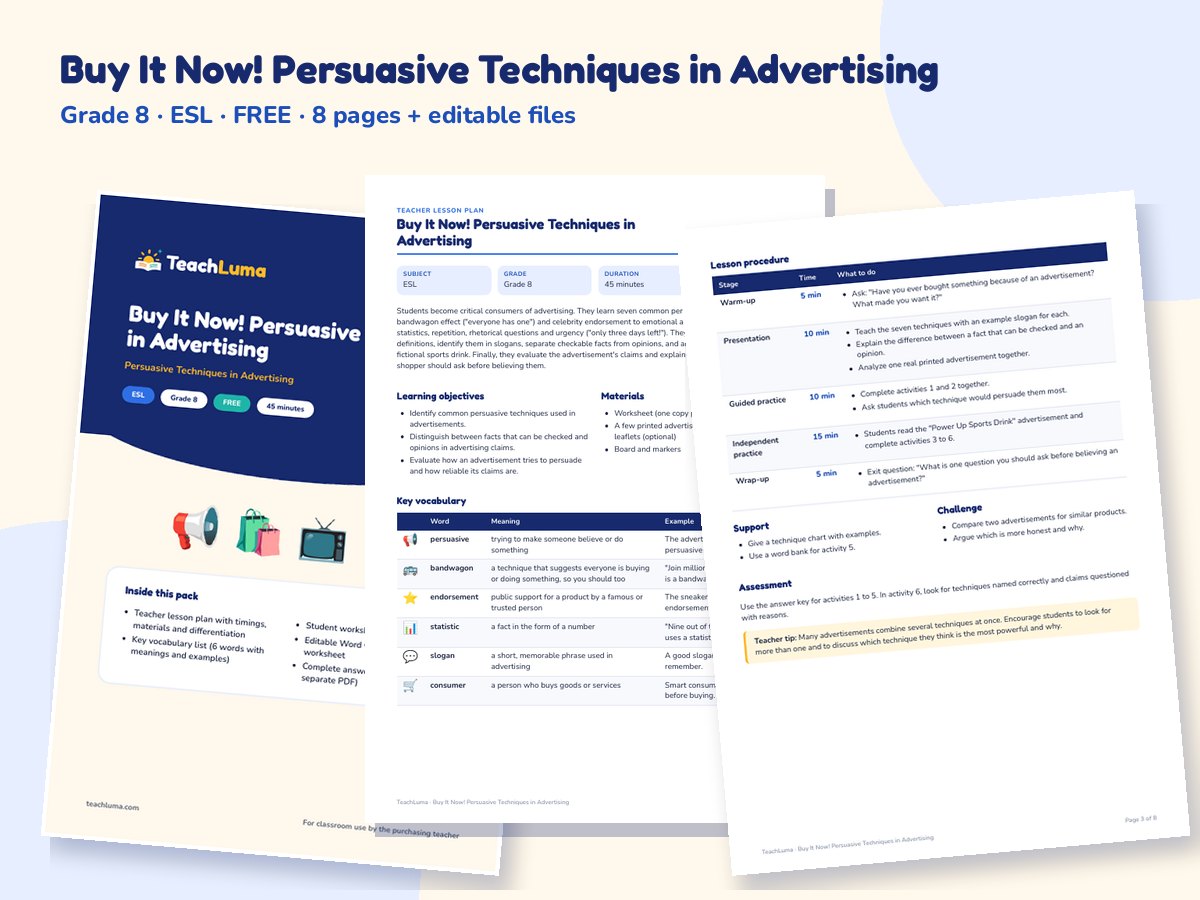
About This Resource

A free Grade 8 ESL reading worksheet on persuasive techniques in advertising: bandwagon, celebrity endorsement, emotional appeal, statistics, repetition, rhetorical questions and urgency, telling facts from opinions in advertising claims, analyzing a full advertisement for a sports drink, and evaluating whether an advertisement's claims can be trusted. Includes a timed lesson plan, a six-activity worksheet, an editable Word version and answer key.

Overview

Students become critical consumers of advertising. They learn seven common persuasive techniques, from the bandwagon effect ("everyone has one") and celebrity endorsement to emotional appeals, impressive-sounding statistics, repetition, rhetorical questions and urgency ("only three days left!"). They match techniques to their definitions, identify them in slogans, separate checkable facts from opinions, and analyze an advertisement for a fictional sports drink. Finally, they evaluate the advertisement's claims and explain what questions a smart shopper should ask before believing them.

Resource Details

Subject
ESL
Topic
Persuasive Techniques in Advertising
Category
Reading
File Type
PDF
File Size
284.3 KB
Published
04 Nov 2026
Downloads
1
Download

Free download — no account required.

Teaching this in class? Try our free Random Name Picker & Timer.

Share:

Looking for something different? Request a Resource.

Grade 8 (ages 13–14) 45 minutes Critical reading media literacy fact and opinion analyzing evaluating

Student Task

  • Ask: "Have you ever bought something because of an advertisement? What made you want it?" List ideas.
  • Teach the seven techniques with examples, then do activities 1 and 2 together.
  • Students complete activities 3 to 6. Answers are in the answer key.

Classroom Use

  • Advertisement hunt: students collect three advertisements from magazines, leaflets or websites and label the techniques used.
  • Sell the ordinary: groups create a short radio advertisement for an everyday object, such as a pencil, using at least three techniques.
  • Claim check: choose one advertising claim and discuss what evidence would be needed to prove it.

Differentiation

Support: give a technique chart with one example slogan for each and a word bank. Challenge: compare two advertisements for similar products and argue which is more persuasive and which is more honest.

Answer Key & Assessment

Activities 1 to 5 check identifying techniques and separating facts from opinions (answer key included). Activity 6 checks evaluation and creating persuasive language.

Learning Objectives

  • Identify common persuasive techniques used in advertisements.
  • Distinguish between facts that can be checked and opinions in advertising claims.
  • Evaluate how an advertisement tries to persuade and how reliable its claims are.

Teacher Tips

Many advertisements combine several techniques at once. Encourage students to look for more than one and to discuss which technique they think is the most powerful and why.

What's Included

  • 8-page printable PDF lesson pack: teacher lesson plan with timings, materials and differentiation
  • Key vocabulary list (6 words with meanings and examples)
  • Student worksheet (6 activities)
  • Editable Word version of the worksheet
  • Complete answer key (also as a separate PDF)

Additional Files


Teacher Reviews

No ratings yet

Be the first teacher to review this resource.

Sign in to review this resource.

Related Resources

Advertisement