Skip to content
Preview
Free ESL Worksheet Grade 7 (Year 8)
No ratings yet

Word Detectives: Using Context Clues

About This Resource

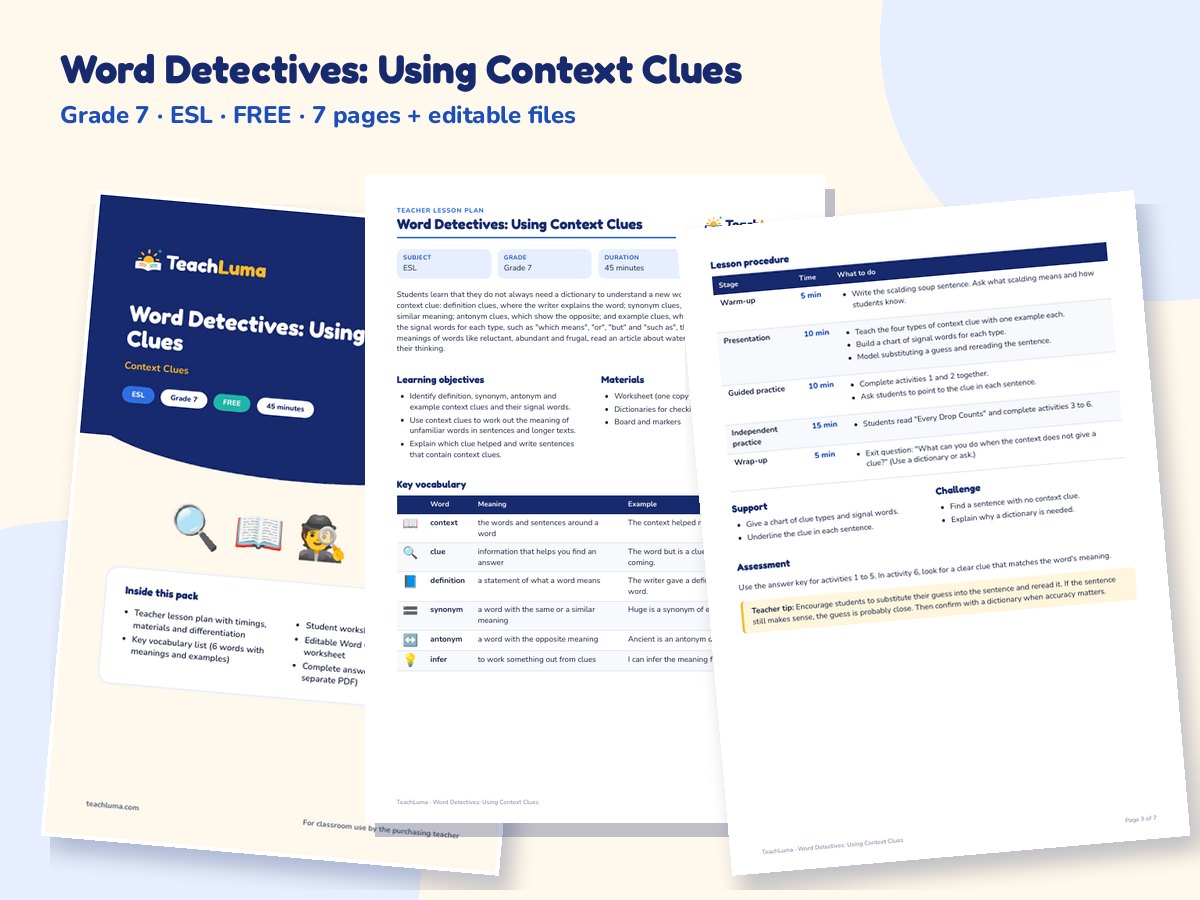
A free Grade 7 ESL reading worksheet on context clues: working out the meaning of unfamiliar words from the words around them, the four main types of clue (definition, synonym, antonym and example), the signal words that point to each type, and practice with real academic vocabulary in sentences and a short article about a desert town. Includes a timed lesson plan, a six-activity worksheet, an editable Word version and answer key.

Overview

Students learn that they do not always need a dictionary to understand a new word. They study four types of context clue: definition clues, where the writer explains the word; synonym clues, which give a word with a similar meaning; antonym clues, which show the opposite; and example clues, which list examples. They learn the signal words for each type, such as "which means", "or", "but" and "such as", then use clues to work out the meanings of words like reluctant, abundant and frugal, read an article about water in a desert town and explain their thinking.

Resource Details

Subject
ESL
Topic
Context Clues
Category
Reading
File Type
PDF
File Size
273.5 KB
Published
04 Nov 2026
Downloads
1
Download

Free download — no account required.

Teaching this in class? Try our free Random Name Picker & Timer.

Share:

Looking for something different? Request a Resource.

Grade 7 (ages 12–13) 45 minutes Reading comprehension vocabulary inference explaining reasoning

Student Task

  • Write: "The soup was so scalding that I burned my tongue." Ask, "What does scalding mean? How do you know?"
  • Teach the four types of clue and their signal words, then do activities 1 and 2 together.
  • Students complete activities 3 to 6. Answers are in the answer key.

Classroom Use

  • Clue hunt: students find three unfamiliar words in a class reader, guess their meanings from context, then check in a dictionary.
  • Nonsense swap: replace one word in a sentence with a blank and ask students which real words could fit, using only the context.
  • Clue writers: pairs write sentences with a tricky word and a context clue, then swap with another pair to solve.

Differentiation

Support: give a chart of clue types with signal words and underline the clue in each sentence. Challenge: find a sentence in a newspaper or textbook where the context gives no clue, and explain why a dictionary is needed.

Answer Key & Assessment

Activities 1 to 5 check clue types and word meanings (answer key included). Activity 6 checks explaining clues and writing with context clues.

Learning Objectives

  • Identify definition, synonym, antonym and example context clues and their signal words.
  • Use context clues to work out the meaning of unfamiliar words in sentences and longer texts.
  • Explain which clue helped and write sentences that contain context clues.

Teacher Tips

Encourage students to substitute their guess into the sentence and reread it. If the sentence still makes sense, the guess is probably close. Then confirm with a dictionary when accuracy matters.

What's Included

  • 7-page printable PDF lesson pack: teacher lesson plan with timings, materials and differentiation
  • Key vocabulary list (6 words with meanings and examples)
  • Student worksheet (6 activities)
  • Editable Word version of the worksheet
  • Complete answer key (also as a separate PDF)

Additional Files


Teacher Reviews

No ratings yet

Be the first teacher to review this resource.

Sign in to review this resource.

Related Resources

Advertisement