Skip to content
Preview
Members Only Science Complete Lesson Pack Grade 5 (Year 6)
No ratings yet

Can We Undo It? Reversible and Irreversible Changes

About This Resource

A complete Grade 5 science pack on reversible and irreversible changes: changes we can undo, such as melting, freezing, dissolving and evaporating, and changes that make new materials, such as cooking, burning and rusting. Students learn the signs of a new material (gas bubbles, a color change, light or heat), test a baking soda reaction and sort everyday changes. Includes slides with notes, a lesson plan, worksheet, quiz, homework, flashcards, a rubric and answer keys.

Overview

Students learn that materials can change in two ways. In a reversible change, no new material is made and we can get the original material back: ice melts and freezes again, and salt dissolved in water can be recovered by evaporating the water. In an irreversible change, one or more new materials are made and we cannot easily get the original back: cooking an egg, baking bread, burning wood and rusting iron are all irreversible. Students learn four signs that a new material has formed, carry out a safe baking soda and vinegar test, and sort everyday changes from the kitchen, the garden and the street.

Resource Details

Subject
Science
Topic
Reversible and Irreversible Changes
Category
Materials & Matter
File Type
PDF
File Size
378.1 KB
Published
08 Nov 2026
Downloads
0

Members Only

Upgrade to Teacher Pro (from ฿199/month) to download this resource.

Share:

Looking for something different? Request a Resource.

Grade 5 (ages 10–11) 55 minutes Physical science observing classifying explaining investigating safely

Learning Objectives

  • Explain the difference between reversible and irreversible changes.
  • Give examples of each, including melting, dissolving, cooking, burning and rusting.
  • Use signs such as gas bubbles, a color change, light or heat to tell when a new material has formed.

How to Use This Resource

  • Start with the slides: show an ice cube and a fried egg and ask, "Can we change each one back?"
  • Teach the two kinds of change with the slides and flashcards, then do the baking soda test and worksheet activities 1 and 2 together.
  • Students complete activities 3 to 6, then use the quiz and send the homework page home.

Classroom Activity Ideas

  • Fizz test: add a spoon of baking soda to vinegar in a cup and observe the bubbles; discuss why this is irreversible.
  • Salt recovery: dissolve salt in warm water, pour a little onto a dark plate and leave it in a sunny place to see the salt crystals return.
  • Change hunt: students photograph or draw changes at home, such as toast, ice pops or a rusty gate, and sort them.

Differentiation

Support: give a picture sort with a clear question on each card: "Can we get it back?" Challenge: students explain why burning a candle includes both a reversible change (melting wax) and an irreversible change (burning).

Assessment

Use the worksheet and quiz to check classifying changes and using signs of a new material. Use the rubric during the fizz test and for the homework change hunt.

Teacher Tips

Students often think dissolving is irreversible because the solid disappears. The salt recovery activity shows that the salt is still there. Teachers should handle any heat or flame demonstrations, and students should wear goggles for the fizz test.

What's Included

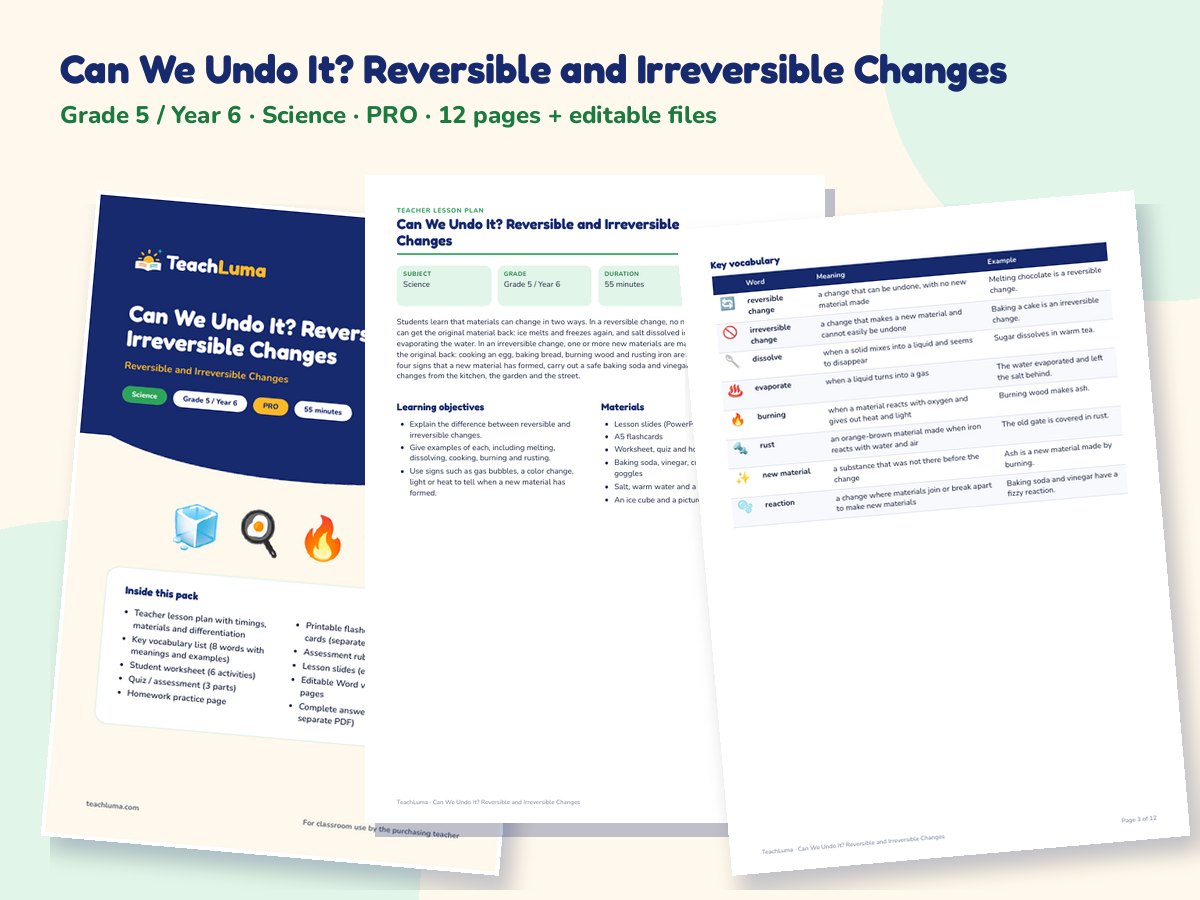
  • 12-page printable PDF lesson pack: teacher lesson plan with timings, materials and differentiation
  • Key vocabulary list (8 words with meanings and examples)
  • Student worksheet (6 activities)
  • Quiz / assessment (3 parts)
  • Homework practice page
  • Printable flashcards: 8 A5 picture cards (separate PDF)
  • Assessment rubric (4 levels)
  • Lesson slides (editable PowerPoint)
  • Editable Word version of all student pages
  • Complete answer key (also as a separate PDF)

Additional Files

  • Lesson Slides (PPTX)
  • Editable Student Pages and Lesson Plan (DOCX)
  • A5 Flashcards (PDF)
  • Answer Key (PDF)

Teacher Reviews

No ratings yet

Be the first teacher to review this resource.

Sign in to review this resource.

Related Resources

Advertisement