Skip to content
Preview
Members Only ESL Complete Lesson Pack Grade 10 (Year 11)
No ratings yet

Claim, Evidence, Analysis: Writing a Literary Analysis Paragraph

About This Resource

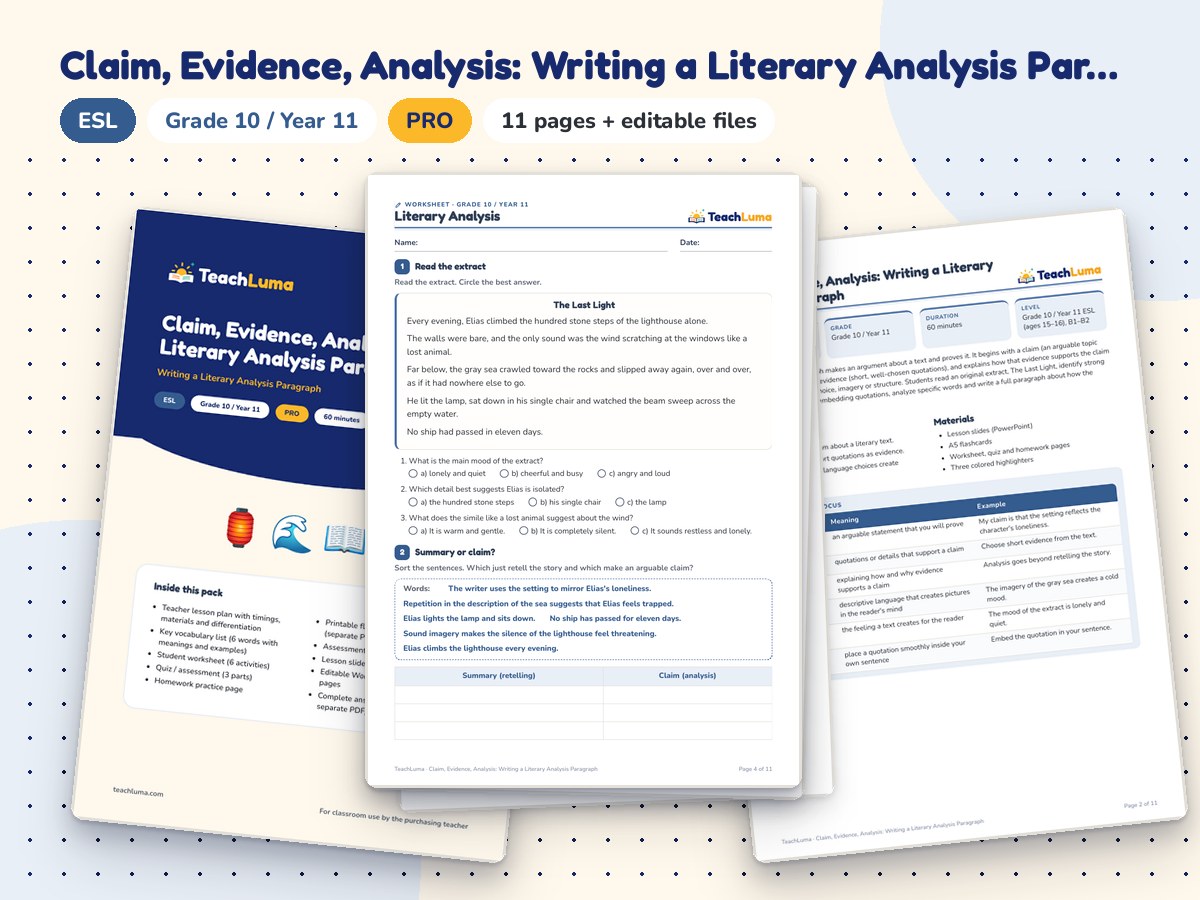
A complete Grade 10 ESL writing pack on literary analysis paragraphs. Using an original short story extract about a lighthouse keeper, students learn the claim–evidence–analysis structure, write arguable topic sentences, embed short quotations smoothly and explain how language creates meaning and mood. Includes slides, a lesson plan, worksheet, quiz, homework, A5 flashcards, a rubric, Word files and answer keys.

Overview

A literary analysis paragraph makes an argument about a text and proves it. It begins with a claim (an arguable topic sentence), supports it with evidence (short, well-chosen quotations), and explains how that evidence supports the claim through analysis of word choice, imagery or structure. Students read an original extract, The Last Light, identify strong and weak claims, practice embedding quotations, analyze specific words and write a full paragraph about how the writer presents loneliness.

Resource Details

Subject
ESL
Topic
Writing a Literary Analysis Paragraph
Category
Writing
File Type
PDF
File Size
374.2 KB
Published
20 Nov 2026
Downloads
0

Members Only

Create a free account to download this resource with one of your 3 Free Pro Previews, or upgrade to Teacher Pro (from ฿199/month) for the whole library.

Share:

Looking for something different? Request a Resource.

Grade 10 ESL (ages 15–16), B1–B2 60 minutes Academic writing literary analysis close reading

Learning Objectives

  • Write an arguable claim about a literary text.
  • Select and embed short quotations as evidence.
  • Analyze how specific language choices create meaning or mood.

How to Use This Resource

  • Ask: "What is the difference between retelling a story and analyzing it?"
  • Read the extract and teach claim, evidence and analysis with the slides, then do activities 1 and 2 together.
  • Students complete activities 3 to 6. Use the quiz and send the homework page home.

Classroom Activity Ideas

  • Claim ladder: students rank claims from summary to strong argument.
  • Quotation surgery: students shorten long quotations to the most powerful words.
  • Peer check: partners color-code each other's paragraphs (claim, evidence, analysis).

Differentiation

Support: give a paragraph frame with sentence starters for each part. Challenge: students analyze two techniques and link them in one paragraph.

Assessment

Use the worksheet and quiz to check understanding of the structure. Use the rubric for the full paragraph.

Teacher Tips

The most common problem is summary instead of analysis. Teach students to zoom in on single words: Why bare? What does crawled suggest? Encourage analytical verbs such as suggests, emphasizes, reveals and conveys.

What's Included

  • 11-page printable PDF lesson pack: teacher lesson plan with timings, materials and differentiation
  • Key vocabulary list (6 words with meanings and examples)
  • Student worksheet (6 activities)
  • Quiz / assessment (3 parts)
  • Homework practice page
  • Printable flashcards: 6 A5 picture cards (separate PDF)
  • Assessment rubric (4 levels)
  • Lesson slides (editable PowerPoint)
  • Editable Word version of all student pages
  • Complete answer key (also as a separate PDF)

Additional Files

  • Lesson Slides (PPTX)
  • Editable Student Pages and Lesson Plan (DOCX)
  • A5 Flashcards (PDF)
  • Answer Key (PDF)

Teacher Reviews

No ratings yet

Be the first teacher to review this resource.

Sign in to review this resource.

Related Resources

Advertisement