Skip to content
Preview
Members Only ESL Complete Lesson Pack Grade 10 (Year 11)
No ratings yet

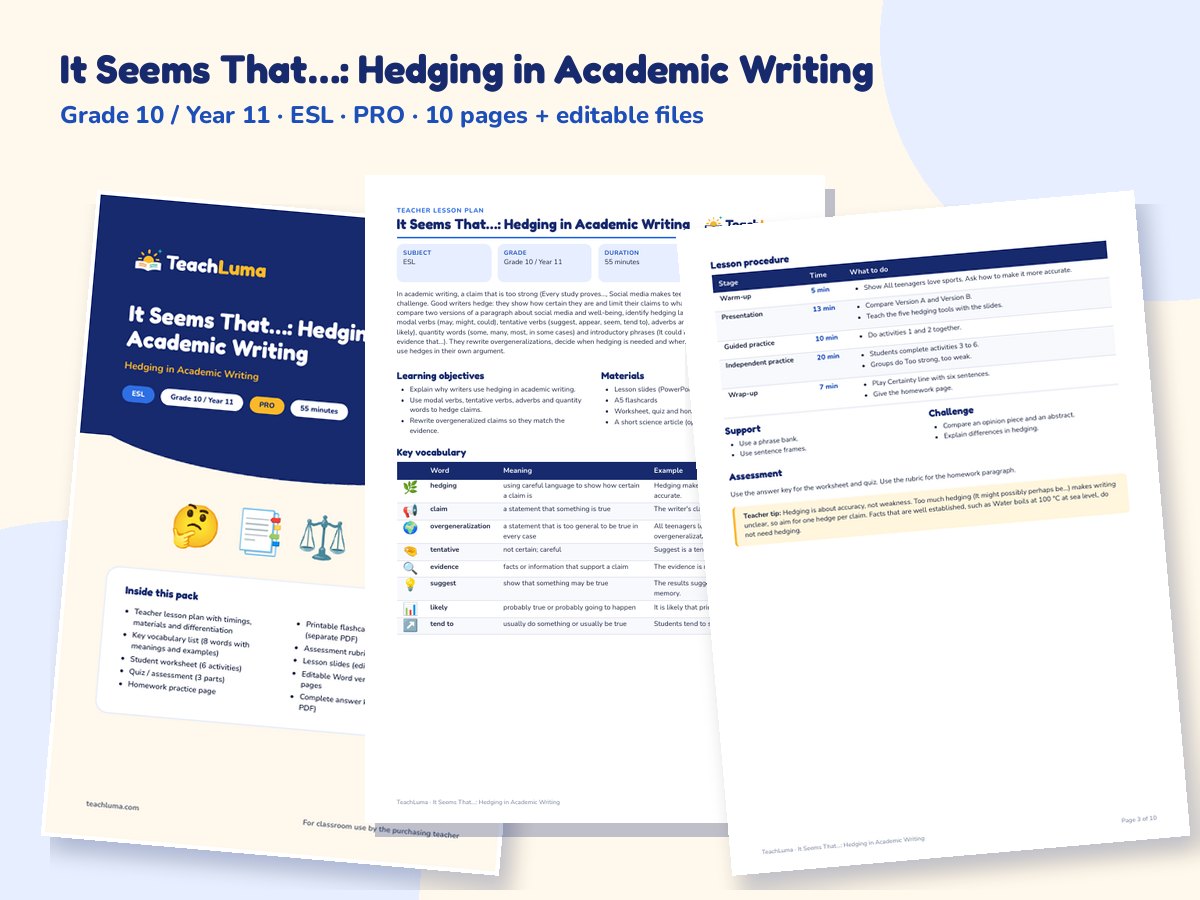
It Seems That…: Hedging in Academic Writing

About This Resource

A complete Grade 10 ESL writing pack on hedging, the careful language writers use to avoid overstating claims. Students compare a strong and a hedged paragraph, learn modal verbs (may, might, could), tentative verbs (suggest, appear, seem), adverbs (possibly, generally, likely) and quantity hedges (some, many, in most cases), rewrite overgeneralizations and hedge claims in their own essays. Includes slides, a lesson plan, worksheet, quiz, homework, flashcards, a rubric and answer keys.

Overview

In academic writing, a claim that is too strong (Every study proves…, Social media makes teenagers unhappy) is easy to challenge. Good writers hedge: they show how certain they are and limit their claims to what the evidence supports. Students compare two versions of a paragraph about social media and well-being, identify hedging language, and learn five tools: modal verbs (may, might, could), tentative verbs (suggest, appear, seem, tend to), adverbs and adjectives (possibly, probably, likely), quantity words (some, many, most, in some cases) and introductory phrases (It could be argued that…, There is some evidence that…). They rewrite overgeneralizations, decide when hedging is needed and when a fact can be stated directly, and use hedges in their own argument.

Resource Details

Subject
ESL
Topic
Hedging in Academic Writing
Category
Writing
File Type
PDF
File Size
327 KB
Published
13 Nov 2026
Downloads
0

Members Only

Create a free account to download this resource with one of your 3 Free Pro Previews, or upgrade to Teacher Pro (from ฿199/month) for the whole library.

Share:

Looking for something different? Request a Resource.

Grade 10 ESL (ages 15–16), B2 55 minutes Academic writing critical thinking modal verbs evaluating claims

Learning Objectives

  • Explain why writers use hedging in academic writing.
  • Use modal verbs, tentative verbs, adverbs and quantity words to hedge claims.
  • Rewrite overgeneralized claims so they match the evidence.

How to Use This Resource

  • Show the slides: All teenagers love sports. Ask: "Is this true? How could you make it more accurate?"
  • Read the two versions of the paragraph and do worksheet activities 1 and 2 together.
  • Students complete activities 3 to 6, then use the quiz and send the homework page home.

Classroom Activity Ideas

  • Certainty line: students place sentences on a line from certain to possible.
  • Hedge hunt: students find hedging language in a science article or textbook.
  • Too strong, too weak: groups rewrite claims that are overgeneralized and claims that are so hedged they say nothing.

Differentiation

Support: give a hedging phrase bank sorted into five groups and sentence frames. Challenge: students analyze a newspaper opinion piece and an academic abstract and compare how much they hedge.

Assessment

Use the worksheet and quiz to check identification and use of hedges. Use the rubric to assess the homework paragraph.

Teacher Tips

Hedging is about accuracy, not weakness. Too much hedging (It might possibly perhaps be…) makes writing unclear, so aim for one hedge per claim. Facts that are well established, such as Water boils at 100 °C at sea level, do not need hedging.

What's Included

  • 10-page printable PDF lesson pack: teacher lesson plan with timings, materials and differentiation
  • Key vocabulary list (8 words with meanings and examples)
  • Student worksheet (6 activities)
  • Quiz / assessment (3 parts)
  • Homework practice page
  • Printable flashcards: 8 A5 picture cards (separate PDF)
  • Assessment rubric (4 levels)
  • Lesson slides (editable PowerPoint)
  • Editable Word version of all student pages
  • Complete answer key (also as a separate PDF)

Additional Files

  • Lesson Slides (PPTX)
  • Editable Student Pages and Lesson Plan (DOCX)
  • A5 Flashcards (PDF)
  • Answer Key (PDF)

Teacher Reviews

No ratings yet

Be the first teacher to review this resource.

Sign in to review this resource.

Related Resources

Advertisement