Skip to content
Preview
Members Only Science Lesson Plan Grade 4
No ratings yet

Classifying Animals: Vertebrates and Invertebrates

About This Resource

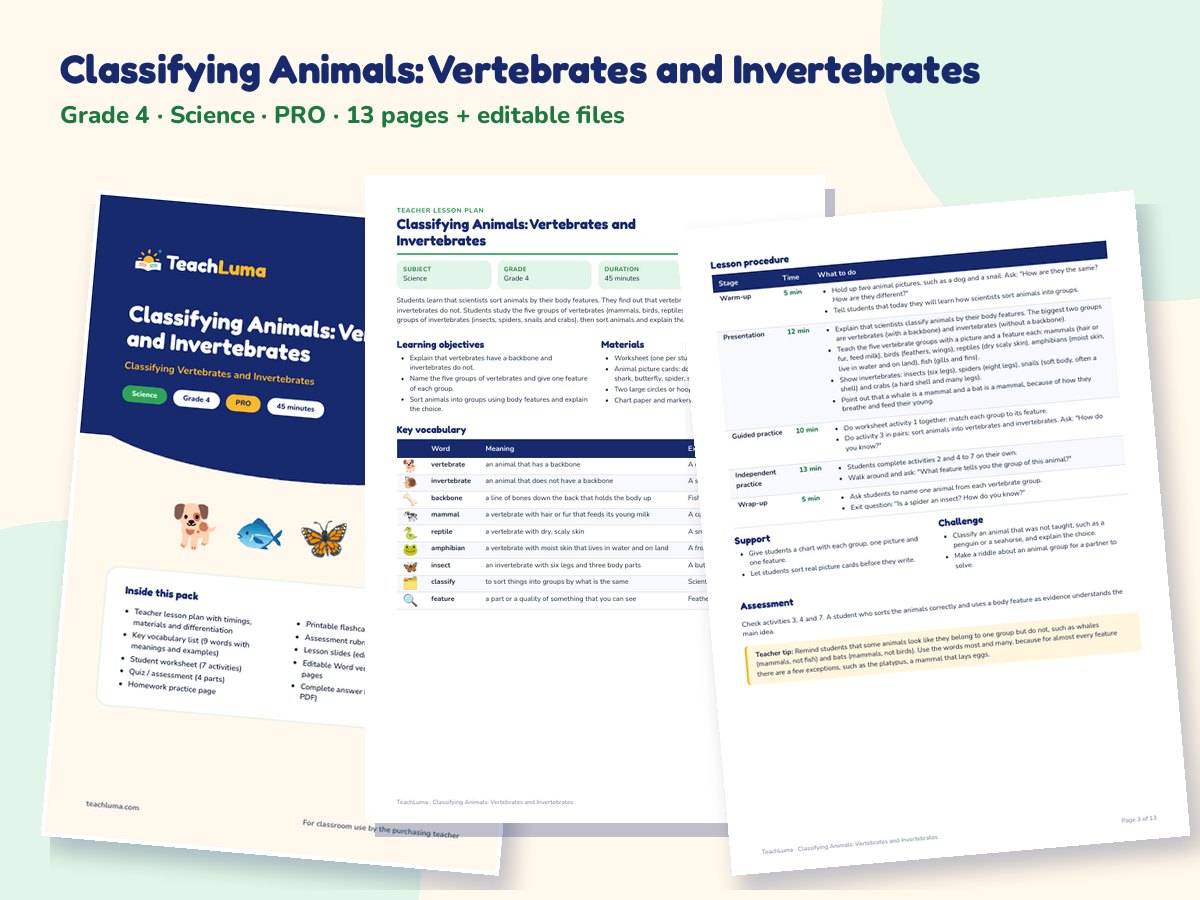
A complete Grade 4 science pack on sorting animals into vertebrates and invertebrates. Students learn the five groups of vertebrates and common invertebrates. Includes quiz, homework and rubric.

Overview

Students learn that scientists sort animals by their body features. They find out that vertebrates have a backbone and invertebrates do not. Students study the five groups of vertebrates (mammals, birds, reptiles, amphibians and fish) and some groups of invertebrates (insects, spiders, snails and crabs), then sort animals and explain their choices with evidence.

Resource Details

Subject
Science
Topic
Classifying Vertebrates and Invertebrates
Category
Living Things
File Type
PDF
File Size
439.6 KB
Published
28 Oct 2026
Downloads
0

Members Only

Upgrade to Teacher Pro (from ฿199/month) to download this resource.

Share:

Looking for something different? Request a Resource.


Grade 4 (ages 9–10) 45 minutes Classifying comparing features scientific vocabulary giving evidence explaining

Learning Objectives

  • Explain that vertebrates have a backbone and invertebrates do not.
  • Name the five groups of vertebrates and give one feature of each group.
  • Sort animals into groups using body features and explain the choice.

Lesson Procedure

  • Use the lesson plan to teach the lesson in about 45 minutes.
  • Print the worksheet for guided and independent practice.
  • Use the quiz to check learning and the homework for practice at home.
  • Use the rubric to record each student's level.

Assessment

Check the sorting and true or false activities for accuracy. Students who put dolphins with fish need to look at how a dolphin breathes and feeds its young. Use the quiz and rubric for a record.

Differentiation

Support: give students a chart with the five vertebrate groups and one picture of each. Challenge: ask students to classify an animal they have not studied, such as a penguin or a seahorse, and explain their choice.

Classroom Activity Ideas

  • Animal sort: students sort animal picture cards into vertebrates and invertebrates and then into groups.
  • Backbone feel: students feel their own backbone and talk about how it helps them move.
  • Mystery animal: one student gives clues, such as has feathers and lays eggs, and the class guesses the group.

Teacher Tips

Remind students that some animals look like they belong to one group but do not, such as whales (mammals, not fish) and bats (mammals, not birds). Use the words most and many, because for almost every feature there are a few exceptions, such as the platypus, a mammal that lays eggs.

What's Included

  • 13-page printable PDF lesson pack: teacher lesson plan with timings, materials and differentiation
  • Key vocabulary list (9 words with meanings and examples)
  • Student worksheet (7 activities)
  • Quiz / assessment (4 parts)
  • Homework practice page
  • Printable flashcards (9 picture cards)
  • Assessment rubric (4 levels)
  • Lesson slides (editable PowerPoint)
  • Editable Word version of all student pages
  • Complete answer key (also as a separate PDF)

Additional Files

  • Lesson Slides (PowerPoint, editable) (PPTX)
  • Editable Student Pages + Lesson Plan (Word) (DOCX)
  • Printable Flashcards (PDF) (PDF)
  • Answer Key (PDF) (PDF)

Teacher Reviews

No ratings yet

Be the first teacher to review this resource.

Sign in to review this resource.

Related Resources

Advertisement