Skip to content
Preview
Members Only ESL Complete Lesson Pack Grade 9 (Year 10)
No ratings yet

Could You Tell Me...? Indirect Questions

About This Resource

A complete Grade 9 ESL grammar lesson pack on indirect questions: why we use them to sound polite, introductory phrases such as Could you tell me...? and Do you know...?, statement word order after the question word, if or whether for yes/no questions, removing do, does and did, correct punctuation, and using indirect questions at a hotel, in a shop and in interviews. Includes slides, a timed lesson plan, flashcards, worksheet, quiz, homework, rubric and answer key.

Overview

Students learn that indirect questions make requests for information sound more polite and less direct, which is especially useful with strangers, teachers and in formal situations. They study common introductory phrases (Could you tell me...?, Do you know...?, I was wondering..., I'd like to know...) and the key grammar change: after the question word, the word order becomes subject + verb, and do, does and did disappear. For yes/no questions, they use if or whether. Students transform direct questions, correct errors, read a dialogue at a hotel reception and role-play polite conversations.

Resource Details

Subject
ESL
Topic
Indirect Questions
Category
Grammar
File Type
PDF
File Size
354 KB
Published
04 Nov 2026
Downloads
0

Members Only

Upgrade to Teacher Pro (from ฿199/month) to download this resource.

Share:

Looking for something different? Request a Resource.

Grade 9 (ages 14–15) 55 minutes Grammar word order polite language speaking error correction

Learning Objectives

  • Explain why indirect questions are used and identify common introductory phrases.
  • Change direct questions into indirect questions with correct word order, if or whether, and no auxiliary do.
  • Use indirect questions politely in real-life situations, with correct punctuation.

How to Use This Resource

  • Start with slide 1: "Where is the toilet?" and "Could you tell me where the toilet is?" Ask, "Which sounds more polite? What changed?"
  • Teach the introductory phrases, word order, if/whether and punctuation with the slides, then do activities 1 and 2 together.
  • Students complete activities 3 to 6, then use the quiz to check and the homework role-play. Answers are in the answer key.

Classroom Activity Ideas

  • Tourist information: one student is a tourist and one works at an information desk. The tourist must ask five indirect questions.
  • Politeness ladder: write a direct question on the board and students climb the ladder by making it more and more polite.
  • Mystery interview: students interview a classmate who plays a famous fictional character, using only indirect questions.

Differentiation

Support: give a chart of introductory phrases and a word order table (question word + subject + verb). Challenge: write a polite email to a summer camp asking four indirect questions about dates, prices, activities and accommodation.

Assessment

Worksheet activities 1 to 5 and the quiz check word order, if/whether, auxiliaries and punctuation (answer key included). Activity 6 and the homework role-play are assessed with the rubric.

Teacher Tips

Students often keep question word order: "Can you tell me where is the bank?" Teach the check: after the question word, say the words as if you were giving the answer — "where the bank is".

What's Included

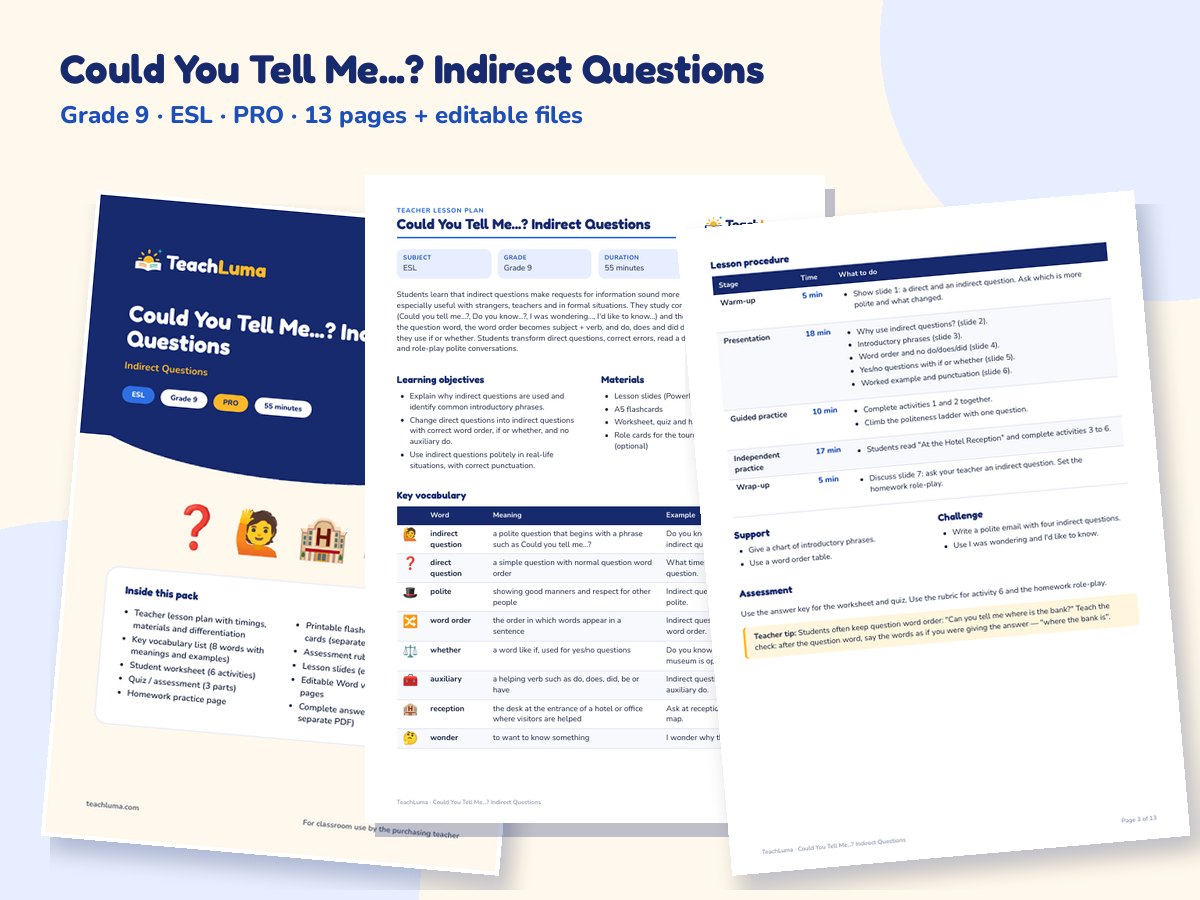
  • 13-page printable PDF lesson pack: teacher lesson plan with timings, materials and differentiation
  • Key vocabulary list (8 words with meanings and examples)
  • Student worksheet (6 activities)
  • Quiz / assessment (3 parts)
  • Homework practice page
  • Printable flashcards: 8 A5 picture cards (separate PDF)
  • Assessment rubric (4 levels)
  • Lesson slides (editable PowerPoint)
  • Editable Word version of all student pages
  • Complete answer key (also as a separate PDF)

Additional Files

  • Lesson Slides (PPTX)
  • Editable Student Pages and Lesson Plan (DOCX)
  • A5 Flashcards (PDF)
  • Answer Key (PDF)

Teacher Reviews

No ratings yet

Be the first teacher to review this resource.

Sign in to review this resource.

Related Resources

Advertisement