Skip to content
Preview
Members Only ESL Complete Lesson Pack Grade 9 (Year 10)
No ratings yet

It Must Be a Clue! Modal Verbs of Deduction

About This Resource

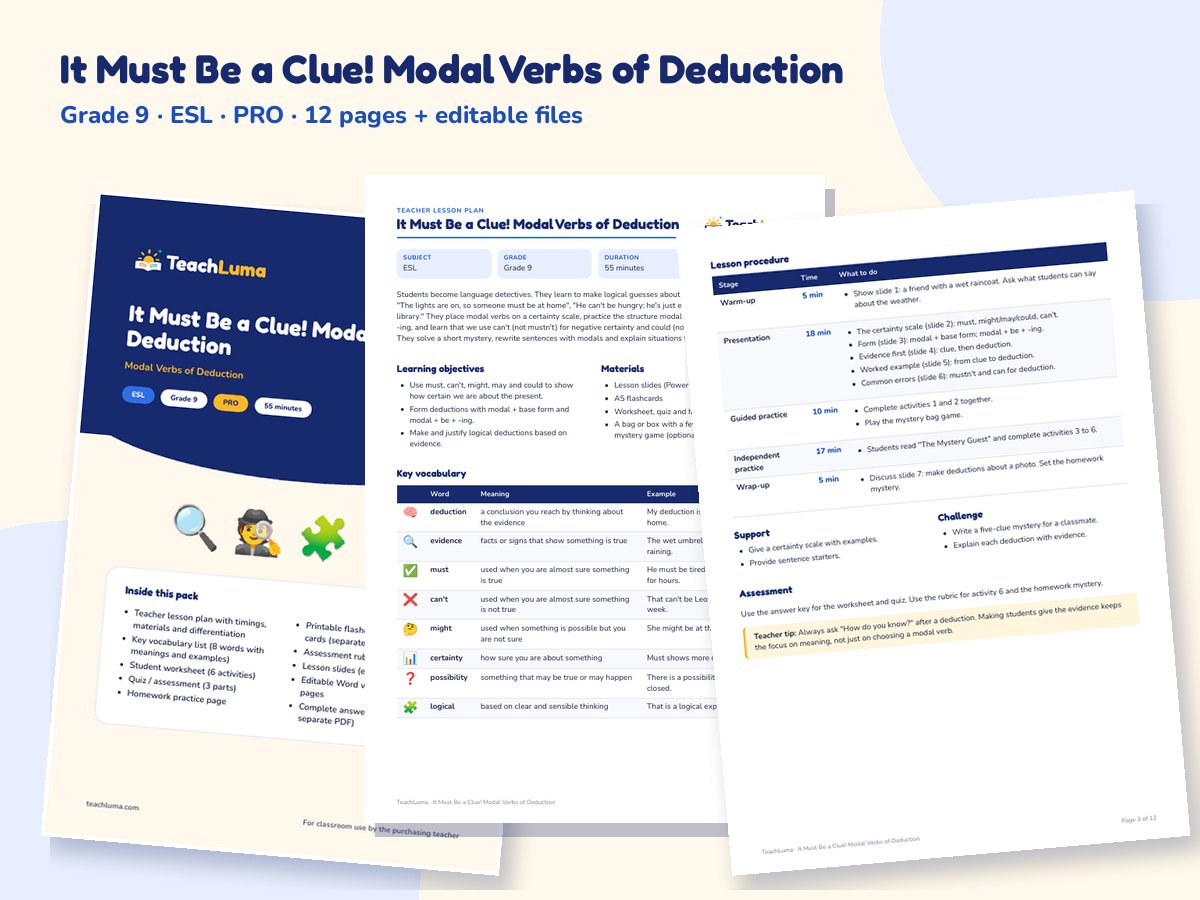
A complete Grade 9 ESL grammar lesson pack on modal verbs of deduction in the present: must for things we are sure are true, can't for things we are sure are not true, and might, may and could for possibilities, with the base form and the continuous form (must be sleeping), reasoning from evidence, and common errors such as "mustn't" and "can" for deduction. Includes slides, a timed lesson plan, flashcards, worksheet, quiz, homework, rubric and answer key.

Overview

Students become language detectives. They learn to make logical guesses about the present based on evidence: "The lights are on, so someone must be at home", "He can't be hungry; he's just eaten" and "She might be at the library." They place modal verbs on a certainty scale, practice the structure modal + base form and modal + be + -ing, and learn that we use can't (not mustn't) for negative certainty and could (not can) for present possibility. They solve a short mystery, rewrite sentences with modals and explain situations from clues.

Resource Details

Subject
ESL
Topic
Modal Verbs of Deduction
Category
Grammar
File Type
PDF
File Size
360.5 KB
Published
04 Nov 2026
Downloads
0

Members Only

Upgrade to Teacher Pro (from ฿199/month) to download this resource.

Share:

Looking for something different? Request a Resource.

Grade 9 (ages 14–15) 55 minutes Grammar reasoning from evidence speaking reading writing explanations

Learning Objectives

  • Use must, can't, might, may and could to show how certain we are about the present.
  • Form deductions with modal + base form and modal + be + -ing.
  • Make and justify logical deductions based on evidence.

How to Use This Resource

  • Start with slide 1: "Your friend is wearing a wet raincoat and holding an umbrella." Ask, "What can you say about the weather?"
  • Teach the certainty scale, the forms and the common errors with the slides, then do activities 1 and 2 together.
  • Students complete activities 3 to 6, then use the quiz to check and the homework mystery. Answers are in the answer key.

Classroom Activity Ideas

  • Mystery bag: put several objects in a bag (a ticket, a key, a receipt). Students deduce who the owner might be and what they must have planned.
  • What's in the box? Students shake a closed box and make deductions: "It can't be a book; it's too light."
  • Photo detectives: show close-up photos of everyday objects and students guess what they might, must or can't be.

Differentiation

Support: give a certainty scale with the modals and an example for each, plus sentence starters. Challenge: write a short mystery with five clues for a classmate to solve using modal verbs of deduction.

Assessment

Worksheet activities 1 to 5 and the quiz check meaning, form and common errors (answer key included). Activity 6 and the homework mystery are assessed with the rubric.

Teacher Tips

Always ask "How do you know?" after a deduction. Making students give the evidence keeps the focus on meaning, not just on choosing a modal verb.

What's Included

  • 12-page printable PDF lesson pack: teacher lesson plan with timings, materials and differentiation
  • Key vocabulary list (8 words with meanings and examples)
  • Student worksheet (6 activities)
  • Quiz / assessment (3 parts)
  • Homework practice page
  • Printable flashcards: 8 A5 picture cards (separate PDF)
  • Assessment rubric (4 levels)
  • Lesson slides (editable PowerPoint)
  • Editable Word version of all student pages
  • Complete answer key (also as a separate PDF)

Additional Files

  • Lesson Slides (PPTX)
  • Editable Student Pages and Lesson Plan (DOCX)
  • A5 Flashcards (PDF)
  • Answer Key (PDF)

Teacher Reviews

No ratings yet

Be the first teacher to review this resource.

Sign in to review this resource.

Related Resources

Advertisement