Skip to content
Preview
Members Only Science Complete Lesson Pack Grade 3 (Year 4)
No ratings yet

Eight Legs, Not Six: All About Spiders

About This Resource

A complete Grade 3 science pack on spiders. Students learn that spiders are arachnids, not insects: they have eight legs, two main body parts and no antennae. They find out how spiders make silk, the different ways spiders catch food (webs, hunting and ambush), why spiders are helpful in gardens and homes, and how to observe them safely. Includes slides, a lesson plan, worksheet, quiz, homework, A5 flashcards, a rubric, Word files and answer keys.

Overview

Spiders belong to a group of animals called arachnids. Unlike insects, which have six legs, three body parts and antennae, spiders have eight legs, two body parts and no antennae. All spiders make silk from spinnerets at the back of the body. Some weave webs to trap insects, some hunt on the ground and some hide and wait. Spiders help people by eating many insects. Students compare spiders and insects, read about different spiders and observe them carefully without touching.

Resource Details

Subject
Science
Topic
Spiders
Category
Animals
File Type
PDF
File Size
375.4 KB
Published
26 Nov 2026
Downloads
0

Members Only

Create a free account to download this resource with one of your 3 Free Pro Previews, or upgrade to Teacher Pro (from ฿199/month) for the whole library.

Share:

Looking for something different? Request a Resource.

Grade 3 (ages 8–9) 45 minutes Classifying comparing reading observing

Learning Objectives

  • Explain how spiders differ from insects.
  • Describe how spiders use silk and catch food.
  • Explain why spiders are helpful.

How to Use This Resource

  • Show a spider and an ant picture. Ask: "Are they both insects? How can you tell?"
  • Teach spider features with the slides, then do activities 1 and 2 together.
  • Students complete activities 3 to 6. Use the quiz and send the homework page home.

Classroom Activity Ideas

  • Venn diagram: spiders and insects.
  • Web watch: photograph or draw a web found outdoors (without touching).
  • Leg count: count legs on pictures of minibeasts and sort them.

Differentiation

Support: give a labeled spider diagram. Challenge: research a spider that does not build webs.

Assessment

Use the worksheet and quiz to check understanding. Use the rubric for the homework observation.

Teacher Tips

Some students may be afraid of spiders. Use photos and drawings, and focus on how spiders help us.

What's Included

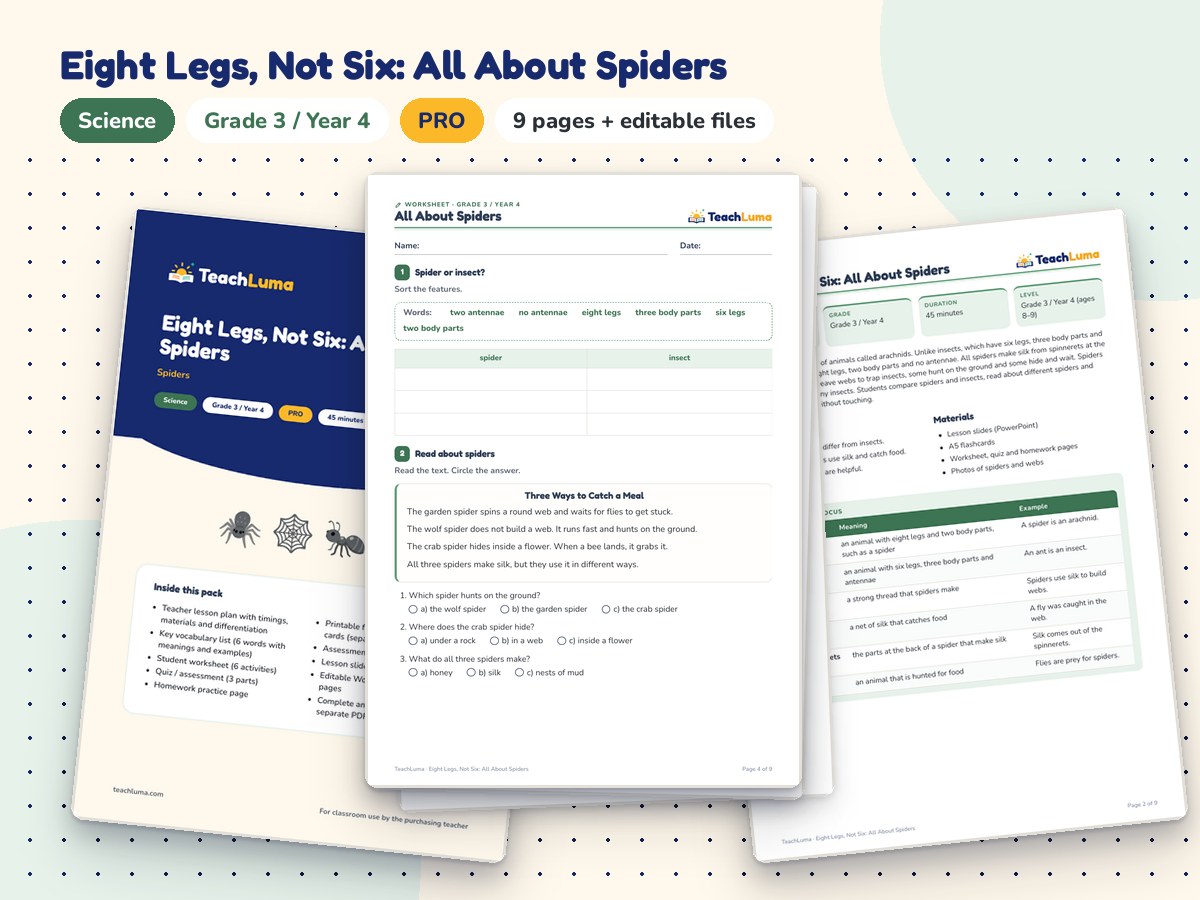
  • 9-page printable PDF lesson pack: teacher lesson plan with timings, materials and differentiation
  • Key vocabulary list (6 words with meanings and examples)
  • Student worksheet (6 activities)
  • Quiz / assessment (3 parts)
  • Homework practice page
  • Printable flashcards: 6 A5 picture cards (separate PDF)
  • Assessment rubric (4 levels)
  • Lesson slides (editable PowerPoint)
  • Editable Word version of all student pages
  • Complete answer key (also as a separate PDF)

Additional Files

  • Lesson Slides (PPTX)
  • Editable Student Pages and Lesson Plan (DOCX)
  • A5 Flashcards (PDF)
  • Answer Key (PDF)

Teacher Reviews

No ratings yet

Be the first teacher to review this resource.

Sign in to review this resource.

Related Resources

Advertisement