Skip to content
Preview
Free Science Worksheet Grade 3
No ratings yet

Built to Survive: Animal Adaptations

About This Resource

A free Grade 3 science worksheet pack on animal adaptations: body parts and behaviors that help animals survive, camouflage, thick fur and blubber, beaks and feet, hibernation and migration, matching animals to their habitats and designing an animal for a habitat. Includes a timed lesson plan, worksheet, editable Word version and answer key.

Overview

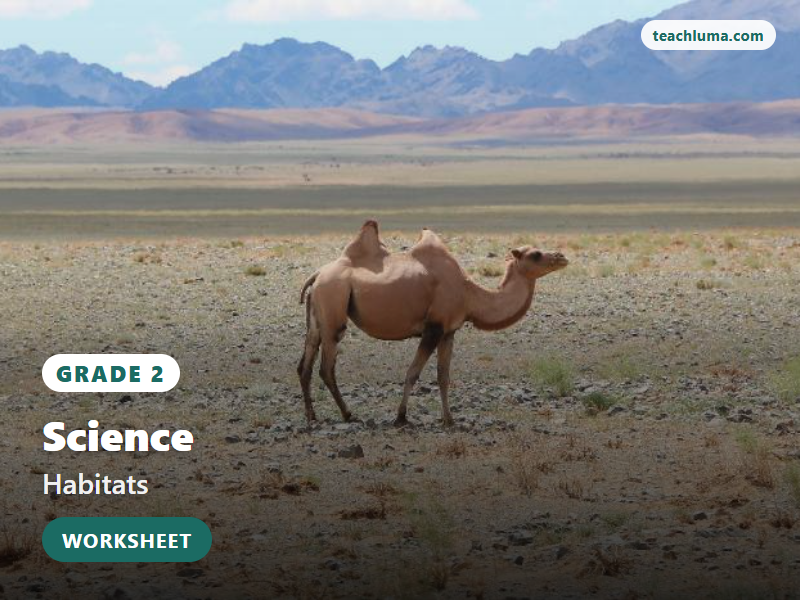
Students learn that an adaptation is a special body part or behavior that helps an animal survive in its habitat. They explore physical adaptations (a camel's hump, a polar bear's thick fur, a duck's webbed feet, a chameleon's camouflage) and behavioral adaptations (bears hibernating, birds migrating, meerkats keeping watch). Students match adaptations to their jobs, sort physical and behavioral adaptations, read about the arctic fox and explain how an adaptation helps an animal.

Resource Details

Subject
Science
Topic
Animal Adaptations
Category
Animals
File Type
PDF
File Size
304.2 KB
Published
01 Nov 2026
Downloads
0
Download

Free download — no account required.

Teaching this in class? Try our free Random Name Picker & Timer.

Share:

Looking for something different? Request a Resource.


Grade 3 (ages 8–9) 45 minutes Life science classifying reading explaining designing

Student Task

  • Show a photo of a polar bear and a camel. Ask: "Could they swap homes? Why not?"
  • Teach physical and behavioral adaptations, then do activities 1 and 2 together.
  • Students complete activities 3 to 6; answers are in the answer key.

Classroom Use

  • Beak buffet: students use tweezers, spoons and clothespins as beaks to pick up rice, marbles and water to see why beak shapes differ.
  • Camouflage hunt: hide paper moths of different colors around the room and see which are hardest to find.
  • Blubber glove: put a hand in a bag of shortening and then in ice water to feel how fat keeps animals warm.

Differentiation

Support: focus on four animals with clear pictures and a word bank. Challenge: design an animal for an imaginary habitat and explain three adaptations.

Answer Key & Assessment

Activities 1 to 5 check matching and sorting adaptations (answer key included). Activity 6 checks explaining how adaptations help.

Learning Objectives

  • Explain what an adaptation is and give examples.
  • Sort adaptations into physical (body) and behavioral (actions).
  • Explain how an adaptation helps an animal survive in its habitat.

Teacher Tips

Use the question "How does this help it survive?" for every example. Students should always link the body part or behavior to food, safety or temperature.

What's Included

  • 7-page printable PDF lesson pack: teacher lesson plan with timings, materials and differentiation
  • Key vocabulary list (4 words with meanings and examples)
  • Student worksheet (6 activities)
  • Editable Word version of the worksheet
  • Complete answer key (also as a separate PDF)

Additional Files


Teacher Reviews

No ratings yet

Be the first teacher to review this resource.

Sign in to review this resource.

Related Resources

Advertisement