Skip to content
Preview
Free Science Worksheet Grade 3 (Year 4)
No ratings yet

Hot, Dry and Alive: Desert Animal Adaptations

About This Resource

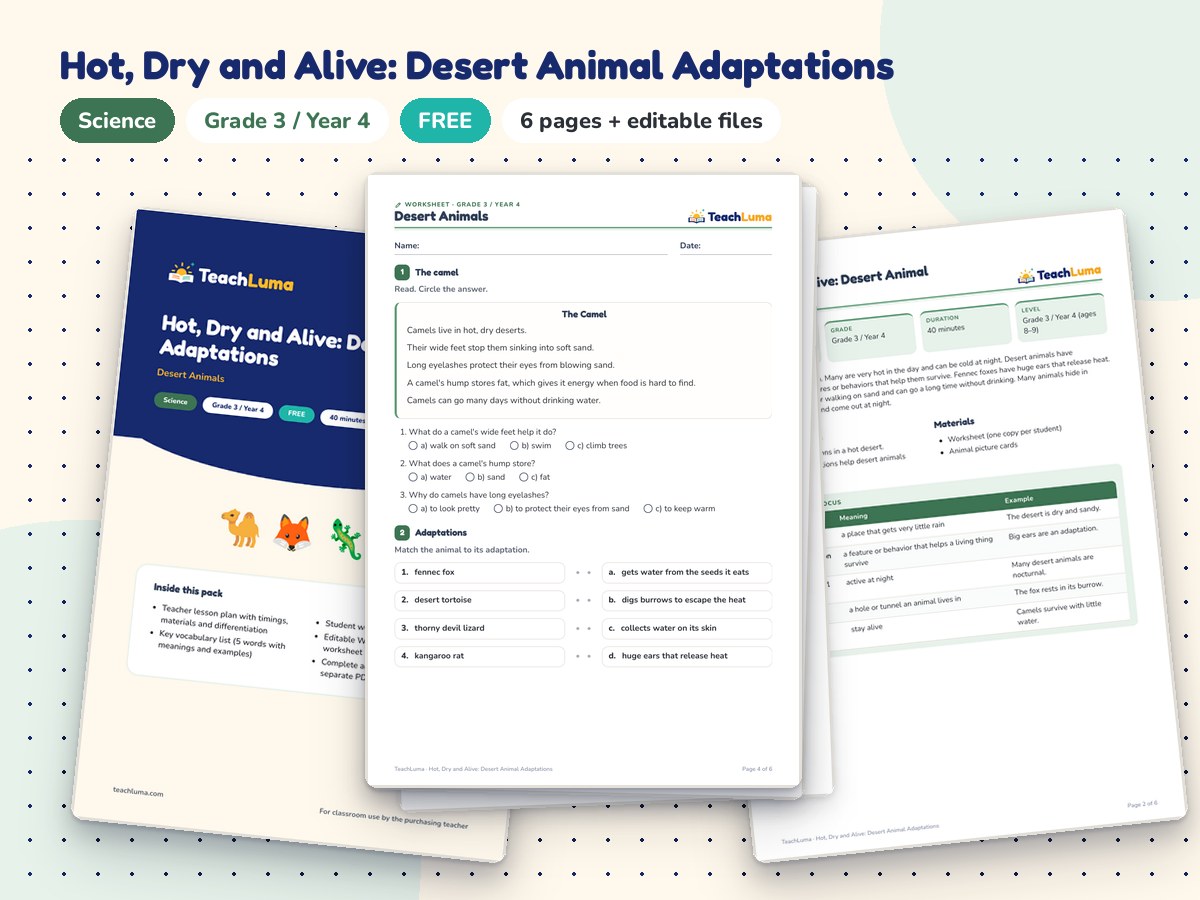
A free Grade 3 science worksheet on desert animals and their adaptations. Students learn how camels, fennec foxes, desert tortoises and lizards survive heat and little water: big ears to lose heat, wide feet for sand, being active at night and getting water from food. They match adaptations to animals and explain how each one helps. Includes a timed lesson plan, an editable Word version and an answer key.

Overview

Deserts get very little rain. Many are very hot in the day and can be cold at night. Desert animals have adaptations, special features or behaviors that help them survive. Fennec foxes have huge ears that release heat. Camels have wide feet for walking on sand and can go a long time without drinking. Many animals hide in burrows during the day and come out at night.

Resource Details

Subject
Science
Topic
Desert Animals
Category
Animals
File Type
PDF
File Size
331.4 KB
Published
21 Nov 2026
Downloads
0
Download Free

Free with a TeachLuma account — it takes a minute.

Share:

Looking for something different? Request a Resource.


Grade 3 (ages 8–9) 40 minutes Reading for information classifying explaining vocabulary

Student Task

  • Ask: "Could you live somewhere with almost no rain? What would you need?"
  • Teach desert conditions and adaptations, then do activities 1 and 2 together.
  • Students complete activities 3 to 5. Answers are in the answer key.

Classroom Use

  • Design a desert animal: invent an animal with three adaptations.
  • Burrow test: compare temperatures in sun and shade with a thermometer.
  • Adaptation charades: act out an adaptation; others guess the animal.

Differentiation

Support: use picture cards for each animal. Challenge: compare a desert animal with a polar animal.

Answer Key & Assessment

Activities 1 to 4 check understanding (answer key included). Activity 5 shows the ability to explain adaptations.

Learning Objectives

  • Describe the conditions in a hot desert.
  • Explain how adaptations help desert animals survive.

Teacher Tips

Clear up a common idea: camels' humps store fat, not water. The fat gives energy when food is scarce.

What's Included

  • 6-page printable PDF lesson pack: teacher lesson plan with timings, materials and differentiation
  • Key vocabulary list (5 words with meanings and examples)
  • Student worksheet (5 activities)
  • Editable Word version of the worksheet
  • Complete answer key (also as a separate PDF)

Additional Files


Teacher Reviews

No ratings yet

Be the first teacher to review this resource.

Sign in to review this resource.

Related Resources

Advertisement