Skip to content
Preview
Members Only Science Complete Lesson Pack Grade 4 (Year 5)
No ratings yet

Frozen and Alive: Life in the Arctic Tundra

About This Resource

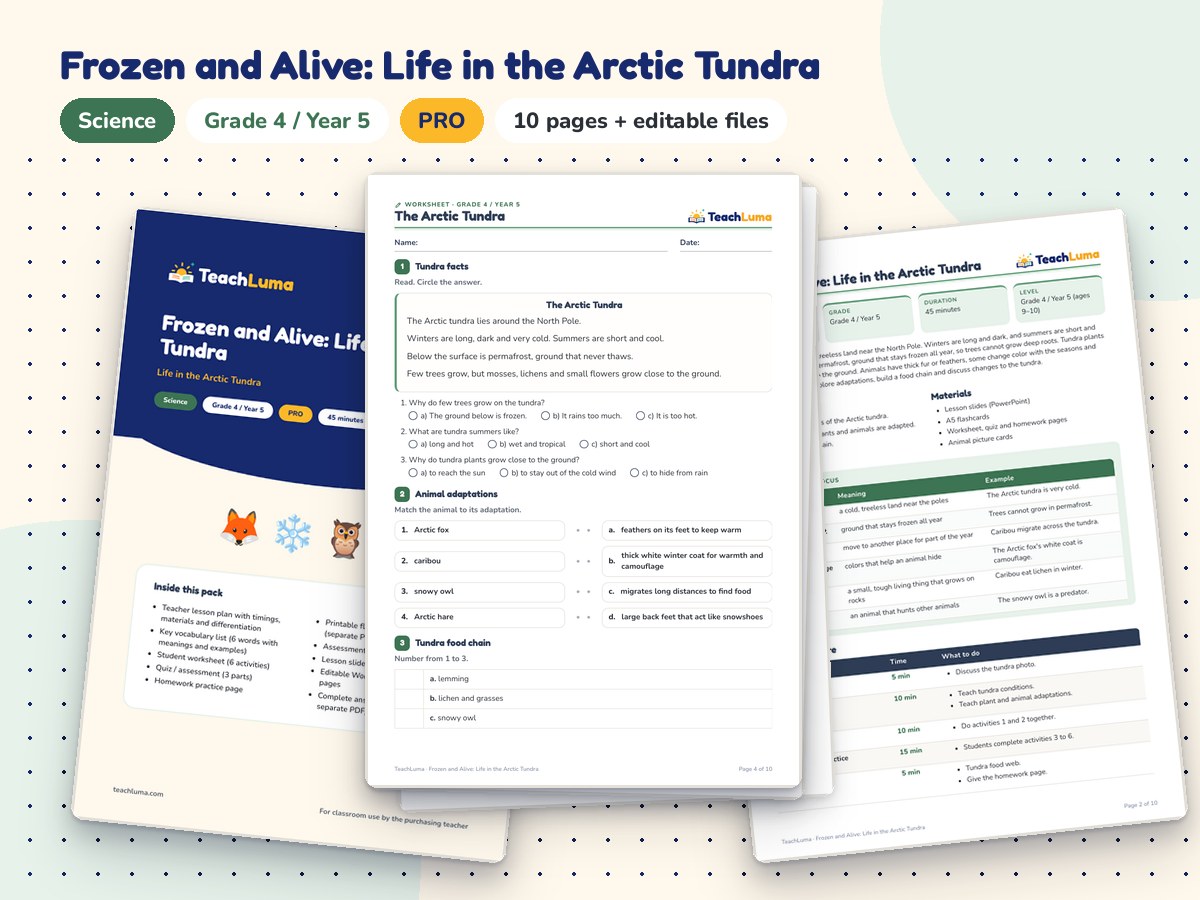
A complete Grade 4 science pack on the Arctic tundra. Students learn about tundra conditions (long cold winters, short summers, permafrost, few trees), how plants and animals such as the Arctic fox, caribou, snowy owl and Arctic hare are adapted, a tundra food chain, and how warming temperatures affect the tundra. Includes slides, a lesson plan, worksheet, quiz, homework, A5 flashcards, a rubric, Word files and answer keys.

Overview

The Arctic tundra is a cold, treeless land near the North Pole. Winters are long and dark, and summers are short and cool. Under the surface is permafrost, ground that stays frozen all year, so trees cannot grow deep roots. Tundra plants are small and grow close to the ground. Animals have thick fur or feathers, some change color with the seasons and some migrate. Students explore adaptations, build a food chain and discuss changes to the tundra.

Resource Details

Subject
Science
Topic
Life in the Arctic Tundra
Category
Living Things
File Type
PDF
File Size
351.8 KB
Published
21 Nov 2026
Downloads
0

Members Only

Create a free account to download this resource with one of your 3 Free Pro Previews, or upgrade to Teacher Pro (from ฿199/month) for the whole library.

Share:

Looking for something different? Request a Resource.

Grade 4 (ages 9–10) 45 minutes Habitats adaptations food chains reasoning

Learning Objectives

  • Describe the conditions of the Arctic tundra.
  • Explain how tundra plants and animals are adapted.
  • Build a tundra food chain.

How to Use This Resource

  • Show a photo of the tundra. Ask: "Why do you think there are no trees here?"
  • Teach tundra conditions with the slides, then do activities 1 and 2 together.
  • Students complete activities 3 to 6. Use the quiz and send the homework page home.

Classroom Activity Ideas

  • Blubber glove: test how fat keeps hands warm in ice water.
  • Color change: show summer and winter coats of the Arctic fox and hare.
  • Tundra food web: connect animal cards with string.

Differentiation

Support: use picture cards with key words. Challenge: explain how melting permafrost could affect tundra animals.

Assessment

Use the worksheet and quiz to check understanding. Use the rubric for explanations.

Teacher Tips

Compare the tundra with a desert: both are harsh and dry, but one is cold and one is hot.

What's Included

  • 10-page printable PDF lesson pack: teacher lesson plan with timings, materials and differentiation
  • Key vocabulary list (6 words with meanings and examples)
  • Student worksheet (6 activities)
  • Quiz / assessment (3 parts)
  • Homework practice page
  • Printable flashcards: 6 A5 picture cards (separate PDF)
  • Assessment rubric (4 levels)
  • Lesson slides (editable PowerPoint)
  • Editable Word version of all student pages
  • Complete answer key (also as a separate PDF)

Additional Files

  • Lesson Slides (PPTX)
  • Editable Student Pages and Lesson Plan (DOCX)
  • A5 Flashcards (PDF)
  • Answer Key (PDF)

Teacher Reviews

No ratings yet

Be the first teacher to review this resource.

Sign in to review this resource.

Related Resources

Advertisement