Skip to content
Preview
Members Only Science Complete Lesson Pack Grade 4 (Year 5)
No ratings yet

Not Plants, Not Animals: Fungi, Mushrooms and Mold

About This Resource

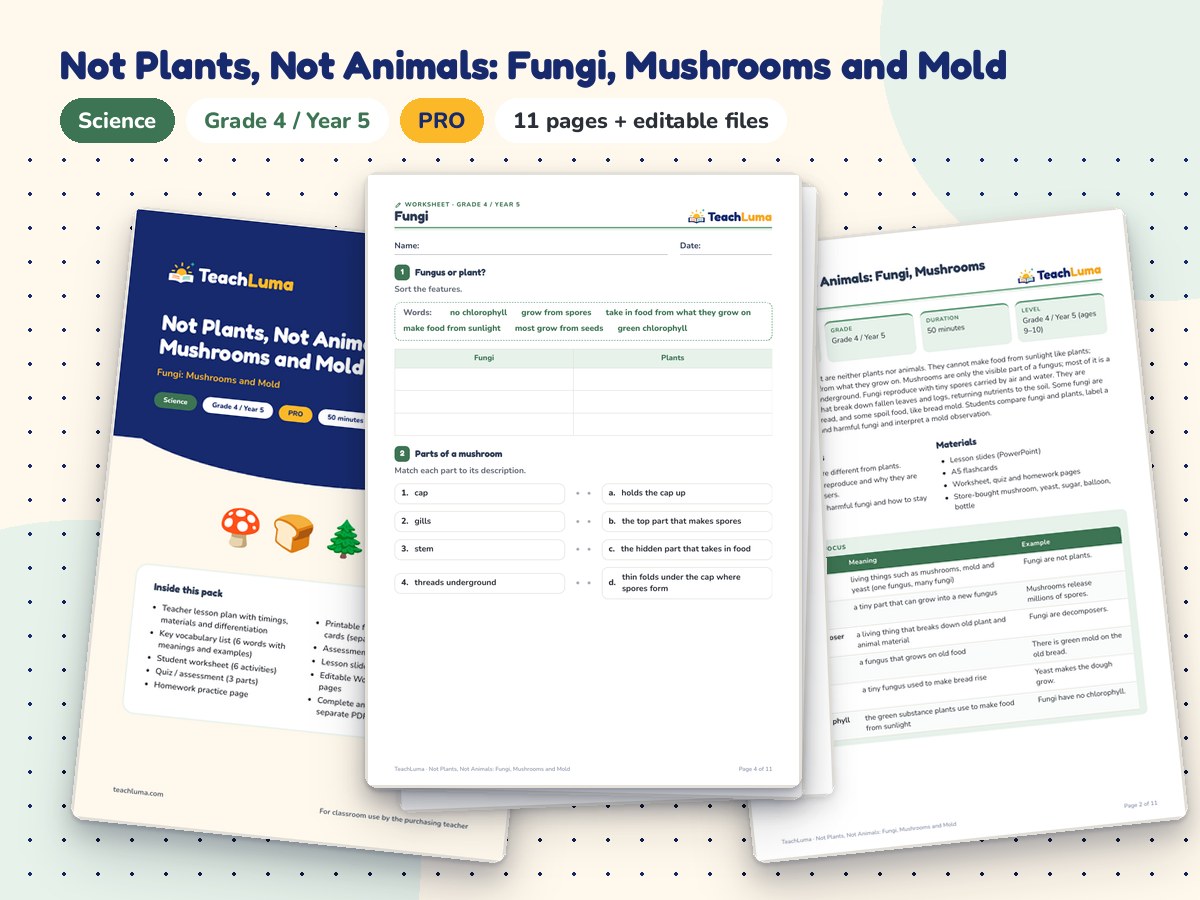
A complete Grade 4 science pack on fungi. Students learn that fungi are their own kingdom of living things, compare them with plants (no chlorophyll, cannot make their own food), explore mushrooms, mold and yeast, learn how fungi help as decomposers and how spores spread, and stay safe by never touching or eating wild mushrooms. Includes slides, a lesson plan, worksheet, quiz, homework, A5 flashcards, a rubric, Word files and answer keys.

Overview

Fungi are living things that are neither plants nor animals. They cannot make food from sunlight like plants; instead they take in food from what they grow on. Mushrooms are only the visible part of a fungus; most of it is a network of thin threads underground. Fungi reproduce with tiny spores carried by air and water. They are important decomposers that break down fallen leaves and logs, returning nutrients to the soil. Some fungi are useful, like the yeast in bread, and some spoil food, like bread mold. Students compare fungi and plants, label a mushroom, sort helpful and harmful fungi and interpret a mold observation.

Resource Details

Subject
Science
Topic
Fungi: Mushrooms and Mold
Category
Living Things
File Type
PDF
File Size
331.7 KB
Published
20 Nov 2026
Downloads
0

Members Only

Create a free account to download this resource with one of your 3 Free Pro Previews, or upgrade to Teacher Pro (from ฿199/month) for the whole library.

Share:

Looking for something different? Request a Resource.

Grade 4 (ages 9–10) 50 minutes Comparing classifying observing explaining

Learning Objectives

  • Explain how fungi are different from plants.
  • Describe how fungi reproduce and why they are important decomposers.
  • Identify helpful and harmful fungi and how to stay safe.

How to Use This Resource

  • Show a picture of a mushroom and a plant. Ask: "Is a mushroom a plant?"
  • Teach fungi features with the slides, then do activities 1 and 2 together.
  • Students complete activities 3 to 6. Use the quiz and send the homework page home.

Classroom Activity Ideas

  • Spore prints: the teacher places a store-bought mushroom cap on paper overnight to show the spore pattern.
  • Yeast balloons: yeast, sugar and warm water in a bottle make gas that inflates a balloon.
  • Decomposer walk: look for fungi on logs from a safe distance.

Differentiation

Support: provide a fungi versus plant comparison chart. Challenge: students research one helpful fungus, such as yeast or the fungus that gives us penicillin.

Assessment

Use the worksheet and quiz to check understanding. Use the rubric for the comparison explanation.

Teacher Tips

Safety first: wild mushrooms can be very poisonous, so students must never touch or eat them. Any mold observation should stay in a sealed bag that is never opened and is thrown away whole by an adult.

What's Included

  • 11-page printable PDF lesson pack: teacher lesson plan with timings, materials and differentiation
  • Key vocabulary list (6 words with meanings and examples)
  • Student worksheet (6 activities)
  • Quiz / assessment (3 parts)
  • Homework practice page
  • Printable flashcards: 6 A5 picture cards (separate PDF)
  • Assessment rubric (4 levels)
  • Lesson slides (editable PowerPoint)
  • Editable Word version of all student pages
  • Complete answer key (also as a separate PDF)

Additional Files

  • Lesson Slides (PPTX)
  • Editable Student Pages and Lesson Plan (DOCX)
  • A5 Flashcards (PDF)
  • Answer Key (PDF)

Teacher Reviews

No ratings yet

Be the first teacher to review this resource.

Sign in to review this resource.

Related Resources

Advertisement