Skip to content
Preview
Members Only Science Complete Lesson Pack Grade 4
No ratings yet

Good Vibrations: How Sound Works

About This Resource

A complete Grade 4 science pack on sound: vibrations, how sound travels through solids, liquids and gases, pitch and volume, how our ears hear, and protecting our hearing. Includes a lesson plan, worksheet, quiz, homework, A5 flashcards, a rubric, detailed slides with speaker notes, Word files and answer keys.

Overview

Children discover that every sound is made by something vibrating. They feel their throat buzz when they hum, watch rice jump on a drum, and learn that sound travels as vibrations through solids, liquids and gases but not through empty space. They explore pitch (high and low) and volume (loud and soft) with rubber bands and bottles, follow sound into the ear, and think about how to protect their hearing.

Resource Details

Subject
Science
Topic
Sound and Vibrations
Category
Forces & Energy
File Type
PDF
File Size
359.3 KB
Published
30 Oct 2026
Downloads
0

Members Only

Upgrade to Teacher Pro (from ฿199/month) to download this resource.

Share:

Looking for something different? Request a Resource.
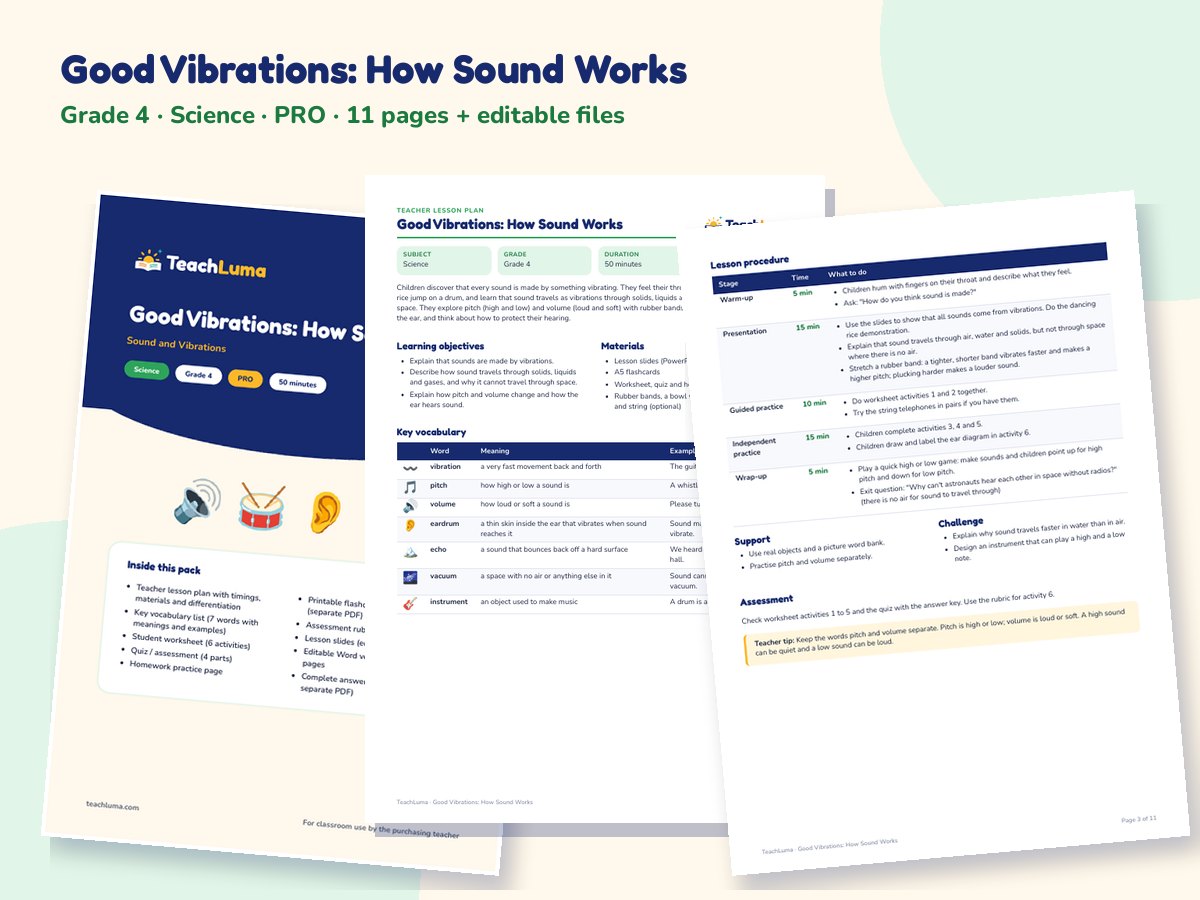

Grade 4 (ages 9–10) 50 minutes Sound investigating observing explaining science vocabulary

Learning Objectives

  • Explain that sounds are made by vibrations.
  • Describe how sound travels through solids, liquids and gases, and why it cannot travel through space.
  • Explain how pitch and volume change and how the ear hears sound.

How to Use This Resource

  • Ask children to put their fingers on their throat and hum. Ask: "What can you feel?"
  • Teach the key ideas with the slides and quick demonstrations, then use worksheet activities 1 to 6.
  • Use the quiz to check learning and send the sound hunt homework home.

Classroom Activity Ideas

  • Dancing rice: sprinkle rice on plastic wrap stretched over a bowl and make a loud noise nearby to see the rice jump.
  • String telephones: two cups joined by a tight string show that sound travels through solids.
  • Bottle band: fill glass bottles with different amounts of water and blow or tap to compare the pitch.

Differentiation

Support: use real objects and a picture word bank. Challenge: explain why astronauts on a spacewalk use radios to talk.

Assessment

Worksheet activities 1 to 5 and the quiz check vibrations, how sound travels, pitch and volume. Use the rubric for the ear diagram in activity 6.

Teacher Tips

Keep the words pitch and volume separate. Pitch is high or low; volume is loud or soft. A high sound can be quiet and a low sound can be loud.

What's Included

  • 11-page printable PDF lesson pack: teacher lesson plan with timings, materials and differentiation
  • Key vocabulary list (7 words with meanings and examples)
  • Student worksheet (6 activities)
  • Quiz / assessment (4 parts)
  • Homework practice page
  • Printable flashcards: 7 A5 picture cards (separate PDF)
  • Assessment rubric (4 levels)
  • Lesson slides (editable PowerPoint)
  • Editable Word version of all student pages
  • Complete answer key (also as a separate PDF)

Additional Files

  • Lesson Slides (PowerPoint, editable) (PPTX)
  • Editable Student Pages + Lesson Plan (Word) (DOCX)
  • Flashcards (PDF, A5, one card per page) (PDF)
  • Answer Key (PDF) (PDF)

Teacher Reviews

No ratings yet

Be the first teacher to review this resource.

Sign in to review this resource.

Related Resources

Advertisement