Learning Objectives
- Say that animals are living things: they move, eat, breathe and grow.
- Name 5 animal groups — mammals, birds, fish, reptiles and insects — and give 2 animals for each group.
- Say one clue for each group: "Mammals have fur." "Birds have feathers." "Fish have fins." "Reptiles have dry scales." "Insects have 6 legs."
- Match an animal to what covers its body: fur or hair, feathers or scales.
- Count the legs to find out if a small animal is an insect ("A spider has 8 legs. It is not an insect.").
- Sort animal pictures into groups and say why: "A cow is a mammal. It has fur."
Lesson Procedure
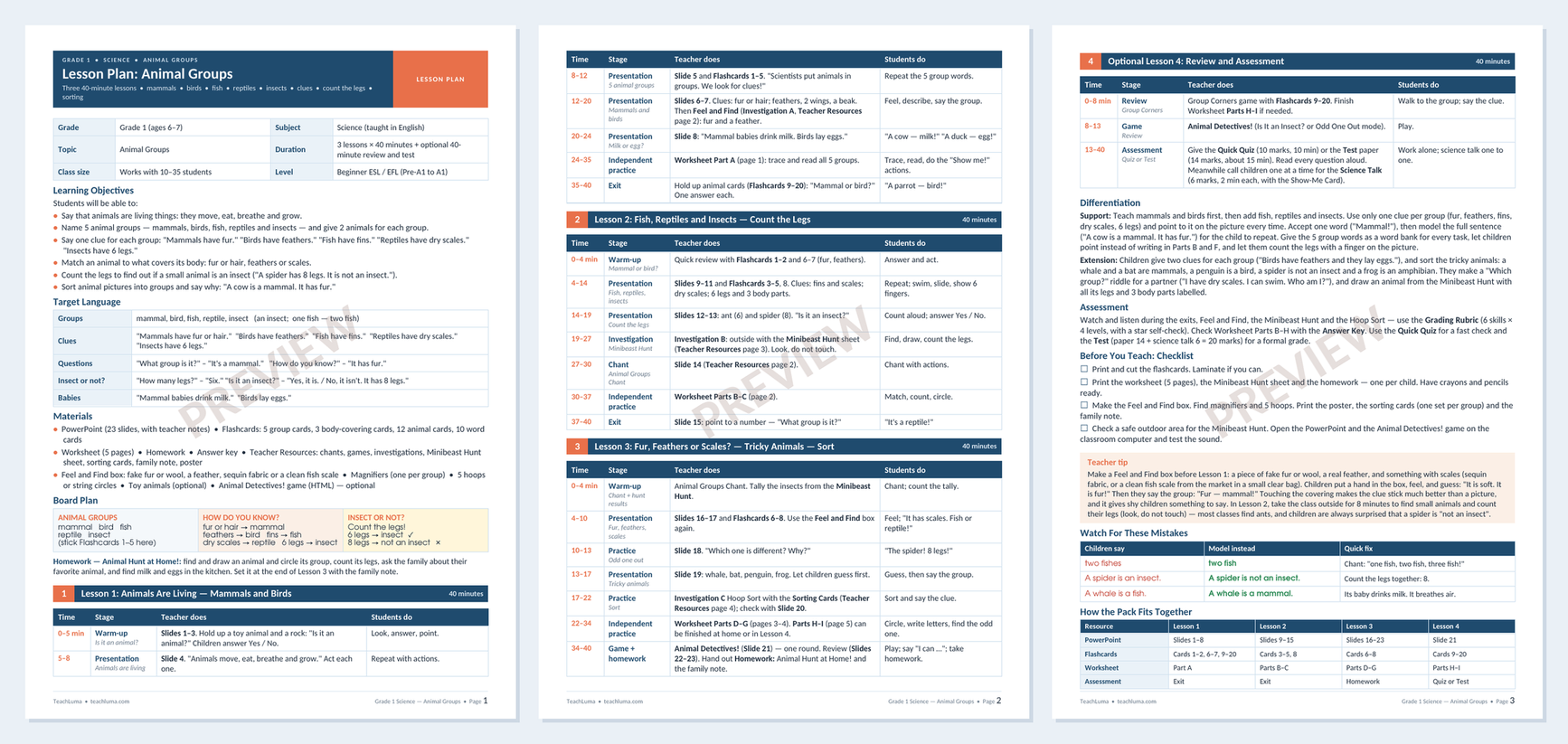
- Read the plan once before Lesson 1 and make the Feel and Find box. Each lesson table shows the time, stage, what the teacher does (with slide and page numbers) and what children do. The table on page 3 shows how every part of the pack fits into the four lessons.
Assessment
The plan shows where to observe with the Grading Rubric (exits, Feel and Find, the Minibeast Hunt, the Hoop Sort) and where to use the Quick Quiz or Test.
Differentiation
Support: Teach mammals and birds first, then add fish, reptiles and insects. Use only one clue per group (fur, feathers, fins, dry scales, 6 legs) and point to it on the picture every time. Accept one word ("Mammal!"), then model the full sentence ("A cow is a mammal. It has fur.") for the child to repeat. Give the 5 group words as a word bank for every task, let children point instead of writing in Parts B and F, and let them count the legs with a finger on the picture.
Extension: Children give two clues for each group ("Birds have feathers and they lay eggs."), and sort the tricky animals: a whale and a bat are mammals, a penguin is a bird, a spider is not an insect and a frog is an amphibian. They make a "Which group?" riddle for a partner ("I have dry scales. I can swim. Who am I?"), and draw an animal from the Minibeast Hunt with all its legs and 3 body parts labelled.
Classroom Activity Ideas
- Start every lesson from Lesson 2 with the Animal Groups Chant and its actions.
- Keep the Feel and Find box on the science table all week so children can explore it again.
Teacher Tips
Make a Feel and Find box before Lesson 1: a piece of fake fur or wool, a real feather, and something with scales (sequin fabric, or a clean fish scale from the market in a small clear bag). Children put a hand in the box, feel, and guess: "It is soft. It is fur!" Then they say the group: "Fur — mammal!" Touching the covering makes the clue stick much better than a picture, and it gives shy children something to say. In Lesson 2, take the class outside for 8 minutes to find small animals and count their legs (look, do not touch) — most classes find ants, and children are always surprised that a spider is "not an insect".
What's Included
- 3-page lesson plan (DOCX + PDF): objectives, target language, materials, board plan, 4 lesson tables, differentiation, assessment, checklist, teacher tip, mistakes table, pack overview
Additional Files