Grade 1
45-55 Minutes
Animal Groups
Science
Question Types & Suggested Use
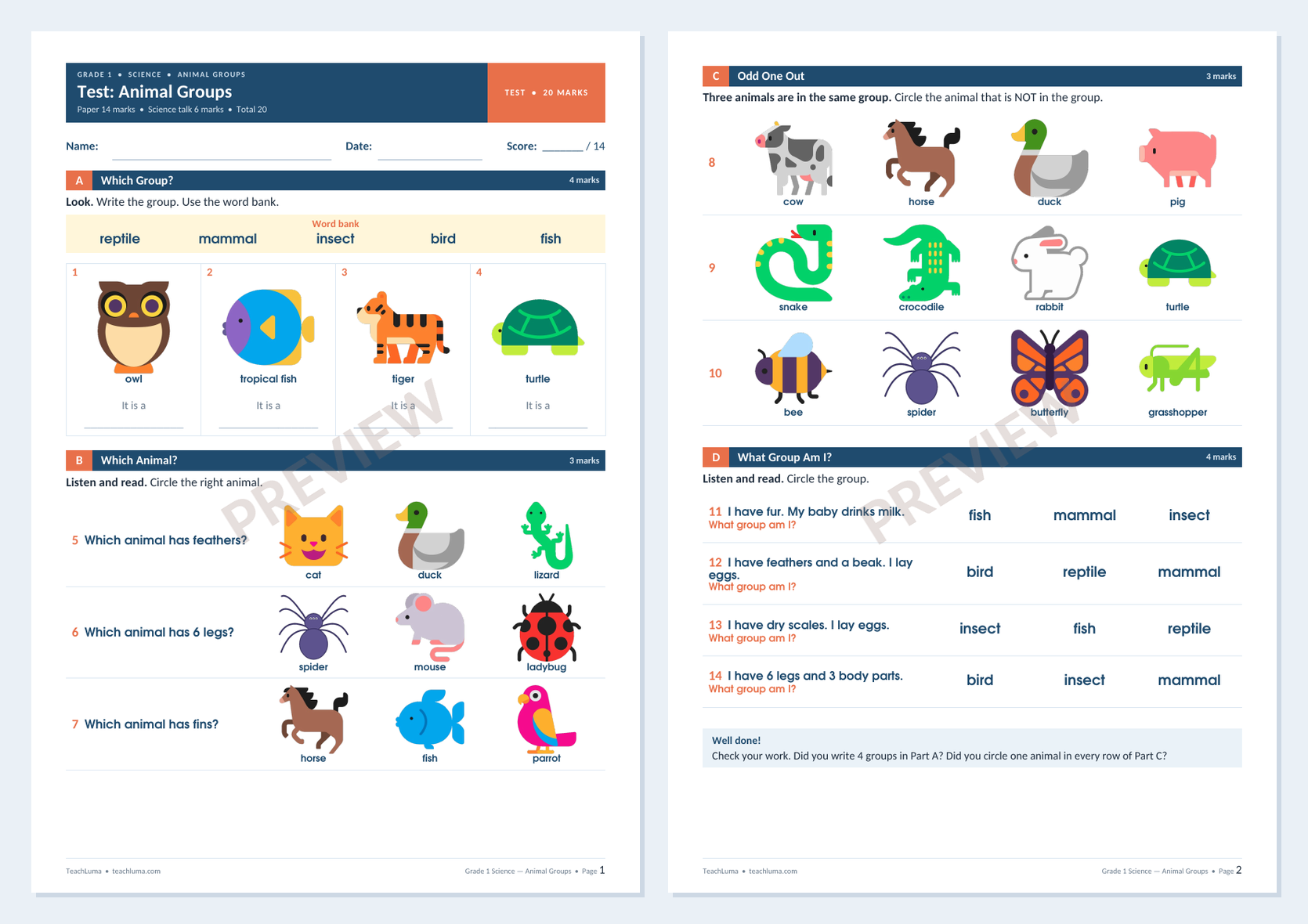
The answer key gives every paper answer, the reason for each odd-one-out answer, a 0/1/2 guide for each science talk item, what to accept, and grade bands (18–20, 14–17, 10–13, 0–9).
Skills Assessed
- Say that animals are living things: they move, eat, breathe and grow.
- Name 5 animal groups — mammals, birds, fish, reptiles and insects — and give 2 animals for each group.
- Say one clue for each group: "Mammals have fur." "Birds have feathers." "Fish have fins." "Reptiles have dry scales." "Insects have 6 legs."
- Match an animal to what covers its body: fur or hair, feathers or scales.
- Count the legs to find out if a small animal is an insect ("A spider has 8 legs. It is not an insect.").
- Sort animal pictures into groups and say why: "A cow is a mammal. It has fur."
How to Administer
- Give the paper to the whole class and read every question aloud. While children work, call them one at a time for the science talk using the Show-Me Card on page 3. Record scores on the class record sheet (page 4).
Differentiation
Support: Teach mammals and birds first, then add fish, reptiles and insects. Use only one clue per group (fur, feathers, fins, dry scales, 6 legs) and point to it on the picture every time. Accept one word ("Mammal!"), then model the full sentence ("A cow is a mammal. It has fur.") for the child to repeat. Give the 5 group words as a word bank for every task, let children point instead of writing in Parts B and F, and let them count the legs with a finger on the picture.
Extension: Children give two clues for each group ("Birds have feathers and they lay eggs."), and sort the tricky animals: a whale and a bat are mammals, a penguin is a bird, a spider is not an insect and a frog is an amphibian. They make a "Which group?" riddle for a partner ("I have dry scales. I can swim. Who am I?"), and draw an animal from the Minibeast Hunt with all its legs and 3 body parts labelled.
Follow-Up Activities
- Use the Show-Me Card again as a review game: "Point to an insect! How many legs?"
- Children who finish early draw in Worksheet Part I.
Teacher Tips
Make a Feel and Find box before Lesson 1: a piece of fake fur or wool, a real feather, and something with scales (sequin fabric, or a clean fish scale from the market in a small clear bag). Children put a hand in the box, feel, and guess: "It is soft. It is fur!" Then they say the group: "Fur — mammal!" Touching the covering makes the clue stick much better than a picture, and it gives shy children something to say. In Lesson 2, take the class outside for 8 minutes to find small animals and count their legs (look, do not touch) — most classes find ants, and children are always surprised that a spider is "not an insect".
Additional Files
-
Grade 1 Science Test: Animal Groups — Paper and Science Talk (20 Marks) (DOCX)
-
Answer Key (PDF)